
GARAMPI, GIUSEPPE. — Cardinal and historiographer, born at Rimini into a noble family on 28 or 29 October 1725, died at Rome on 4 May 1792.
At a very young age, in Florence, he formed a friendship with Giovanni Lami; at Modena, L. A. Muratori confirmed him in his passion for historical studies. Having gone to Rome, in 1749 he dedicated to Benedict XIV the work De mummo argenteo Benedicti III, in which, among other things, he disproved the explanation of the legend of Pope Joan and reconstituted the chronology of the popes in the ninth century. Having received Holy Orders, on 14 November 1749 he was appointed custodian of the Vatican Archives.
In 1755 he published the Memorie ecclesiastiche appartenenti all'istoria ed al culto della beata Clara da Rimini and in 1756 the Notizie, regole e orazioni in onore dei ss. Martiri della Basilica Vaticana. In 1759 he united the “custody” of the Castel S. Angelo Archives with that of the Vatican.
In 1761–62 he travelled through Germany, Switzerland, Holland, and France. In 1763 Clement XIII sent him once again to Germany for the negotiations for the Peace of Augsburg and then to the Diet of Frankfurt. Clement XIV (27 January 1772) created him titular archbishop of Berito and sent him, fully empowered, to Poland and then to Vienna in 1774. Pius VI, on travelling to see the Emperor Joseph II in 1782, took him as his companion, and in the Consistory of 14 February 1785 created him cardinal.
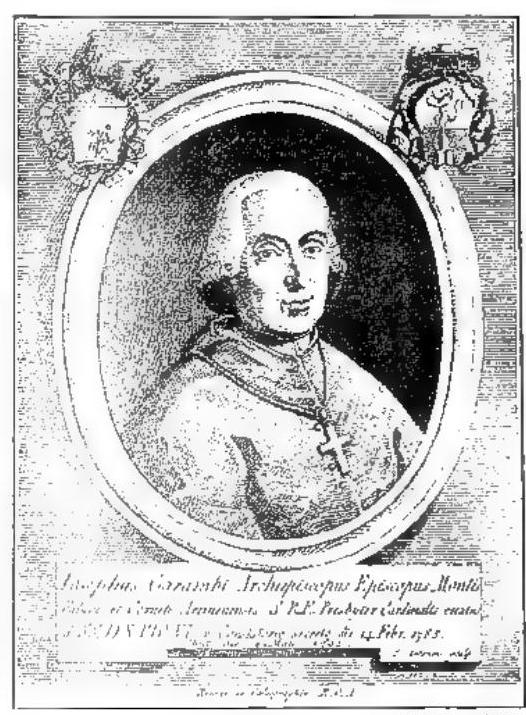
GARAMPI, GIUSEPPE - Ritratto, Incisione di C. Antonini (1792).
logo, in 5 grossi volumi, compilato da Mariano De Romanis (Roma 1796).
Dei viaggi in Europa il G. ha lasciato un diario, in parte edito, nel quale si mostra appassionato ricercatore di antichità e bibliografia. Buon diplomatico, era soprattutto un erudito: con questo animo egli si accinse all'impresa di raccogliere nell'Orbis Christianus quanto mancava alle opere dell'Ughelli, del Pirro, ecc. per dare una storia completa di tutti i vescovati che doveva constare di 22 volumi oltre il codice diplomatico. Dell'opera gigantesca, i materiali preparati dal G. e dai suoi collaboratori costituiscono il più vasto indice per la consultazione dell'Archivio Vaticano. Le schede di spoglio, raccolte e incollate in 124 volumi in-fol., sono sistemate secondo otto classi (papi, cardinali, uffici, chiese di Roma, vescovi, abati, benefici, miscellanea), oltre un indice cronologico.