
ERA. - Wife of Zeus, one of the most important Greek divinities. Her nature is debated: a chthonic goddess, or of lunar light, or of the air and atmospheric storms, or of female fertility, or the “goddess bride.”
She is generally considered to have originated in the Argolid; a recent hypothesis makes her the domestic divinity of the Mycenaean rulers of Argos; from Argos she would have spread throughout the Peloponnese, the principal seat of her cult, and throughout Greece. Important sanctuaries were, besides the Heraeum of Argos, where at the Erec there were contests of horsemen with a shield as prize, those of Olympia, of Samos, where she had festivals with processions of armed men and contests of maidens, and, in Italy, those of the Lacinian promontory near Crotona and of Posidonia. She was venerated principally as a symbol of feminine dignity and marriage; in spring the commemoration of her sacred nuptials with Zeus was celebrated.
BIBLI: L. R. Farnell, The cults of the greek states, I, Oxford 1896, p. 179 ff.; S. Eitrem, s. V. Wissowa, VIII, col. 369 ff.; U. V. Wilamowitz-Moellendorff, Der Glaube der Hellenen, I, Berlino 1931, p. 237 ff.; B. Pace, s. V. ENOCH. Ital., XIV (1932), p. 169 ff.; U. Pestalozzi, Βοβιτς δέννια "Hgr. in Athenaeum, 12 (1930), p. 105 ff.; M. Nilsson, Geschichte der Griechischen Religion, I, Monaco 1941, p. 400 ff. For southern Italy: G. Giannelli, Culti e miti della Magna Grecia, Firenze 1924, p. 144 ff. Luisa Banti
ERA. - A fixed moment in time, varying from people to people, corresponding to some great religious or national event, taken as the starting point for the reckoning of years.
I. OLYMPIAD ERA
Greek historians did not feel the profound need for a uniform chronological criterion in their narratives: Thucydides himself counted the years both from the Trojan War and from the Battle of Marathon; moreover, each Greek state had its own calendar and its own era, which could hardly be made to correspond with those of other states. Nevertheless, a term more or less common to all Greeks was found in reference to one of the four great national festivals: Olympic, Nemean, Isthmian, and Pythian, and more precisely to the first, which prevailed over the others, being about two centuries older.After the Sicilian historian Timaeus (d. ca. 250 B.C.) used it in his Σικελικαί, the Olympiad era was generally adopted by Greek writers, but in various states, in documentary use, the system of counting years from the series of eponymous magistrates survived: kings in Sparta, archons in Athens, and so on.
An Olympiad consisted of a four-year period, which was counted as I, II, III, IV of each Olympiad. It should be noted that the year of the Olympiad began with the plenilune preceding or following the summer solstice: therefore, alternating its beginning between July and August, each Olympiad year corresponded to the second half of a Roman or Christian year and to the first half of the following one.
Christian chronographers placed the birth of Jesus in the IV year of the 194th Olympiad, so that the I Olympiad would date back to 776 B.C.
II. ERA OF ROME
In Rome, alongside consular dating (v. ANNO CONSOLARE), historians—but not official documents—used to count years from the foundation of Rome. However, while the day remained fixed (April 21), the year varied among authors (for Cincius Alimentus, 728 B.C.; for Cicero, 754 B.C., etc.). Eventually, the dates of Varro (753 B.C.) and the Catonian or Capitoline Fasti (752 B.C.) prevailed.The Varronian computation was the most widely used by historians and was also adopted by modern scholars for solemn dating of documents issued from the Capitoline.
III. ERA OR PROVINCIAL YEAR OF MAURETANIA
The numbering begins from 39 A.D. In inscriptions, it is indicated with ann. prov. or ann. pr. or ann. p. Therefore, to obtain the modern calculation, 39 units must be added.(From V. FEDERICI, GIACOMO, La scrittura delle cancellerie italiane, Rome IV, pl. 3)
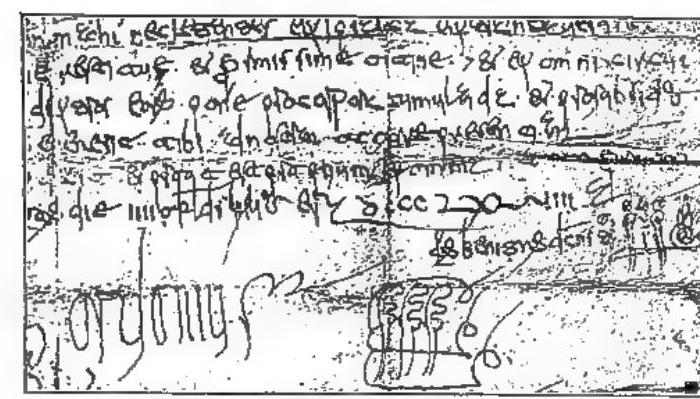
ERA – Deed of donation by Ordoño I, king of Castile and León, to Bishop Fronimio, with indication of the Spanish era DCCCXCVIII (year 860).
IV. SPANISH ERA
It begins on the 38th year B.C.; it was adopted not only in the Iberian Peninsula but also in the provinces occupied by the Visigoths in Gaul and Africa. In Christian inscriptions, it appears in the 3rd century in Cantabria, at the end of the 4th century in Mérida, then in Lusitania, Baetica, and Galicia in the second half of the 5th century. It became generally used during Visigothic rule; in the eastern zone, not before the Mozarabic period. To obtain the exact date, 38 must be subtracted. (J. Vives, Inscripciones cristianas de la España Romana y Visigoda, I, Barcelona 1941, p. 7). In inscriptions, the words era, aera, in era, sub era, or the abbreviations er. or e. are used. It disappeared only in 1180 in Catalonia, in 1349 in Aragon, in 1358 in Valencia, in 1383 in Castile and León, and in 1422 in Portugal.V. ERA OF DIOCLETIAN OR OF THE MARTYRS
The year 284,marking the accession of Emperor Diocletian to the throne (the exact day varies between August and October), was taken as the starting point
for another era, which took its name from this Emperor and was later called,
by Christians beginning in the 7th century, the era of the martyrs,
in memory of the great persecutions ordered by that emperor. Of Egyptian origin, it spread to Europe as well;
it was used by St. Cyril of Alexandria for his Paschal tables, by Evagrius, by St. Bede; today it is still in use among the
Copts of Upper Egypt. In Milan, St. Ambrose also employed it, dating his epistle 23 (Episcopis per Aemiliam constitutis) "in the eighty-ninth year from the day of Diocletian's reign."
VI. BYZANTINE ERA
This is the most widespread of the systemsthat trace back to the hypothetical date of the creation of the world,
set by this era to 5508 B.C., so that the year 5509
corresponded to the first year of the Christian era. Introduced around
the 7th century, it spread throughout the Orthodox East and was
abolished in Russia only by Peter the Great on January 1, 1700.
In Italy, it was used in the southern regions also for the dating of documents,
especially in the Greek language.
The year began for this era on September 1.
VII. CHRISTIAN ERA
Introduced by the Scythian monk Dionysius Exiguus (d. 556), who disseminated in the West the table of Paschal cycles compiled by Cyril of Alexandria, covering the years 437-531, and continued it from the following year. However, unlike Cyril, who calculated the years according to the Era of Diocletian, he wished to eliminate the name of the persecutor from his cycles. Considering that no historical event equaled in importance the advent of the Redeemer, he took this as the starting point for the reckoning of years. He thus fixed, albeit erroneously, the birth of Jesus Christ on December 25 of the year 753 ab urbe condita according to the Varronian calculation, so that the year 754 ab urbe condita corresponded to the first of the new era. It was first used only by chroniclers; it entered public documents in England and France in the 8th century, in Germany in the 9th, and in Spain in the 14th. In Italy, the earliest examples date from 890 and 961. At the end of the 9th century, it also appears in imperial documents, where it became established in the following century. In papal acts, it appears with John XIII in 968. Its use, however, was not uniform, as the date of the beginning of the year varied according to different styles (v. ANNO, beginning of the).VIII. ERA OF THE PASSION
Used insome French documents until the 11th century, it
dates the years starting from an epoch that varies between
31 and 34 A.D., taking as its reference point the crucifixion of Jesus Christ. In practice, it was often confused with the Christian era.
IX. È. MAOMETTANA. - Ha inizio il
1° luglio 622, data della fuga di Maometto
a Medina (ègira), e segue il calendario islamico basato sugli anni lunari, di 10 o 11
giorni più corti dell'anno solare; di conseguenza 33 anni dell'ègira corrispondono a
32 dei nostri.
La corrispondenza esatta di un anno
dell'è. maomettana con quello dell'è. cristiana non può
trovarsi quindi se non riferendosi a tavole cronologiche.
L'uso di tale è, si ritrova, oltre che in documenti
arabi, anche in versioni latine o volgari di carte o di
testi arabi.
BIBLIOTHE: in generale: R. Brinckmeier, Praktisches Handbuch
d. historischen Chronologie, Berlino 1882, pp. 10-62; F. Rühl,
Chronologie des Mittelalters und der Neuzeit, Berlino 1897, pp. 130-366; A. Giry, Manuel de diplomatie, nuova ed., Paris 1915,
pp. 88-93; A. Cappelli, Cronologia e calendario perpetuo, 2ª ed.,
Milano 1930; C. Paoli, Diplomatie, nuova ed. a cura di G. C.
Bascapè, Firenze [1942], pp. 103-214. Sulle è, del mondo
classico: [W.] Kubitschek, Aera, in Pauly-Wissows, I,
coll. 606-66; Bischoff, Kalender, ibid., X, II, coll. 1368-1602;
L. Ziehen, Olympia, ibid., XVIII, I, coll. 1-3; W. Kubitschek,
Grundriss der antiken Zeitrechnung (Handbuch der Klassischen
Altertumswissenschaft, I, 7), Monaco 1928. Sull'è. di Spagna:
I. Vives, Über Ursprung und Verbreitung der spanischen Aera, in
Histor. Jahrbuch, 58 (1938), pp. 97-108; id., Inscripciones cristianas de la España romana y visigoda, Barcellona 1942, pp. 177-190; A. Ferrua, Tombe che parlano, in Cro. Catt., 1943, IV,
pp. 97-99 e 166-71. Sull'è. maomettana: R. Campani, Calendario arabo, Modena 1914; [F.] Wüstenfeld-[E.] Mahler, Vergleichungs-Tabellen der mohammedianischen und christlichen Zeitrechnung, 2ª ed., Lipsio 1936.
Carmelo Trasselli-Alessandro Pratesi