
ANNO, BEGINNING OF THE. — The practice of beginning the years of the common era on 1 January, according to the modern style (mos) or the Circumcision style, now commonly adopted among all Christian peoples, was not immediate, as might be thought, but gradually gained acceptance at different times until it completely replaced the other styles in the countries of Europe. Nevertheless, even earlier, in many places where another system was in force for the beginning of the legal year, 1 January was regarded as the first day of the current year. The process of replacing the modern style
in Italy began to take shape after 1450 (although we find it already in use at Reggio Emilia as early as 1379); from the 16th century onward in the rest of Europe. The consistent practice of this style began in Italy in 1459 at Milan, in the ducal chancery; in 1476 at Alessandria, Como, Crema, Genoa and Liguria, Novara, and Pavia; in 1486 at Modena, but only among certain notaries; in 1510 at Lucca; in 1582 at Rome, under the pontificate of Gregory XIII, the reformer of the calendar; in the early years of the 1600s in Sicily; in 1750 in all the Tuscan cities, by virtue of an edict promulgated on 20 November 1749 by Grand Duke Francesco I of Lorraine to remedy the confusion caused by the use of different styles in public documents, as Zobi explains in his Storia Civile della Toscana dal MDCCXXXVII al MDCCCXLVIII (I, Florence 1850, pp. 294–95). In France, its use began in 1568 by virtue of the Edict of Paris (art. 39) of 1563, issued by Charles IX: interrupted in 1793, when the republican calendar came into force, it was restored by Napoleon I on 31 December 1805; in Germany after 1560, during the reign of Ferdinand I; in England and Ireland in 1752, introduced there by Lord Chesterfield; in Spain and Portugal toward the end of the 1500s; in Holland from 1576, by an ordinance of the Duke of Requesens dated 16 June 1575; in Russia in 1725; in Sweden in 1559; in Switzerland in 1575; in Denmark in 1700, definitively displacing the practice, widespread among many, of beginning the year on 11 August, the feast of St. Tiburtius.
In any case, before the Circumcision style was universally accepted in Europe, various styles were used in individual European countries and cities, corresponding to different ways of beginning the year. The best known are:
1. Venetian style (more veneto or simply designated by the abbreviations m. v.), so called because it was officially adopted for the legal year in the documents of the Republic of Venice until its fall in 1797. It reckoned the year as beginning on 1 March, and thus lagged two months behind the modern style; in fact, all documents dated from 1 January to 28 or 29 February must be assigned to the following year. Outside Venice, this system is found in France, first under the Merovingians and perhaps again in the 10th century during the reign of Henry I; at Benevento in the 12th century and in Sicily during the period of Arab rule.
2. Style of the Incarnation or Annunciation «anno dominicae incarnationis» or «ab incarnatione Domini», «anno
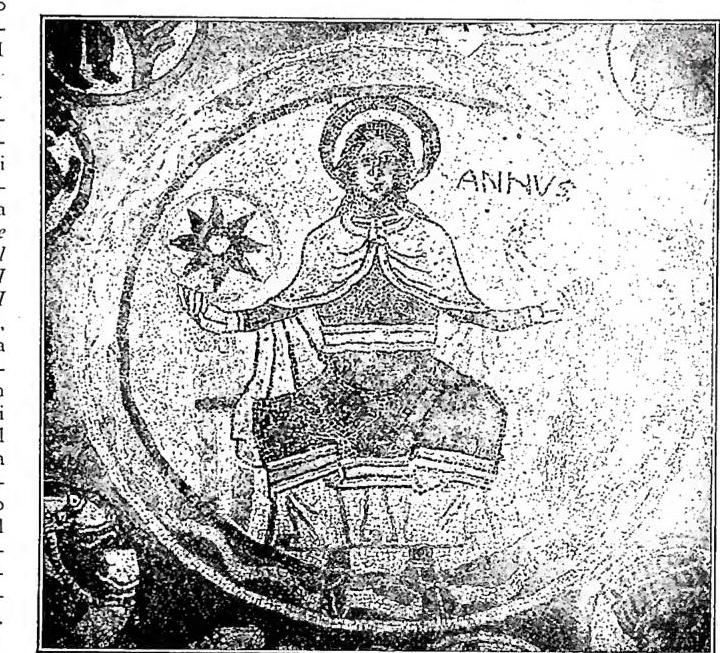
ANNO, beginning of the — Representation of the A. governing the Sun and Moon — Pavement mosaic executed by the local artist Stefano Mossetta between 1420 and 1434 on an ancient model — Aosta, Cathedral.
Piacenza, and Siena from the 10th century onward; at Bobbio from the 12th century; at Cortona from 1411; at Rome, in the papal chancery, from 1145, made obligatory for bulls in 1445 by Eugene IV; at Bologna from 1025; at Naples from 1270; at Prato from the 12th century; at Ravenna in the 12th and 13th centuries; at Verona from the 9th century; it is still found in use at Borgonovo, Colle Valdelsa, Cremona, Fiesole, Lucca, Mantua, Reggio Emilia, Salerno, S. Gimignano, and Turin. Outside Italy, its use was extensively widespread in very many cities of France, alone or alongside other styles, until the 16th century; in Germany, in the Electorate of Trier and in the suffragan dioceses of its archbishopric from 1307 onward, where it was also designated by the name stius trecerensis;
in Portugal until 1420; in England (known as nos anglicus), especially sporadically from 1066, then continuously and exclusively from 1200 to 1752; in Spain from the 12th to the 14th century; in Hungary and in several cantons of Switzerland. Much more restricted, on the other hand, was the use of the style of the Incarnation according to the Pisan reckoning; besides Pisa, where it was systematically used until the end of 1749, it is found at Bergamo in the 11th century, at Corneto until 1234, at Lodi until the 10th century, at Milan sporadically in the 9th–10th centuries, at Padua until the 12th century, at Piombino in the 14th century; at Rome, in the papal chancery, from Urban II (1088–99) to Innocent II (1130–43), alongside the Florentine reckoning; and at S. Miniato al Tedesco until 1369.
3. Easter style («anno a Paschate, a Resurrectione»), or French style (nos gallicus), begins the year with the feast of Easter or, more frequently, with Holy Saturday, in any case in a highly unstable manner, since this solemnity could fall at different times between 21 March and 25 April. According to such a system, each year displays inequalities in relation to the others because of the differing length of each one; consequently, there could sometimes be years of eleven months, and at other times even of thirteen, with the annual duration ranging between three hundred and thirty and four hundred days. Relating this style to the modern one is therefore difficult and can be achieved only through elaborate research; there is also the inconvenience that in certain years the last ten days of March and the first twenty-four of April appear twice, or are omitted altogether, thus making interpretation even more difficult, because the person entering the date did not always take care to distinguish this repetition with the formulas ante Pascham or post Pascham. The practice of this style was widespread in France from very ancient times and was later employed, perhaps in the 11th century, in the royal chancery as well; in French Flanders, for example, and in Artois it is found as early as the second half of the 9th century. Outside France, it is found used mainly in Holland and Belgium; in Germany it was limited to the city of Cologne alone; in the apostolic chancery it was adopted only under the pontificate of Nicholas IV (1288–92). Isolated traces also appear toward the end of the 12th century in England and Ireland.
4. Byzantine style, so called from Ibananzo, where it began to be used, established the beginning of the year on 1 September, and thus placed it four months ahead of the modern reckoning. It was widely used in the countries of southern Italy, in that part known as Magna Graecia, especially in Apulia, Calabria, and Sicily, for all documents in the Greek language and also for Latin documents dealing with matters concerning the East.
5. The Nativity Style (= anno a Nativitate or anno a Nativitatis Domini) was the style most widely used during the Middle Ages, especially in Italy, although in competition with the styles already mentioned. The year began on 25 December, the feast of Christmas, anticipating it by seven days. Because of its extensive use in Rome, both by notaries and private individuals, and in the papal chancery, though not continuously, from the time of Giovanni XIII (965–72) onward it was also known by the twofold designation of Roman style (nos romano) or pontifical style (stiles romane curiae). It is generally encountered in Alessandria, Crema, Gallarate, Genova and the Ligurian cities, Vercelli until 1476, Bergamo from 1310, Bologna from 1073, Brescia, Modena, Padova, Novara and Pavia from the twelfth century, Chiavenna, Mantova, Napoli, Reggio Emilia, Rimini, Torino and Voghera from the mid-thirteenth century, Como in the fourteenth century, Ferrara until the fifteenth century, Milano from the eleventh century, in many Tuscan cities, in southern Italy itself, where it was introduced by the Swabian emperors, and in Sicily. Outside Italy it was widely used in France, especially in Provence from the eleventh to the thirteenth century, at Foix in the twelfth, at Avignone and Soissons in the thirteenth, in Languedoc in the thirteenth and fourteenth, and in the Dauphiné from 1292; in England and Ireland it was used exclusively until 1066, and less frequently until the thirteenth century; in Germany, where it had already been adopted in the chancery of the Carolingian emperors, it remained widespread until about 1550; in Spain and Portugal from the end of the fourteenth century; in Switzerland from about 1550; in Hungary from the mid-thirteenth century; and in Denmark and Holland until about 1559.
In other eras the beginning of the year appears in a more absolute form, that is, not divided among different styles or systems as in the Common or Christian Era, which nevertheless thereby sought to honor the most significant dates in the life of Our Lord, with the exception of the Byzantine Era, which only accidentally belongs in this category. Thus, in the West, the Spanish or Caesarian Era begins on 1 January, the Masonic or Era of the True Light on 1 March, the Olympic Era on 1 July, and the Era of the Foundation of Rome on 21 April, while the Era of Diocletian or of the Martyrs begins on 29 August; in the East, the Byzantine or Constantinopolitan Era begins the year on 1 September, and the Muhammadan Era (Hegira) on 16 July.
For the rites concerning the beginning of the year V. CAPODANNO.
Niccolò Del Re