
ABBREVIATORE. — He was an official of the Apostolic Chancery, entrusted with the task of drafting the preliminary version (notam facere) of pontifical acts. Numbering 24 under the antipope Benedetto XIII, the abbreviators rose to 70 under Pio II, who constituted them as a college (1463); the following year Paolo II gave it a new organization. Sisto IV (1479) increased their number to 72, distributed as follows: 12 de parcu maiori, for preparing the drafts of documents; 22 de parcu minori, for their assessment and dispatch (parco was the name given to that part of the chancery hall enclosed by a balustrade); 38 de prima visione. The office of a. could be purchased; consequently, the office was called venal. Platina (v.) following Paolo II’s dismissal of the a. are well known.
Pio X, with the constitution Sapienti consilio of 1908, abolished the college of a. entirely and transferred its functions to the college of Protonotari Apostolici di numero partecipanti.
I. LAPIDARY ABBREVIATIONS
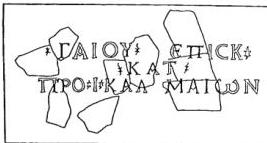
In monumental epigraphic writing, abbreviations of two kinds are found, consisting either in the omission of part of the final letters of the word or of its central letters (the Latins called the former suspensiones and the latter contracciones). An abbreviation reduced to one or two letters (initial; initial and final) is often called a siglum (sigla is equivalent to “small sign”). Genuine sigla are, for example, the Roman numerals. The use of abbreviations is naturally always limited for reasons of clarity.The Greeks used them much less than the Latins, who regularly abbreviated names designating offices co(n)in(ul), ep(isopus), official titles c(larissimus) v(ir), d(omi)n(us), worship d(ent), s(an)(itus), kinship f(ilius), m(ater), formulas of affection or courtesy b(ene)m(erenti), a(nimos) s(ancis), burial formulas h(ic) s(itus) e(st), d(e)pi(otio), p(osuerunt), f(ecit), the elements of the date III h(a)(endas) ap(ile), and of the age lived esix(ir) an(nos) V m(enses) X; the praenomina and sometimes the more commonly used nomina f(inistus) Aur(elius); names of cities and various conventional phrases are likewise often given as sigla. Abbreviations are especially numerous where space is very limited, as on coins and stamps.
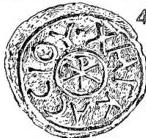
A system of abbreviations from the High Middle Ages gives only the initials of each syllable. Particular abbreviations are the ligatures that merge elements of two successive letters, and monograms (v.), a kind of multiple ligatures; related is the use of smaller letters, higher or smaller, often inscribed within others in order to save space. Famous examples of abbreviations are the cryptogram ΙΧΘΥΣ (v.), which in Greek means fish and is to be read Ἰησοῦς Χριστὸς Θεοῦ Υἱὸς Σωτὴρ, and the sibylline [ e XMI (palma feliciter and Χριστὸς Μιχαὴλ Γαβριήλ). Signs of abbreviations are usually punctuation at the end, a bar placed above, or a transverse stroke.
Antonio Ferrus
II. GREEK PALAEOGRAPHIC ABBREVIATIONS
Abbreviations are generally divided into two kinds: by suspension or truncation, when letters at the end of a word are omitted; and by contraction, when the internal part of a word is omitted, leaving its beginning and end.In the writing of pre-Christian literary papyri in majuscule (uncial), abbreviations hardly ever appear: the only one found with any frequency is the replacement of v at the end of a line by a horizontal line placed above: ΠΟΛΤ, ΤΟΤΤΟ. This form of abbreviation continued in the following centuries.
Abbreviations were used much more extensively in documents (receipts, accounts, public and private acts), whose nearly uniform formulaic language made it unnecessary to write out in full many terms that recurred frequently and were readily understandable to contemporaries.
The oldest and simplest system of abbreviation is that of suspension: words were indicated by the initial letter alone, with an abbreviation sign according to the ancient Greek practice of indicating numerals: Π (έντε), Δ (έκα); thus: ν' = νύω, γ' = γάρ, μ' or μ' = μετά, etc.; or by the first letters, to which were added, in smaller writing above the line, those that immediately preceded the omitted part: τ=τέκνν, αδ=άδελφός, πολ=πόλεμος, etc. This system of abbreviation later underwent many variations (v. II).
Later, in the Christian period, the system of contraction was used to abbreviate words of a sacred character—the nomina sacra—which also recurred very frequently in the Sacred Scriptures (v. NOMINA SACRA).
Then, with the introduction of minuscule as a literary script (9th century), the ancient system of suspension (which has no break in the history of Greek palaeography) appears enriched, in addition to the Christian contractions, by many signs—derived for the most part from tachygraphy—which replace a word either in part or in its entirety; and abbreviations, at first not very frequent, become increasingly numerous up to the 13th–14th century and acquire such a personal character that it is difficult to establish a fixed form for them. We shall therefore limit ourselves to indicating the most common or characteristic abbreviation signs (v. tabelle omesse), adding brief explanations for some of them.
TABLE I. — 1) α was formerly represented by a simple horizontal line —, placed beside or above the last written letter; subsequently it was ex-
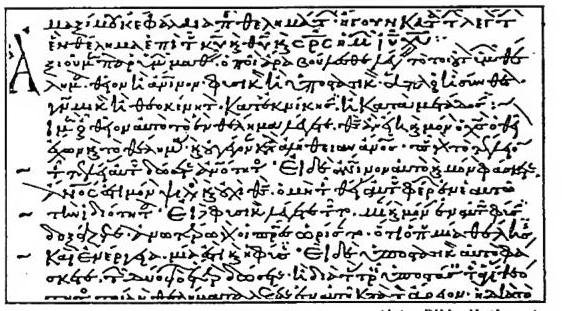
PALEOGRAPHIC ABBREVIATIONS CRECHE - Cod. Val. gr. 304, fol. 146, lower part of the second column - Parchment manuscript, year 1105, minuscule script: St. Maximus, De voluntatibus et operationibus capitula.
TRANSCRIPTION: Μαξί μου κεφάλαια πε(ρί) θελ-μάτ(ων), ήγουν κατά τ(ών) λεγ(όντ(ων) | ἐν θέλῃμα ἐπί τ(ού) κ(υρίο) κ(αί) θ(εο)ῦ κ(αί) σ(ωτήρ(ο)ς ἡμ(ῶν) Ἰ(ησο)ῦ Χ(ριστο)ῦ. - Ἀξι-οῦμ(εν) παρ' ὑμῶν μαθ(είν), ὁποῖ(ον) ἄρα βούλεσθε λέγ(ειν) τὸ τοιούτ(ον) ὑμῶν) θέλῃμα, θεῖον ἢ ἀν(θρώπ-η)νον, φυσικ(όν) ἢ ὑποστατικ(όν), ἀπλ(ούν) ἢ σύνθε-τ(ον), | γν(ω)μικ(όν) ἢ θεοκίνητ(ον), κατ' ἐκνικησ(ιν) ἢ κατὰ μετάδοσ(ιν). | <ε> ἰ μ(έν) (οὖν) θεῖον αὐτὸ τὸ ἐν θέλῃμα λέγετε, θ(εό)ς ἂν εἴη κ(αί) μόν(ον) ὁ Χ(ριστὸς) ὁ θεῖ(ον) | ἔχων κ(αί) τὸ θέλῃμα, κ(αί) οὐ γέγον(έν) κ(αί)τὰ ἀλήθειαν ἀν(θρωπ)ος π(ού) γ(άρ) τὸ τέλειο(ν) | τ(ῆς) τελεῖ(ας) αὐτ(ού) δώσετε ἀν(θρωπ)ό-τητος; εἰ δὲ ἀν(θρώπ)νον αὐτὸ κ(αί) μόν(ον) φάσκετε. | ἀν(θρωπ)ός ἐστι μόν(ον) ψιλ(ός) κ(αί) οὐχὶ θ(εό)ς ὁ μὴ τ(ῆς) θεῖ(ας) αὐτ(ού) φέρ(ων) ἐν εαυτῷ | τὴν ἰδιότητα. εἰ (δὲ) φυσικ(όν) λέγετε τ(ού)το, μ(άν) κ(αί) μόν(ην) ἐν αὐτ(ῷ) φύσι(ν) | δοξάζετε ἀνωτέρω γ(άρ) οἱ π(ατέ-ρες) ὥρισ(αν)το, ὅτι ὅτι(ου) μία θέλῃσ(ις) | καὶ ἐνέρ-γεια, μία ἐστι κ(αί) ἢ φύσι(ις). εἰ δὲ ὑποστατικ(όν) αὐτὸ φάσκετε, τ(ῶν) δύο τὸ ἕτερ(ον) δώσετε - ἢ διὰ τ(άς) τρ(είς) ὑποστάσι(εις) τ(ῆς) ἁγ(ίας) θεό(τητ(ος) τρία κ(αί) θελήματα λέξετε ἐν αὐτῇ κ(αί)τὰ τ(όν) ἄρει-ον, ἢ διὰ τὸ
E·P·B·Λ·T·X·M
2
VIBIV·ELMV·S·RVIKA·SEP
DIC·III·ET·MAX·COS
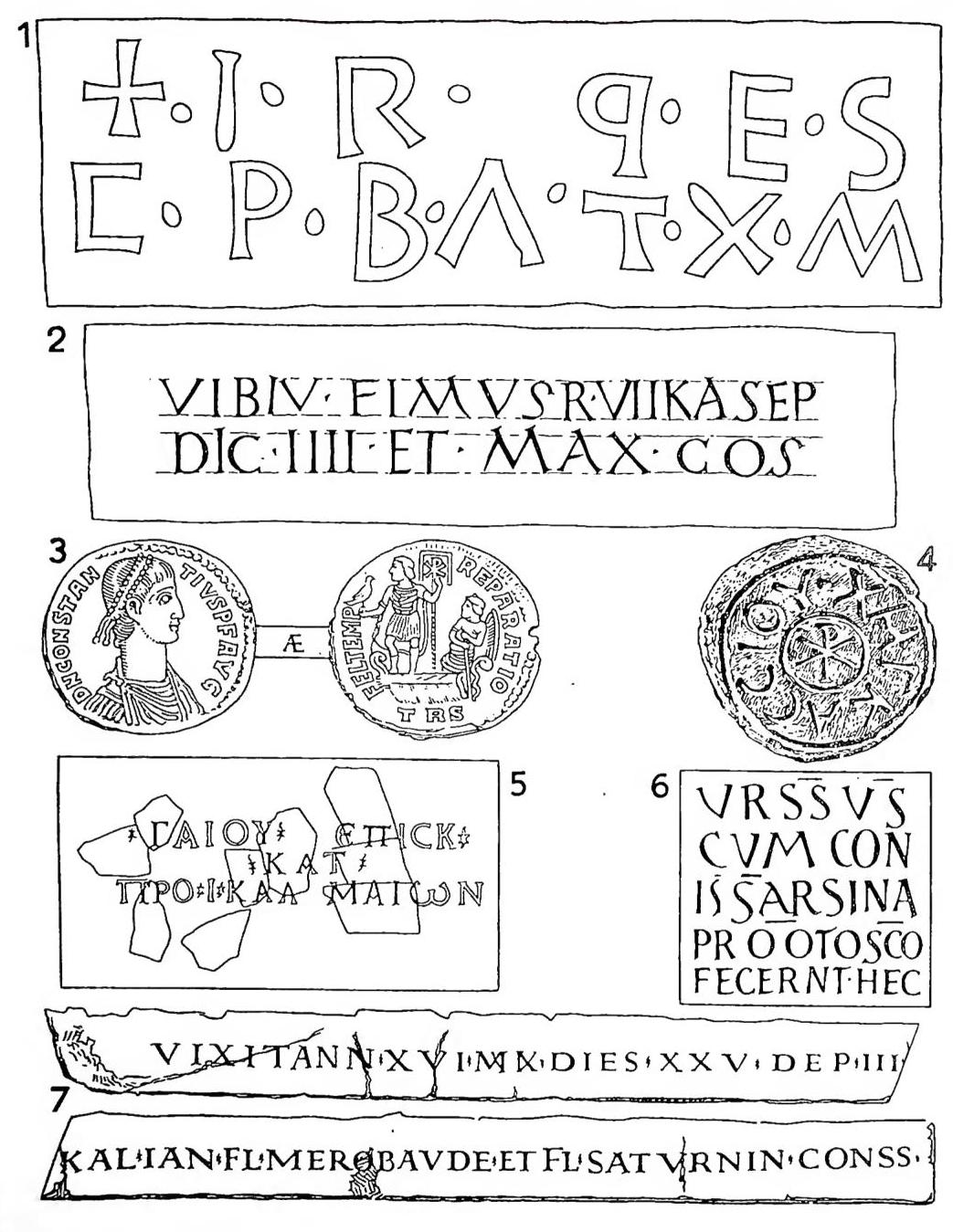
6
VRSSVS CVM CON IS SARSINA PROOTOSCO FECERNTHEC
7
KALIANFLMEROBAVDEETFLSATVRNINCONSS
(drawing, Enc. Cott.)