Machine translation of the 1948–1954 Italian original. The original text is authoritative.
PLATINA, BARTOLOMEO SACCHI detto il. — Humanist, born at Piadena (from which his name derives), near Cremona, in 1421; died in Rome of the plague on 21 September 1481. For four years he served under Francesco Sforza and Niccolo Piccinino, then pursued humanistic studies in Mantua under the guidance of Ognibene Bonisoli, whom he succeeded as tutor to the sons of the marquis Ludovico Gonzaga. From 1457 to 1461 he studied Greek in Florence under Giovanni Argiropulo and befriended the leading humanists. In 1462 he followed the newly created cardinal Francesco Gonzaga, his patron, to Rome. He was among the members of the Roman Academy, and Pius II admitted him among the abbreviators. But under Paul II his fortunes changed.
He was imprisoned twice: in 1464, for four months, because of his violent protests against the suppression of the college of abbreviators, and in 1468, together with Pomponio Leto and other academicians, on charges of impiety and conspiracy against the Pope. He was released before May 1469, but regained prosperity and honors only under Sixtus IV, who in 1475 entrusted him with the custody of the Vatican Library. The principal work of P. is the Liber de vita Christi ac omnium pontificum, completed in 1474 and subsequently recast in a shorter form (in Rer. Ital. Script., III, I, Bologna 1913–32), which enjoyed extremely wide circulation, although it was not always impartial, especially in the section concerning the pontiffs of his own time. It was later continued by various authors. Also noteworthy are a Historia urbis Mantuae (1466–69; in Rer. Ital. Script., ed. Milan 1731, XX, pp. 611–862) and two political treatises of uncertain date (De principe, ed. Genoa 1657; De bono cive, edited by F. Battaglia, Bologna 1944), which
(photo: Enc. Cuit.)
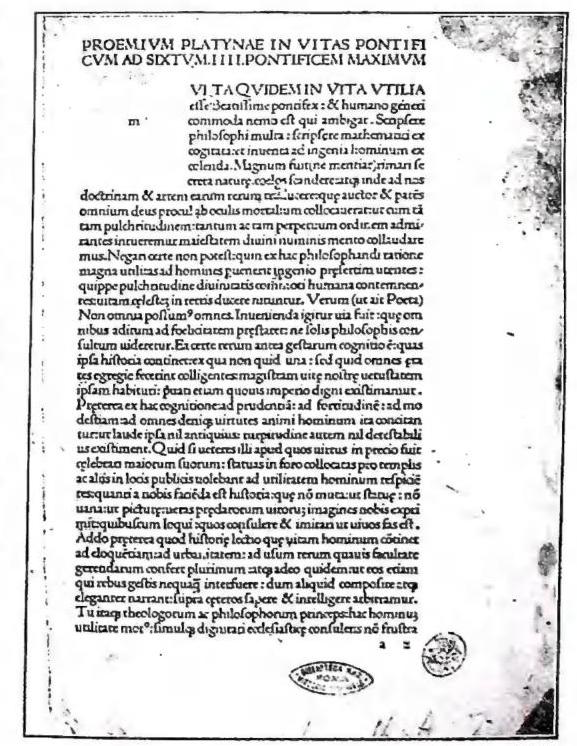
PLATINA – Preface to the editio princeps of the Vitae Pontificum, Venezia 1479 – Roma, copy of the Bibl. nazionale Vitt. Eman.
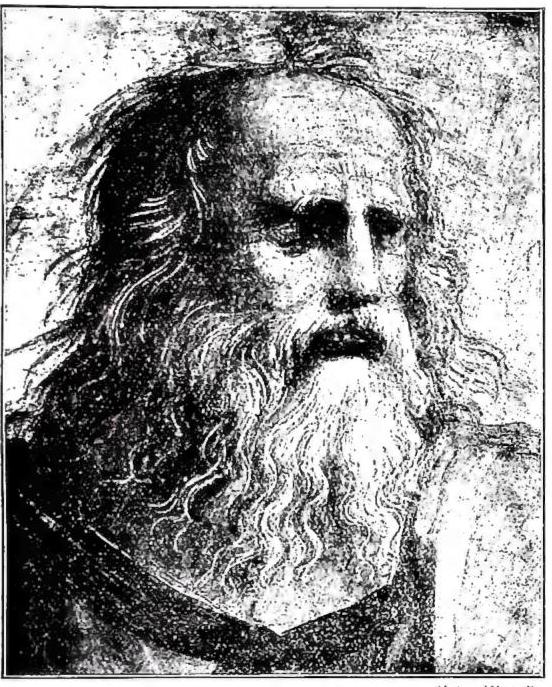
(phot. Alinari) PLATONE — The face of P., with an evident recollection of the figure of Leonardo da Vinci, painted by Raffaello in the School of Athens. Vatican, Raphael’s Rooms.anticipate certain positions of Machiavelli. The philosophical writings are less important (De vera nobilitate; De falso et vero bono, appendix to the Liber, ed. Cologne 1540 and elsewhere) as are the rhetorical ones (De flosculis quibusdam linguae latinae; De laudibus bonarum artium, in T. A. Vairani, Cremonensium monumenta Romae extantia, part I, Rome 1778).
BIBL.: A. Luzio - R. Renier, Il P. e i Gonzaga, in Giorn. stor. della letter. ital., 13 (1880), pp. 430–40; V. Zabughin, Pomponio Leto, I, Grottaferrata 1912, p. 58 ff.; G. Cammelli, Giovanni Argiroppulo, Florence 1941, p. 97 ff.; A. Campana, Antonio Blado e B. P., in Miscellanea bibliografica in memoria di d. Tommaso Accurti, Rome 1947, p. 39 ff. On the political works: F. Cavalli, La scienza politica in Italia, in Memorie dell'Ist. Ven., 12 (1864), pp. 487–95 (in separate publication, Venice 1865). On philosophical thought: N. Caregaro-Negrin, Il « De felicitate » di Francesco Zabarella e due trattati sul bene e la felicità del sec. XV, in Classici e neolatini, 5 (1906), pp. 281–93; E. Garin, Filosofi italiani del '400, Florence 1942, pp. 263–73.
Gioacchino Paparelli
Cite this article
“PLATINA, BARTOLOMEO SACCHI DETTO IL.” Enciclopedia Cattolica, vol. IX (1952), p. 967. Azione Romana digital edition, https://azioneromana.com/article/platina-bartolomeo-sacchi-detto-il.