
VITTORINO (dei RAMBALDONI) da FELTRE. – Educator and humanist, born in Feltre, probably in 1373, died in Mantua on 2 February 1446.
At the age of eighteen he went to Padua, where at the University he had distinguished teachers: Giovanni di Conversino and Gasparino Barzizza for literature, Paolo Veneto for philosophy, Jacopo da Forlì for the physical and astronomical sciences, and Biagio Pelscani da Parma for mathematics. Having obtained his doctorate, he went to Venice to perfect his knowledge of Greek under Guarino; then, having returned to Padua and been invited to teach at the University, he accepted the invitation of the citizens, who admired his method and his goodness, to open a private school. But, disgusted by the carefree conduct of the young people of Padua, he moved to Venice and founded a new school there, to which the sons of the Venetian patricians and pupils from throughout Italy flocked; and there he received an invitation from Gian Francesco Gonzaga, lord of Mantua, to accept the position of tutor to his sons.
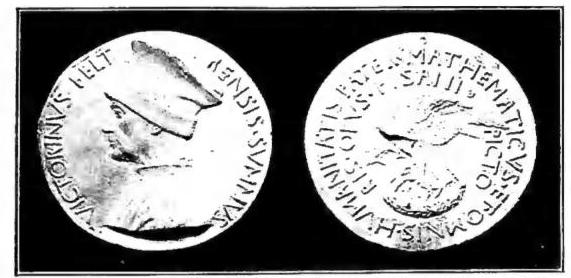
(from G. F. Hill, Pisanello, London 1965, pl. 55)
VITTORINO DA FELTRE – Recto and reverse of the Medal of V. da F., executed by Pisanello (ca. mid-15th century) – Berlin, Museum.
iosa”—which, however, he wished to change to “Giocosa,” to make it clearer that play, that is, ludus (understood in the sense both of delight and of school as discipline of the mind and of conduct), was to be the emblem of the new institution—as well as in the two other institutions he founded, one for the sons of the most distinguished families who came from Italy and abroad, the other for young scholars without means, whom he supported at his own expense. V. left no important pedagogical writings; but his method and its effectiveness can be amply reconstructed from the memoirs left by grateful pupils and by learned men who visited his work.
The first characteristic feature of Vittorino’s pedagogy is the place assigned to physical education, understood in its broadest sense. He categorically banished delicate foods, the luxury of gold and silver furnishings, heavy clothing, excessively long sleep, servants, and carefree playmates; he wanted everything to bear the stamp of aristocratic simplicity. Convinced, moreover, that a healthy and vigorous body exerts a salutary influence on the spirit, he attached great importance to everything that served to develop muscular strength, agility, grace, and bodily beauty, while at the same time restoring energy and readiness of character. Study was therefore interspersed with physical exercises carried out in the open air, in cold and heat, wind and rain: games, dancing, riding, fencing, wrestling, hunting, fishing, acts and assaults of war. He also wished to cultivate the tone and sweetness of the voice and the fluency of speech through reading aloud and lively discussions.
In the intellectual sphere, the program of study, shaped by a sound encyclopedism, was to neglect nothing (and here V. had to struggle against bitter opponents with very reactionary ideas): Latin and Greek from not only Christian but also pagan classics (preferably, though without excluding others, Virgil, Cicero, Quintilian, Hesiod, Xenophon, Plato, and Plutarch), mathematics, of which V. was an eminent student, astronomy, rhetoric and philosophy, moral science, and music. The method was as thoroughly educational as one could desire: exact pronunciation and a clear voice for the younger pupils; for the older ones, translations, literary exercises in prose and verse, memorizing extensive passages from authors (which he considered extraordinarily effective in life as well), and changing subjects in order to dispel the tedium of monotony and quicken the intellect.
Yet V.’s greatest merit does not lie in having been a learned humanist and a skilled teacher, but in having known how to imbue his humanism with a vivid Christian spirit, which did not diminish it in the least, and in having maintained constant vigilance in forming characters for life and for the various circumstances through which his pupils would later have to pass. Religion therefore held the first place; every day he himself led the pupils to Mass, which he attended with composed and devout bearing; confession and Communion were monthly. He reserved religious instruction to himself, and even used passages from the pagan authors for this purpose, demonstrating their incorrectness and insufficiencies. Equally attentive was the moral aspect of education: the study of characters in order to win their confidence; also the study of the families to which the pupils belonged, to identify hereditary and environmental influences, better forestall their consequences, and direct their activities; discipline founded more on understanding and on the effectiveness of self-education and self-mastery than on corporal punishment, which was to be avoided whenever possible; and encouragement through praise and a healthy sense of self-esteem. No improper speech or careless and unbecoming manners; rather, always, everywhere, and with everyone, purity of thought and speech, effortless elegance, and distinction of bearing.
These are the aspects under which V.’s work and educational style present themselves: on the one hand, a vibrant sympathy for the child’s soul, smiling freshness in his manner, and a ready understanding of the child’s need for movement, play, and joy; on the other, strict personal discipline, a lofty conception of life, and a vigilant pursuit of moral perfection insofar as it is Christian perfection—features that did not negate one another but blended harmoniously. The fact is that V. regarded the teacher’s educational apostolate as a priesthood, a vocation assigned to him by God, which first of all imposed upon him an irreproachable sobriety, to be transformed into an effective mission of charity and love. Nor should it be omitted that, despite his intense activity as tutor and educator, V. still found time to visit orphans and widows, the sick and prisoners, dispensing consolation and aid everywhere, so that he died with his property burdened by so many debts that his heirs refused the inheritance and he had to be buried at the expense of the marquises of Mantua.
Moreover, “the good fruits of the ‘Casa gioiosa’ were seen not only in Mantua but elsewhere as well, since for a long time V.’s pupils could be recognized by a loyalty of character that formed a striking contrast with the general corruption of the age” (P. Villari, N. Machiavelli e i suoi tempi, I, 3ª ed., Milano 1912, p. 161).
His school, in fact, continued for another twenty years under the direction first of his disciple Ognibene da Parma and then of Bartolomeo Sacchi, called il Platina. It was a true forge in which men were tempered who were not so much literary scholars as men effectively prepared for life, as the Gonzaga and the Montefeltro, heads of state, demonstrated themselves to be; Sassolo da Prato, Nicolò Perotto, and Giov. Andrea Bussi, prelates; and others, military commanders, humanists, and scientists (cf. Gerini, op. cit. in bibl., pp. 67-73). On the medal in V.’s honor, Pisanello wrote: “Victorinus Feltrensis summus mathematicus et omnis humanitatis Pater.” In 1868 a monument to V. Feltre, bearing the inscription: “Al suo V. principe degli educatori.”