
DANZA. — 1. It consists in a complex of ordered movements of the body, and especially of the feet, according to the musical tempo marked by singing or instruments. It may be an artistic representation, such as the ballet, or a popular exercise.
Among primitive peoples, the use of d., a manifestation of a physical order observable when certain rhythmic factors coincide, is widespread, though the determining motives vary among peoples in their natural state. Among these peoples, ethnologists distinguish first of all between masculine, feminine, and mixed d.; collective and individual; occasional and periodic. All of these, moreover, except for a few rare instances, find their deepest meaning in religion (v. dei). Usually, d. are not accompanied by music, but are in any case rhythmically marked by crude instruments or by clapping of the hands or fingers, by stamping, or by guttural cries.
The frenzied d. of sorcerers among various tribes of Australia and of the dervishes are intended to create a genuine self-intoxication (which produces ecstasy), in which the dancer acquires the ability to do things beyond the normal (e.g., prophesy); and the same desire for stimulation lies at the basis of various types of war d.: on the one hand, the desire to exalt courage; on the other, the performance
of a kind of symbolic combat against supposedly hostile supernatural forces. Nor is the intimate meaning of agricultural d. different: they are intended to facilitate the development and growth of seeds; the same is true, in general, of magical d., through which, by means of mimesis, one seeks to obtain something necessary (e.g., rain). Within the framework of the religious phenomenon understood in its broadest sense are placed certain types of initiation d. (in which the ritual death and rebirth of the initiate are represented), whereas love d., which preside over engagements and marriages and which often aim to exalt the fecundity of the woman, lie outside this sphere. In Sacred Scripture, d. occurs as a collective manifestation of joy (Ex. 15, 20; Iudc. 11, 34; I Sam. 18, 6), as an act of celebration (Iudc. 21, 21), and as a sign of honor to God (Ps. 67, 26; 149, 3). In the episode of the golden calf, the Hebrews sin by dancing around it, and Moses finds them doing so (Ex. 32, 19). The best-known passage of the Old Testament concerning d. is that of David and the Holy Ark (II Sam. 6, 14). On the whole, d. appears to be a spontaneous phenomenon rather than a fixed element of ritual.
At the beginning of this century, as a result of a progressive relaxation of morals, certain systems of d. were introduced, originating in the indigenous customs of the Negroes of South America; in these, because of the various ways of moving the feet and the various positions of the dancers, the lower parts of the bodies of the members of the couple easily come into contact. Because of the different movements employed in the dance, these modern dances have various names: one-step, two-steps, turquey-trot, pas de l'ours, tango, spirù, charleston, foxtrot, rumba, carioca, boogie-woogie, samba, raspa, etc.
2. In any case, dancing in itself is not an illicit act: it is a manifestation and almost an explosion of joy; enjoyment is achieved by seeing one’s own body and that of another respond with rhythmic movements synchronized to the notes of the music. Malice is not intrinsic to dancing, unless it prescribes deliberately obscene acts, but it may be added by those who practice it; often encouraged by circumstances, today in particular, perfidiously devised and arranged by planners, composers, and organizers so that they may facilitate and make
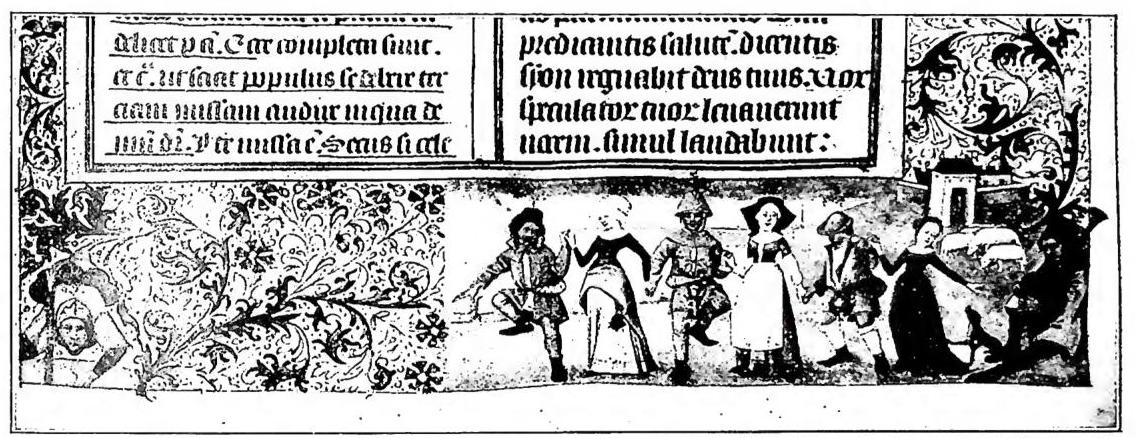
DANZA - D. rural, Missal of Poitiers (15th century) - Paris, National Library, ms. Lat. 873, f. 21.
From these solemn dances there developed, beginning in the Renaissance, the ballroom dance, which in subsequent centuries became increasingly impoverished of folklore and increasingly individualized between the individual gentleman and the individual lady. From the moral point of view, moreover, the great revolution took place in the 18th and 19th centuries, under the influence of a liberalism that was also expressed in customs: from the dance in which the gentleman touched only the lady’s hand, there came the embrace of the upper part of the bodies of the couple moving in continuous circles (dances tournantes). The dances thus performed took different names according to the various movements of the body: waltz, polka, galop, mazurka, rédova, scottish, caucan, cotillon, cake walk, etc.
From that time, too, the ecclesiastical authorities’ interest in dancing as a moral problem can be observed in the decrees of the SS. Congregations and in the letters of the pontiffs, both as universal pastors and as sovereigns of the Papal States, not to mention the pastoral measures adopted by the bishops.
There are indeed strong condemnations of dancing even in patristic literature (s. Pier Crisologo, Serm. 127, 174: PL 52, 452, 654; s. Ambrogio, De Elia et icinio, cap. 12; In Ps. 40, 24: PL 14, 711, 1078; s. Gerolamo, Ep. 70 ad Heliodorum: PL 22, 601 etc.) and in the conciliar legislation of the Middle Ages. Those writings, however, reflect a different situation. Whereas the Fathers had before them dancing as a remnant of paganism (Arnobio, Adversus gentes, cap. 6: PL 5, 1118) and often, according to the testimony of the pagans themselves, as a diversion involving revolting obscenities (Ammiano Marcellino, XIV, cap. 5, 6), the councils of the Middle Ages condemned dances held in cemeteries and churches chiefly ratione loci.
almost inevitable. The prescribed movements of the body are themselves at times almost expressions of arousal and sexual acts.
When dancing openly degenerates, it is no longer dancing; it is an obscene act or a series of obscene acts, which must be assessed as such. Thus, for example, this must be said of the so-called «angelic dance», in quo nuditas est totalis, and of certain entr'actes in which the dance is a pretext. If it still retains the appearance of dancing, it remains an occasion of proximate or remote sin, depending on the subjective and objective circumstances.
Leaving aside the subjective circumstances, which vary according to each person’s sex, age, and education, as well as the care taken in observing the rules of dancing, the objective circumstances that chiefly carry weight in the moral judgment are the following: a) women’s greater license in dress; b) conversation, often free and provocative; the readiness to venture certain more or less lustful acts, especially during intervals of rest; c) the appearance of the other dancers, which can at times be more provocative than the very moments of active participation in the dance; d) music that is often lascivious, as jazz frequently is, and to which an obscene song text was not rarely originally joined, recalled by the notes themselves; e) the use of intoxicating or excessively stimulating beverages; f) insufficient lighting, especially in certain corners assigned to couples’ rest, particularly when sudden interruptions of the lighting are added, whether anticipated or arranged;
g) meeting together after the dance solus cum sola and the ensuing excitations that may be provoked in the imagination.
These circumstances, in whole or in part, can be more easily eliminated at private dances than in public dance halls, since the former proceed by invitation, ordinarily extended to persons who are, at least outwardly, honest.
3. Whether dancing is a proximate or remote occasion of sin cannot be determined a priori, by fixed rules, but only reconstructed on the basis of experience—that is, according to whether falls occur frequently or not—and the confessor must regulate his conduct with penitents accordingly. Collective experience shows that very often (though, of course, not always) the more modern dances mentioned above are a proximate occasion of sin. Hence the frequent pastoral letters of the bishops against dancing, and the strong warning of Benedict XV in the encyclical Sacra propediam of 6 January 1921, which classifies modern dances as «barbarous, one worse than the other» and asserted of them: «one could not find a more suitable means of eliminating every remaining trace of modesty» (AAS, 13 [1921], p. 39). This warning was repeated by Pius XI in the encyclical Ubi arcano Dei of 23 December 1922 (ibid., 14 [1922], p. 679), where he deplores women’s frivolity «especially in dress and in dances».
In practice, when dancing is for an individual a proximate occasion of sin, it must either be avoided or, if necessity requires one to make an appearance, attended with all natural and supernatural safeguards; when it is a remote occasion, participation is conditional upon the application of specific precautions preventing the occasion from becoming proximate rather than remaining remote.
Frequent use of dancing, especially dances of the most modern type, must in any case be combated, because it promotes moral frivolity and has a deleterious influence on mental health as well, given the excessive excitation of the nerves.
The principles of morality that we have set forth apply to everyone. As for clerics, in cap. 140 it is forbidden not only to attend dances that are in themselves unbecoming, but also those at which the presence of an ecclesiastic would in any event cause scandal.
After what has been said, even supposing that the dances are in themselves honest, it is unbecoming for a priest and for Catholic organizations to promote them even for charitable purposes, and the Church has sought to eliminate this abuse wherever it had become established (cf. Acta et decreta Concilii plenarii Baltimorensis III, Baltimore 1886, n. 290; S. Congregazione Concistoriale, decree of 31 March 1916, in AAS, 9 [1916], pp. 147-48; decree of 10 December 1917, ibid., 10 [1917], p. 17).