Machine translation of the 1948–1954 Italian original. The original text is authoritative.
DANZA MACABRA. — The theme is connected with the meditations common in the 14th and 15th centuries on the transience of earthly goods and human splendors, and on the equality of all people before death.
As early as the 13th century, the “encounter of the three dead and the three living” was frequent in French literature; moreover, it soon became known in Italy as well, as is evident from the famous frescoes in the Camposanto of Pisa and from those from which they derive, of which fragments remain in S. Croce in Florence, attributed to Andrea Orcagna.
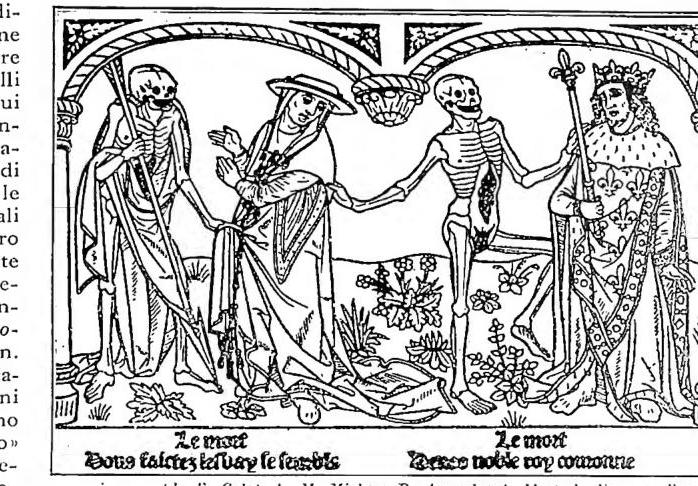
(from F. Calot, L. M. Michon, P. Angoulvent, L'art du livre en France des origines à nos jours, Paris 1911, p. 57) DANZA MACABRA - D. m. Woodcut from La danse macabre, Paris, Guy Marchand 1485.The image of death itself understood as a skeleton was already common in the 14th century. In the same century the strange word macabre, originally macabré, appeared in France. «Le fis de macabré la dance», says the poet Giovanni Le Fèvre in 1376. The etymology of the term macabre is much debated; it nevertheless seems certain that it is connected with a proper name; indeed, an attempt has been made to relate it to the Maccabean martyrs. In any case, a d. m., that is, a sequence of scenes or tableaux in which images of the dead and the living appeared dancing, was performed in France at the beginning of the 15th century; and the duke of Burgundy had such a dance performed in 1449 in his palace at Bruges. These theatrical performances would have given rise not only to the engravings of Guyot Marchant and Holbein but also to the most celebrated of all the ancient d. m., the one painted in 1424 on the portico of the cemetery of the Innocents in Paris, later destroyed in the 17th century, from which in turn derived the numerous other d. m. painted at that time in France, including some that have been preserved, such as that in the church of La-Chaise-Dieu, which dates from the second half of the 15th century.
The representation was repeated in Germany and in the other countries where the French Gothic taste and culture spread, and it also appeared in northern Italy, where the most interesting is certainly that at Clusone near Bergamo, painted in 1485.
In Italy, however, from as early as the 14th century, the theme of the “triumph of death” prevailed, not only in the frescoes of the cemetery of Pisa mentioned above, but also in 14th-century Rimini painting; a “triumph of death” is also depicted in a small panel in the picture gallery of Siena attributed to Pietro Lorenzetti, and in a large 15th-century fresco, the work of a painter trained in the forms of Catalan art, formerly in the courtyard of the Sclafani palace in Palermo and now in that city’s municipal building.
BIBL.: P. Vigo, Le d. m. in Italia, 2nd ed., Bergamo 1901; F. Neri, s. V. in Enc. Ital., XII (1931), pp. 369-70; I. Huizinga, Autunno del medioevo, Florence 1940, translation of the 3rd ed. of 1928, pp. 192-96. Emilio Lavagnino
Cite this article
“DANZA MACABRA.” Enciclopedia Cattolica, vol. IV (1950), p. 718. Azione Romana digital edition, https://azioneromana.com/article/danza-macabra.