
HOLBEIN, HANS, the YOUNGER. – German painter and engraver, b. in Augsburg in the winter of 1497–1498 and d. between 7 October and 29 November 1543 in London. A pupil of his father, he was then in Basel in 1514, where he worked first as an assistant to Hans Herbster and later on his own. Belonging to these first years of activity are the portraits of J. Meyer, burgomaster of Basel, and his wife (1516), and the frescoes of 1517 in Lucerne, inside and on the façade of the house of the mayor of Hertenstein.
In the summer of 1518 he probably went to Italy, and the influence of Italian art, especially Lombard art and Mantegna, is visible in his immediately subsequent work. Back in Basel in September 1519, he received civic rights there a year later. Here (where he enjoyed the friendship of famous men, such as Erasmo da Rotterdam, of whom he made many portraits that initiated his fame as a portraitist) he was admitted to the artists’ guild, worked for the city’s publishers, providing illustrations for books, and frescoed the façade of a dance hall (Haus zum Tanz), as well as the Council Chamber in the Town Hall (1521). Among the other works of this period are the portrait of Bonifacio Amerbach (1519), who was later to become one of the principal collectors of his drawings (his collection is in the Kunstsammlung of Basel); the statesman of Freiburg; and the Madonna of Solothurn (1522).
In 1524 he went to France, where he came into contact with the art of the Clouets, from whom he derived the technique of drawings in coloured chalks (his earlier drawings, in fact, are all in silverpoint); it was after this journey that he made his most celebrated woodcuts, the Imagines mortis and the
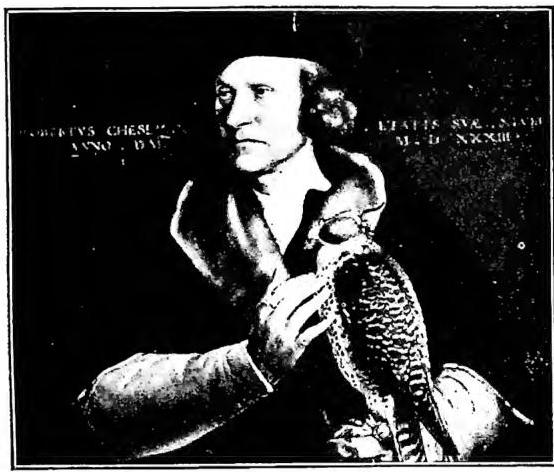
H. H. the Younger is certainly the artist closest to the spirit of the Italian Renaissance ever produced by German art. Contact with the works of Mantegna, Michelangelo, Leonardo, Raffaello—in short, with those of the most famous Italian painters—enabled him, among other things, in contrast with the painters of his homeland who had preceded him and were still traditionally Gothic, to define his representations in a more explicitly plastic sense. And he certainly owes much of his fame, which derives from his best-known activity as a portraitist, to the influence of the art of Leonardo and the Clouets. His portraits (the Two Ambassadors in the National Gallery in London is a marvellous example) are defined with such analytical power and such clarity of vision that they rank among the greatest expressions of the art of all times and all countries. – Vedi tav. XCII.