
HOUDON, JEAN-ANTOINE. — French sculptor, born on 20 March 1741 in Paris, where he also died on 16 July 1828. A pupil of M. Slodtz, he won the « prix de Rome » in 1761, but did not go to Rome until 1764, remaining there until 1768.
From the Roman period date the S. Brunone in S. Maria degli Angeli and the model for what was to be the companion statue representing S. Giovanni Battista (Galleria Borghese), derived from the first model of his famous Scorticato, the fruit of his passion for anatomical studies. On returning to France, he acquired fame especially through his portraits: numerous were those exhibited at the Salon of 1777, among them the portraits of the count and countess of Provence, the princesses Vittoria and Adelaide, Turgot, Gluck, Mme Jaucourt, etc. One of his most celebrated busts is certainly that of Molière (1776), preserved in the foyer of the Théâtre-Français; dating from 1781 is the other no less famous statue representing the seated Voltaire, at the Comédie Française, which concluded a long series of portraits of the philosopher. Among his other busts, those of Rousseau (1779), Buffon, and Luigi XVI (1787) should be recalled. On 22 July 1785 he went to America for a few days with Franklin (whose portrait he had also made), to prepare the sketches for the statue of G. Washington, subsequently erected in 1796 in the Capitol of Richmond. His activity did not cease even with the advent of the Revolution (busts of Bailly, La Fayette, and Necker, 1791), but
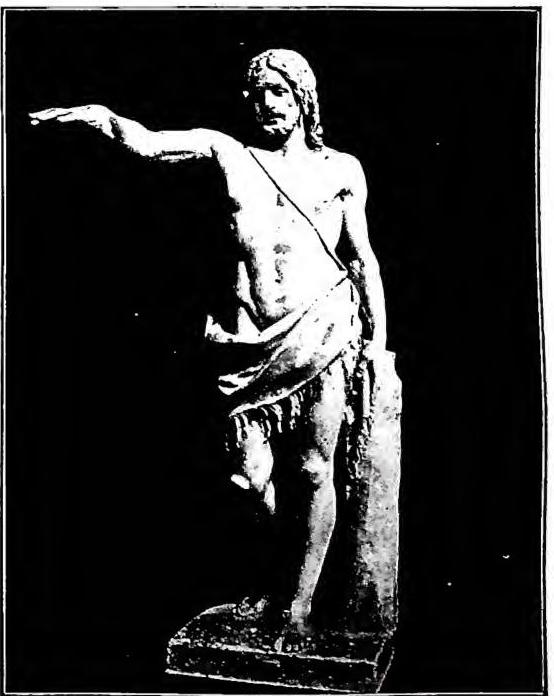
The journey to Rome was certainly decisive for the art of the French sculptor, who precisely in Rome, under the influence of Winckelmann and especially fascinated by the art of Michelangelo, abandoned the Baroque art in which he had been trained by Slodtz, in order to turn toward classicism. Classicism which, even if it became rigid in him, places him among the most significant representatives of the new French sculpture, which at the same time found its standard-bearer in painting in G. L. David. The two statues of S. Bruno, both in Rome—that of Slodtz at S. Pietro and that of H. at S. Maria degli Angeli—can serve admirably to define the contrast between the old and the new ways of seeing. But H.’s fame is above all linked to his portraits, especially carefully executed with regard to the expression of the face and therefore tending toward a decisive individual characterization: for the sculptor, an attentive realist, always held as the principle of his art—as he himself once said—“preserving the truth of forms.”