
DIGIONE, DIOCESI di. - It is the chief town of the department of the Côte-d'Or in France, situated at the confluence of the rivers Ouche and Suzon on the Burgundy Canal. The diocese extends over 875.344 sq. km. and has a population of 335,602 inhabitants (census of April 1946), of whom 325,000 are Catholics. D. Divio, or Castrum Divionense, was in the Gallo-Roman period a city of the territory of the Lingones. It then belonged to the Kingdom of the Burgundians; from 1015 it was part of the Duchy of Burgundy until 1477, when Louis XI united it to the Kingdom of France. It suffered a Swiss siege in 1513. The diocese was created by Clement XII on 9 April 1731, by separation from that of Langres.
By virtue of the Concordat of 1802 it included the departments of the Côte-d'Or and the Haute-Marne because the diocese of Langres was then suppressed; when this was re-established in 1817, it included, as it still does, certain parts that had previously belonged to the dioceses of Langres, Autun, Chalon, and Besançon. The diocese is divided into three archdeaconries: the first of S. Benigno, which comprises 15 deaneries and 190 parishes; the second of St-Vorles with 6 deaneries and 78 parishes; the third of Notre-Dame is subdivided into the two archpriestships of Beaume and of Semur, and comprises 16 deaneries and 253 parishes. In total, 727 parishes are served by only 337 diocesan priests and 73 regulars (1948). It is a suffragan of Lyon. Patron saint of the diocese: St. Benignus.
P. Van Hooff pointed out (Acta SS. Novembris, I, Paris 1887, p. 138) that this passio is modelled on that of the saints of Saulieu, Andochius, Thyrsus and Felix (ibid., p. 155); he was followed by Duchesne (Fastes épiscopaux de l'ancienne Gaule, I, 2nd ed., Paris 1907, pp. 51 ff.) and by Delehaye (Les origines du culte des Martyrs, 2nd ed., Brussels 1933, pp. 86, 354).
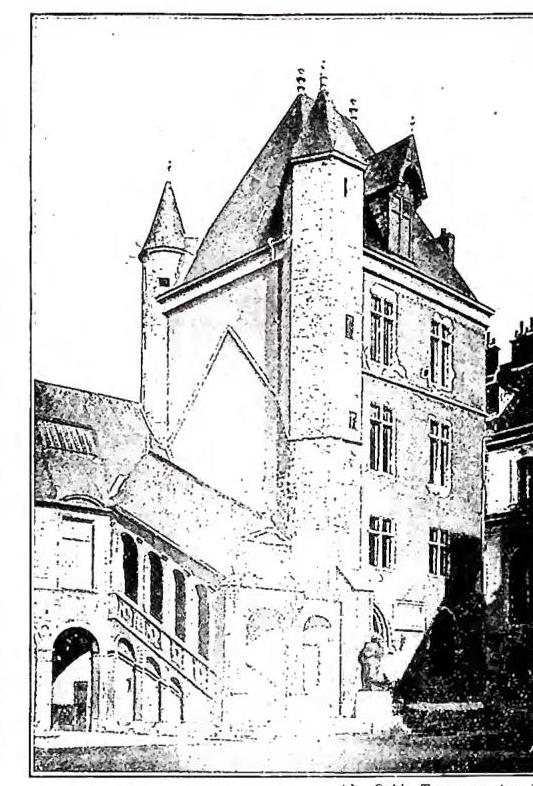
The basilica and monastery received donations from King Guntram in 584; repairs were carried out c. 870 by Bishop Isaac of Langres. Nothing remains of the rotunda built in 990 by Abbot William. In 1001 the building was converted into a Romanesque structure which was consecrated by Paschal II. In 1106 the tomb of an unknown St Pascasia may have been included in the new church. Further modifications were made in 1280 and the building was restored several times thereafter. Today very few ancient remains are visible: inside, the crypt where in 1858 the tomb of St Benignus was discovered; outside, part of the portal which Bouchardon later decorated with the martyrdom of St Stephen; there also survive some architectural elements of the ancient monastery. The central spire, 95.59 m high, was erected in 1742. Outside the castrum stood the church and Benedictine abbey of St John; now a parish church, it was the burial place of the Bishops of Langres, Gregory, whose epitaph was composed by Venantius Fortunatus and Tetradius (539–72; E. Le Blant, Recueil des inscriptions chrétiennes de la Gaule, I, Paris 1856, p. 5, no. 2; p. 6, no. 3).
The church of St Stephen is certainly the intramural basilica mentioned by Gregory of Tours. The attached abbey, originally Benedictine, passed to the Augustinians in 1113; it became a cathedral in 1731, then a granary in 1792 and subsequently a stock exchange in 1897. Other abbeys were those attached to the churches of St Michael and the Holy Trinity. St Michael’s was an abbey c. 1000; externally it appears Gothic, internally it is classical. The Carthusian abbey of the Holy Trinity was founded at Champmol by Philip the Bold, Duke of Burgundy, in 1383; consecrated in 1388, it was suppressed during the Revolution (F. Mercier, La Chartreuse de Champmol, Dijon 1920).
Of Gothic style are the churches of: Notre-Dame of Dijon (1252–1334); Notre-Dame de Semur; the abbey of St-Seine (Seine).
Especially honoured in Dijon, besides St Benignus, are: St Seine (Seine) b. at Magny and d. in 580, founder of the monastery of Réôme; St William (961–1031), who became abbot of St Benignus in Dijon in 990 (reformer of the Benedictine Order in the 10th cent.); St Robert of Molesme; St Stephen Harding. Born in Dijon were St Jane Frances de Chantal (1572–1641) and Jacques-Bénigne Bossuet (1607–1704), the Venerable Sister Margaret of the Blessed Sacrament (1619–48), known as the Little Saint of Beaune, the Venerable Benignus Joly, canon of St Stephen’s in Dijon (1644–72).
Among the Christian inscriptions found in Dijon two Merovingian ones are noteworthy: the first of a Banderisima (CIL, XIII, 5463) and the other of a monk Turpericus (ibid., 5593). For Christian sarcophagi V. Wilpert, Sarcophagi, I, p. 91; II, pp. 5, 264; pl. 65, 2–3. – See pl. XCV.