
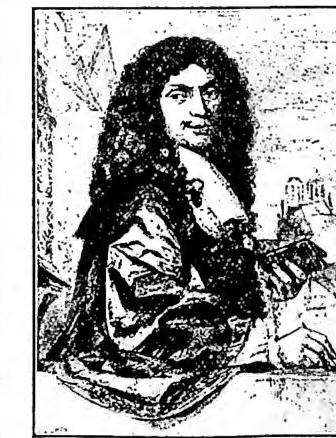
MOLIÈRE, JEAN-BAPTISTE POQUELIN, called. — Dramatist, born in Paris in January 1622, died there on 17 February 1673. He entered with impetuous force into the artisan and popular tradition of the comedians of the Commedia dell’Arte who had passed from Italy into France, carrying it to extreme consequences; and in theatrical forms of daring and ingenious vividness he composed farcical and spectacular entertainments for the amusement of a carefree hour, as well as comedies that, despite their comic and grotesque modes, attain the desperate and cruel grandeur of pitiless tragedy.
His father, although as a merchant he belonged to the wealthy and industrious Parisian bourgeoisie, historically linked to the monarchy of France, as “valet and upholsterer to the King” had a precise function at court: he was, one might say, the arranger of royal ceremonies; nor would his son ever forget this condition. Having received the classical education appropriate to his social class, he undertook, albeit only marginally, studies of law, but the theatre called him: this meant placing himself beyond the norm, living adventurously in a guarded and resentful independence as an outlaw. In 1643 he founded the “Illustre Théâtre,” ambitiously, but in company with actors, the Béjart, highly experienced in the profession. The enterprise was unsuccessful, and in 1645 the impresario was imprisoned for debt. He then accepted the common condition of comedians, vagabondage, and until 1658 travelled from one province to another, especially in southern France, gaining a fruitful experience in theatrical technique and popular language. His ambitions aimed higher, toward reconciling the theatrical profession with literature: already during the final period of his provincial tour he composed farces of overtly Italian imitation (La jalousie du Barbouillé; Le médecin volant) and comedies of more complex intent (L'étourdi; Le dépit amoureux); but in Paris he made his début with a tragedy by Corneille in the Guards’ Hall at the Louvre (24 October 1658); and the first comedy to open the way to his success was Les Précieuses ridicules (1659), which, between its literary satire of preciosity and the farce of disguised servants, subtly introduces a highly intelligent note of social observation. The masterpiece L'Ecole des femmes (1662) established him with great éclat: he worked at the Théâtre du Palais Royal, became the official playwright of Louis XIV, and relied on the King and on his authority, ambitious to place itself above all divisions, including controversies touching religion, during the long dispute over Tartuffe ou l'Imposteur (1664-69): the comedy that presumed to vindicate the rights of natural honesty and reasonable common sense against the masked turpitudes of hypocrites, and that intervened in the Jansenist controversy by rejecting both sets of disputants and appealing to the Monarch, far-sighted, generous, and just. In a few years of enormous labour, M. devoted himself to the many functions of author, actor, impresario of his comic troupe, and arranger of the festivities of King Louis: it is useful to identify them by listing his masterpieces: Dom Juan ou le Festin de pierre (1665), Le misanthrope (1666), George Dandin (1668), L'avare (1668), Les femmes savantes (1672), Le malade imaginaire (1673). Death seized him while he was performing the comedy of the man who refuses to know that he must die: apparently provided with the consolations of religion, but not buried in Christian ground.
Three great themes run through his great dramaturgy: love, kingship, and nature. But love is the life of the senses, and jealousy, which makes it subject to its own craving for possession, poisons all its joys (the character of Arnolfo in L'Ecole des femmes is exemplary). Kingship appears to be a refuge, assuring greatness and protection to human destiny, but the court poet becomes a wearied director of ballets and pastorals when he does not adapt himself to assisting the sovereign in his amorous disguises (Amphitryon, 1668). Nature, which, in his fear of all transcendence, and even in the proud challenge of Don Giovanni, ought to be his mother, besets man with illness and threatens him with death: nor does it help him, condemned to die young in the grotesque ceremony that assigns the imaginary invalid to the Faculty of Medicine, to mock the supposed transgressors against nature, the physicians. In
BIBL. edd.: Oeuvres (accompanied by ancient engravings and annotated by B. Guégan), 7 vols., Paris 1925-29; Oeuvres de M. (according to the original texts, with information by J. Copeau), 10 vols., there 1929; Oeuvres complètes (critical text and notes by M. Rat), 2 vols., there 1932. Bibliographical repertories: P. Lacroix, Collect. molièresque, 20 vols., there 1867-75; id., and G. Monval, Nouvelle collect. molièresque, 17 vols., there 1861-90; C. Levi, Saggio di una bibl. italiana di M., in Studi molieriani, Palermo 1922, p. 187 ff.; P. F. Saintonge-R. W. Christ, Fifty years of M. studies (1892-1941), Baltimore 1942. Biographies and studies: among the numerous contributions, see especially: C. Levi, M., Rome 1922; F. Picco, M., Florence 1930; G. Michaut, M. raconté par ceux qui l'ont vu, Paris 1932; M. Apollonio, M., Brescia 1942; P. Brisson, M., sa vie dans ses oeuvres, Paris 1942; D. Mornet, M., there 1943.