MOLFETTA, DIOCESE of. — City and diocese in the province of Bari. It includes the dioceses of Giovinazzo and Terlizzi. It has a population of 90,000 inhabitants, almost all Catholics. It comprises 15 parishes served by 83 diocesan and 22 religious priests, one seminary, eight male and 17 female religious communities (Ann. Pont., 1951, p. 273).
HISTORY. – The year in which the episcopal see was established is disputed. Gama and others place the first bishop, Giovanni, around 1136; others, following Ughelli, place the same bishop in 1179, since a person of that name appears on the list of participants in the Lateran Council of that year, convoked by Alessandro III. It nevertheless seems certain that the origin of the episcopate dates back to the middle of the twelfth century, as a suffragan of Bari. Among the bishops of the diocese, the figure of G. B. Cibo, a Genoese (1473), stands out; transferred here by Sisto IV, he was elected cardinal the following year and, in 1484, became Pope Innocenzo VIII. Despite his brief stay, the future pontiff retained a grateful memory of M., because, immediately after his election, he made the diocese independent of the metropolitan see of Bari and declared it immediately subject to the Holy See. Among the others, mention should be made of: Alessio Celadoni (1508), who took part in the Fifth Lateran Council; Ferdinando Ponzetti (1517), a Florentine and later a cardinal, assisted by his nephew Giacomo, during whose episcopate the terrible sack of 1529 took place at the hands of Lautrec; and Carlo Loffredi (1670), a Theatine, who pacified the clergy and the magistracy and promoted various charitable works in favor of religious institutions. In 1818 Pius VII united the suppressed dioceses of Terlizzi and Giovinazzo to M.; later, however (1833), at the request of the Bourbon Ferdinando II, he restored episcopal dignity to the two sees, while leaving them united to M. and directly dependent on the Holy See.
MONUMENTS. – During the period of its greatest prosperity, M., like the other sister cities, adorned itself with notable monuments, among which the massive bulk of the Old Church or S. Corrado, the ancient cathedral of the medieval borough, still stands out. It was begun in the second half of the 12th century and completed at the end of the 13th. Its structures bear the mark of the various interruptions that the building works had to endure: it is asymmetrical in plan, with 2 truncated towers flanking a façade that was never built, and 2 three-storeyed bell towers crowned with small arches. The interior, almost entirely intact, expresses a rugged vigour through the static quality of its elements. Four cruciform pillars with attached semicolumns support the polygonal drums of 3 domes: the middle one ellipsoidal, the others hemispherical. The drums rest on pendentives slenderized by niches with spherical caps or, in the third, by rows of small arches. The intrados of the vaults consists of regular courses of voussoirs, externally covered by pyramids of stone slabs (chiancarelle), connected by means of low walls to the outer walls, so as to form a single complex that contributes uniformly to the equilibrium and stability of the building. These structural elements (domes, wall connections, capitals, ogival curves, ornamentation, etc.) give the church exceptional importance in the history of Apulian art. Nevertheless, Muslim and Byzantine, Lombard and indigenous influences can be discerned in it, in accordance with the finest school that raised the characteristic cathedrals of this region. Another notable church is the New Cathedral, with a heavy Baroque façade (17th century). Inside are a Visitazione by C. Rosa and an Assunta by C. Giaquinto, a native of Molfetta (1699–1765); in the sacristy:
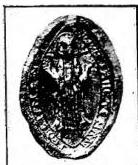
(from J. Laurent, Cartulaires de l'Abbaye de M., Paris 1897, pl. 3) MOLESME. – Gothic seal of Marian type, with the legend: Sigillum sanctae Mariae Molismensis (12th century).