Machine translation of the 1948–1954 Italian original. The original text is authoritative.
GIAQUINTO (GIAQUINTO), CORRADO. - Painter, born in Molfetta in 1703, died in Naples in 1765. In Naples, in 1719, after a very brief stay with N. M. Rossi, he joined the school of Solimena. In 1722 he was in Rome as a collaborator of S. Conca, perhaps until 1731, the date of his first contract made in his own name for the frescoes of S. Nicola dei Lorenesi.
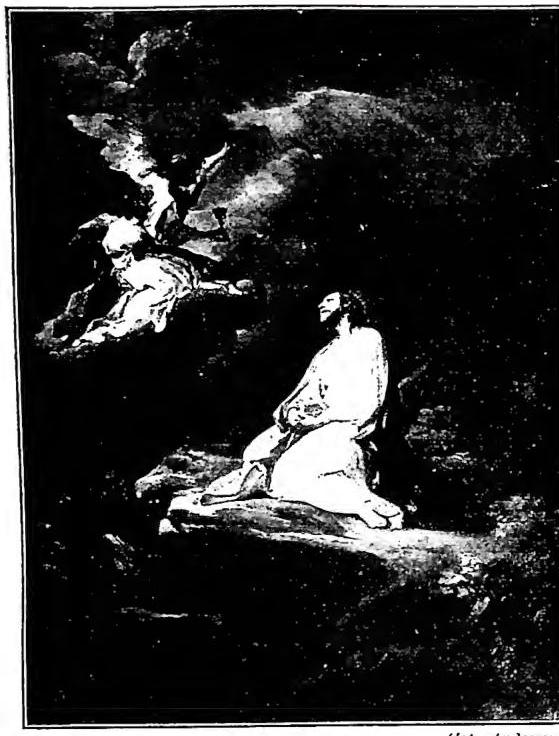
(Int. Anderson) GIAQUINTO (GIAQUINTO), CORRADO - Prayer of Jesus in the Garden. Painting in the Prado Gallery - Madrid.He stayed in Rome until 1752, carrying out a prolific body of work in fresco and oil; he left his best works in S. Lorenzo in Damaso (1741-43), S. Giovanni Calibita (1741-42), S. Croce in Gerusalemme (1744-46), S. Nicola dei Lorenesi (1746; oil canvases), and Palazzo Borghese (1747-47); and he alternated his Roman activity with frequent journeys (Turin 1733 and 1735-39, Macerata after 1733, Cesena 1750-51) and with the execution of commissions for churches in Lazio and other regions (Rocca di Papa 1739, Naples 1744-45, Pisa 1751-52). In 1753, at the invitation of Ferdinand VI, he moved to Madrid; there he was appointed First Painter to the King and President of the Academy of S. Fernando; and, drawing upon his previous experiences, he produced a vast output of high quality (Madrid, Prado and Royal Palace; Aranjuez, castle). He returned to his homeland in 1762 and settled in Naples.
G. was a fluent and spirited painter who delighted in brilliant decoration, in which he succeeded in translating with rococo taste what he had assimilated from the great fresco painters of the 17th century, of whom he may be considered a direct continuation. Indeed, he completed Solimena's teachings through the study of L. Giordano and the Roman works of Lanfranco, P. da Cortona, and especially G. B. Gaulli. He was above all a refined colorist who, to bring to life a fairytale world of pure fantasy, employed an intense yet delicate chromatic range, extremely rich in glazes and halftones, which for its precious variety finds few equals in contemporary painting. His rapid and nervous brushstroke, of a genuinely Neapolitan character, almost always makes his sketches more interesting than his finished works. In Spain and Italy he had a large following of pupils and imitators.
BIBL.: anon., s. V. in Thieme-Becker, XIII, pp. 587-90, with bibl.; V. Moschini, G. artista rappresentativo della pittura barocca tarda a Roma, in L'arte, 27 (1924), pp. 104-24; A. de Rinaldis, s. V. ENOCH. Ital., XVI (1932), pp. 943-44; M. Loret, I pittori napoletani a Roma nel '700, in Capitolium, 11 (1934), pp. 11-25.
Cite this article
“GIAQUINTO (GIAQUINTO), CORRADO.” Enciclopedia Cattolica, vol. VI (1951), p. 249. Azione Romana digital edition, https://azioneromana.com/article/giaquinto-giaquinto-corrado.