
FLIGHT INTO EGYPT. – Episode in the life of Jesus, occurring after the visit of the Magi and briefly narrated in Mt. 2:13. Herod, angered because the Magi had not returned to report news of the King of the Jews, ordered all male children under two years of age who were in Bethlehem and its surroundings to be killed.
But Jesus escaped him, because an angel appeared to Joseph in a dream, ordering him to take the Child and Mary and flee to Egypt.
Around this simple event, legend created a whole flowering of episodes, recounted in the apocryphal Gospels and serving as subjects for Christian art.
I. ARCHIPOLOGY
The first appearance of the Flight into Egypt in Christian art shows that the artist was inspired by the narrative of the apocryphal Gospel «de nativitate Mariae et infantis Salvatoris», known as the Pseudo-Matthew (chap. 2.4), as can be seen on the triumphal arch of S. Maria Maggiore. The Child Jesus, with a halo surmounted by a cross, is escorted by two winged and haloed angels, while Aphrodisius prepares to venerate him, having seen that, at his appearance, all the statues of the idols had been shattered (J. P. Richter, Di un varo soggetto rappresentato nel mosaico della Basilica Liberiana, in Nuovo Bull. di arch. crist., 5 [1890], pp. 137 ff.).The artists who depicted the scene in several rock-hewn churches of Cappadocia would later draw from the same apocryphal source,
as at Belikilisse, Memabeykilisse, Elmelykilisse and Tokaly-kilisse, and at Susam Bayry, near Urgub, where the idols’ statues are represented as falling to the ground, according to the narrative of the apocryphal work.
In the early years of the eleventh century, the Flight is painted in S. Urbano alla Caffarella: the Madonna with the Child is on the donkey, followed by s. Giuseppe.
In the twelfth century, the dream and the Flight into Egypt are depicted in the mosaics of the Cappella Palatina in Palermo. On the left is s. Giuseppe, awakened by the angel; on the right he supports the Child on his left shoulder, while with his right hand he leads the donkey on which the Madonna is seated; a servant follows. The scene of the Flight into Egypt is also found in the crypt of S. Biagio, near Brindisi, which an inscription dates to the year 1197. Around the same date Benedetto Antelami sculpted the Flight in the baptistery of Parma. On the façade of S. Zeno in Verona, the relief scene was sculpted by a master Guglielmo: s. Giuseppe leads, with the staff over his shoulder, to which the small baggage is tied; with his right hand he holds the rope by which the donkey is secured, on which the Madonna with the Child is seated (mid-twelfth century).
Enrico Jasi
II. ART
Developed extensively during the Romanesque period and in the 14th century because of the narrative character of the representation, the theme was treated by Nicola Pisano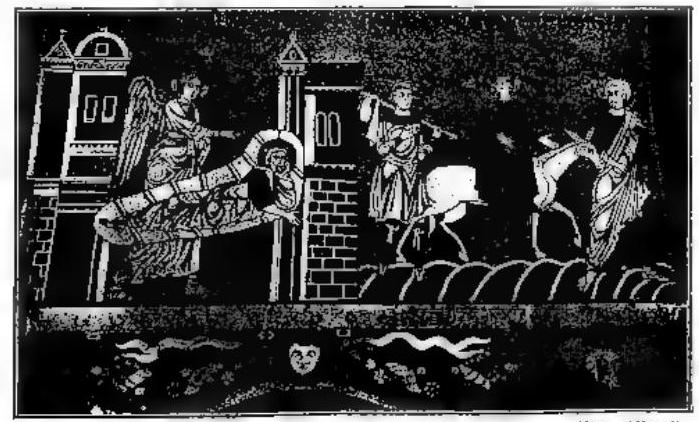
However, at the beginning of the fourteenth century, it is in the Arena Chapel at Padua, among the frescoes painted there by Giotto, that perhaps the finest representation of the theme up to that time may be identified. The figures of Joseph, of the Virgin holding the Child in her arms, of the little donkey, and of the Angel assume a new monumental character. Squared like the rocks of the barren landscape, these figures articulate the composition, enhancing its spatial values.
The great Giottesque model, also repeated in the lower church of Assisi, was repeatedly kept in mind by fourteenth-century painters and was still recalled during the fifteenth century, when the naturalistic spirit of the new age found a way to express itself by reducing the sacred episode to a pleasing narrative of an almost profane, idyllic character, as later in the frescoes attributed to the Peruzzi in S. Onofrio al Gianicolo in Rome. This narrative orientation was also fostered by the addition to the episode of the Flight of the other episode of the Rest during the flight into Egypt, with numerous, at times original, variations.
Thus the episode narrated by the Evangelist and enlarged by the imagination of painters and sculptors frequently reappears in German art of the late Gothic and Renaissance periods. It may be identified in a painting by Schongauer in the Vienna Museum, in another by van Orley (1541) in Cologne, and in still others by Luca Cranach, Giovanni van Scorel, Giovanni Gossart, etc.
Among sixteenth-century representations of the flight into Egypt and of the Rest, however, the finest are those left by Correggio in his paintings in the Uffizi, the Galleria di Parma, and that of Naples. Also highly notable are the compositions on this theme by Federico Barocci (Pinacoteca Vaticana and Museo del Prado in Madrid), increasingly inclined toward an idyllic representation of a profane character. This tendency decisively prevailed when, during the seventeenth century, the episode provided Nicola Poussin, Claudio di Lorena, and other great Italian and foreign painters with a pretext for painting beautiful landscapes with tiny figures. Eighteenth- and nineteenth-century art did not alter this orientation. - Vedi tav. CXXI.