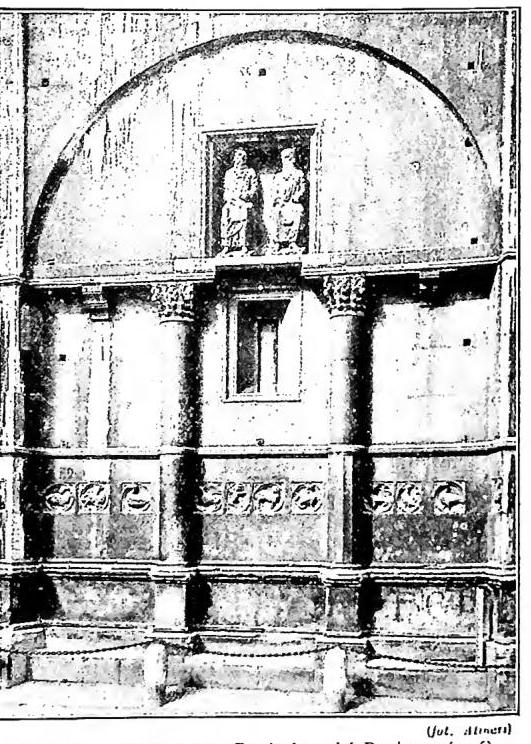
ANTÈLAMI, BENEDETTO. — Architect and sculptor. The surname is an appellation that was given, from as early as the 12th century, to the master masons and builders originating from the Valle d'Intelvi, who formed a powerful corporation in Genoa. Two works bear his signature and the date: the high relief with the Deposizione in the cathedral of Parma (1178) and the architrave of the northern doorway of the baptistery of Parma (1196). The Deposizione formed part of the rood screen of the Cathedral of Parma, together with other fragments: four stilophorous lions, now placed in the Bernini chapel of the Cathedral; three historiated capitals in the museum (the fourth is missing); and another chiselled relief representing Christ in glory flanked by the four symbols of the Evangelists, the four Doctors of the Church, and three angels, also in the museum (a third relief, which together with the Deposizione and the Cristo in gloria was set into the parapet of the rood screen, has been lost). Chronologically, the episcopal throne in the choir of the Cathedral of Parma must be placed between the rood screen and the baptistery. In addition to the rich sculptural decoration on the exterior and interior of the baptistery, partly executed by assistants, the design and construction of the building, completed in its essential parts, including the dome, in 1216, are also attributable to A. The cathedral of Borgo San Donnino and some of the many sculptures that adorn it are likewise works of A. (certainly the two prophets within niches on the façade, which remained unfinished); in these, however, the predominant intervention of mediocre followers can be discerned. In 1219 he began the construction of the abbey of S. Andrea at Vercelli (almost completed in 1223), decorating its central portal with the Martirio di S. Andrea.
A. must have spent the years of his training and artistic education in Provence, since memories of the sculptural complexes on the façades of the church of St-Gilles and, above all, of the portal and cloister of S. Trofimo at Arles assert themselves abundantly and vigorously from the master’s earliest works, forming the substratum of his art, while mingling with an increasing influence of the Gothic art of northern France, which appears particularly vigorous at S. Andrea di Vercelli. But A., far from passively accepting these French elements, thoroughly elaborated and transformed them, giving his creations a distinctly Lombard imprint in the firm, compact density of their volumes, avoiding both the trite, animated pictorialism proper to the Provençal school and the upward thrust and refined elegance that characterize the Gothic architecture and sculpture of the churches of the Île-de-France. Even in the broad iconographic themes developed by A., especially in the Baptistery of Parma, which is his masterpiece, one can discern, despite their partial derivation from France, strongly original accents and an uncommon subtlety in the selection and mutual interconnection of the themes. A., whose importance within the sphere of medieval Lombard architecture and sculpture still awaits more precise definition by criticism, may be regarded, for strength of intellect and breadth of culture, as one of the most powerful personages