Machine translation of the 1948–1954 Italian original. The original text is authoritative.
WASHINGTON, GEORGE. — First president of the United States, born at Bridges Creek (Virginia) on 22 February 1732, died at Mount Vernon (Virginia) on 14 December 1799.
The son of a wealthy planter, he received an irregular education and, having been orphaned at an early age, had to take charge of administering the considerable family estates, which he increased through shrewd land purchases, especially in the territories of the West, a region whose colonization he actively pursued and whose importance for the future development of the country he was among the first to perceive. Having entered the Virginia army (1753), he took part in several actions against the French and distinguished himself to such an extent that, at only 23 years of age, he was appointed commander of the colony’s troops. The many difficulties encountered because of the inadequate collabo-
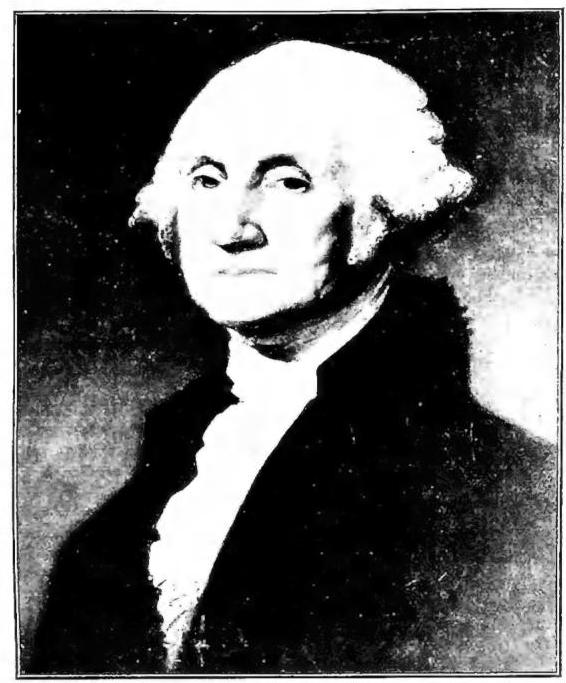
(phot. U.S.I.S.) WASHINGTON, GEORGE — Portrait, painted by Edward Savage (1790) — Boston, Harvard College.The lack of cooperation from the civil authorities and an illness contracted in service, however, induced him to resign in 1758. In the following years, and until the eve of the War of Independence, he resumed the management of his estates, greatly increased through an advantageous marriage, while at the same time taking part in public life as a member of the Virginia assembly (House of burgesses). When the colonies’ agitations against the mother country began, W. supported the various economic reprisals they adopted and participated as Virginia’s delegate in the first “Continental Congress,” which met in Philadelphia (1774). At the outbreak of hostilities, appointed commander-in-chief of all the colonial troops (1775), W. played a vital role not only in organizing the new confederate army, but also in leading and sustaining his ragged and poorly equipped troops through an exceedingly harsh and protracted war against vastly superior forces. Endowed with admirable strength of character and inspiring prestige, rather than exceptional military ability, he knew how to endure even the serious defeats inflicted on him by the English armies, which went so far as to occupy the seat of the “Congress,” without ever admitting defeat and taking advantage of every favorable circumstance to launch counterattacks. At the same time, he had to contend with continual conflicts with a “Congress” too weak to meet his requests for new troops; with his own men, who during the most difficult periods were overcome by discouragement and mutinied; and with some of his generals, who schemed to deprive him of command. Once the situation improved through France’s intervention on the side of the insurgents, W. was able to abandon his delaying tactics and secure the surrender of the English troops at Yorktown (1781), which virtually marked the conclusion of the war. After the peace was signed (1783), his popularity was such that some considered him a possible sovereign of the new State; he responded to these suggestions with a blunt refusal and preferred to resume his peaceful activities on his lands. Concerned, however, about the weakness of the state structure, he worked in favor of a radical constitutional reform; and when an assembly was convened to draft it (1787), he was elected its president.
Averse to oratorical battles, he used the authority of his name to reconcile the various tendencies and interests at stake and to secure the country’s ratification of the new constitution. Elected unanimously to the presidency of the Republic (1789), he devoted his administration to a methodical effort to consolidate the State, regarding himself as above the parties then taking shape and as arbiter of their disputes. Reelected in 1792, he supported a policy of neutrality between France and England and negotiated a treaty with the latter, thereby alienating the Francophile Republican Party. Subjected to every kind of accusation, at the end of his second presidency (1797) he refused to stand again as a candidate and spent his final years on his estates. Of an apparently cold and aloof temperament, he was judged an aristocrat by his contemporaries. Nevertheless, both they and posterity agreed in conferring on him the title of father of the country of democracy; and, to underscore the significance of his work, they gave his name to the country’s capital.
BIBL.: W.’s writings are collected in the national edition edited by J. C. Fitzpatrick: The writings of G. W. ecc., 39 vols., Washington 1931–44. Studies: H. C. Lodge, G. W., 2 vols., Boston 1889; W. Wilson, G. W., Nueva York 1903; A. F. Guidi, W. and the Italians, in the volume Italy and the Italians, there 1933; N. W. Stephenson and W. H. Dunn, G. W., 2 vols., there 1940; B. Knollenberg, W. and the Revolution, there 1940; D. S. Freeman, G. W., 5 vols., there 1948–52. Gabriele Musatti
Cite this article
“WASHINGTON, GEORGE.” Enciclopedia Cattolica, vol. XII (1954), p. 1029. Azione Romana digital edition, https://azioneromana.com/article/washington-george.