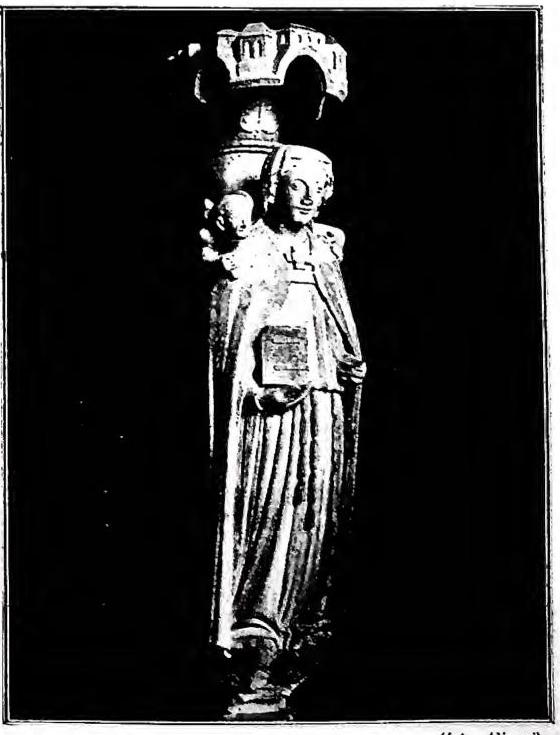
**GENOVEFFA, Saint.** – She is commemorated in the *Martyrologium Hieronymianum* on January 3. The complete biography, dating between the 6th and 8th centuries, is variously assessed by scholars both in terms of its time of composition and the historical value to be attributed to II. G. was born in Nanterre around 420.
**SAINT GENOVEFFA – Sculpture from the mid-13th century. From the Abbey of Saint G. – Paris, Louvre Museum.**
---
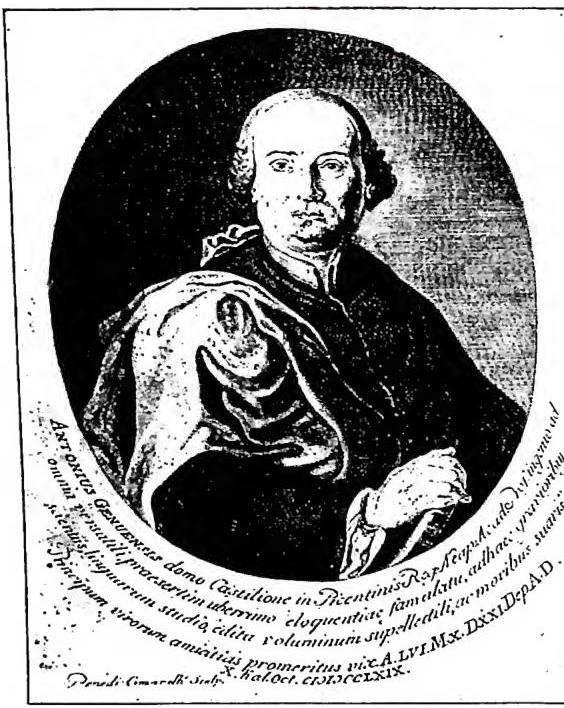
**GENOVESI, Antonio** – Neapolitan philosopher and economist (Castelnuovo di Maddaloni, Caserta, 1713 – Naples 1769). He held the first chair of Mechanics and Commerce, the first chair of political economy in Italy, if not in Europe. Intieri endowed it with an annual stipend of 300 ducats and stipulated that the first to occupy it should be G., who began teaching on November 5, 1754, and continued to do so for the rest of his life.
Influences on G.’s philosophical formation included, alongside the ancients, Locke, Hume, the sensists, and Leibniz. Enlightenment culture entered the Kingdom of Naples chiefly through G., who had understood the usefulness of studying new doctrines, if only to combat their errors with the same logical weapons. His *Elementa metaphysica mathematicum in morem adnotata* (Naples, 1743–47; 2nd ed., 1751, dedicated to Benedict XIV) indeed reveal an apologetic foundation: the first part, on ontosophy and cosmosophy, refutes pantheists and fatalists, especially Spinoza; the second, on theology, refutes deists; the third, on psychosophy, refutes Epicureans and materialists in general; the fourth, supplementary part, on morality, combats libertines. In 1755, the work was denounced to the Holy Congregation of the Index for pantheism and Jansenism; in truth, while the first accusation was unfounded, the second seemed to have some basis. The *Elementa artis logico-critica* (ibid., 1754) are of particular interest for their practical conception of knowledge, an approach that is fully developed in the *Discorso sopra il vero fine delle lettere e delle scienze* (1753), which marks G.’s decisive turn toward practical sciences, though he continued to cultivate pure philosophy, publishing in 1758 the noble *Meditazioni filosofiche sulla religione e sulla morale*, in 1759 the self-apologetic *Lettere filosofiche*, and in 1766 the *Logica* and *Metafisica per i giovanetti*. The 1753 *Discorso* declares vain and harmful any study not directed toward the solid utility of mankind; here lies the program of G.’s economic teaching, collected in the *Lezioni di commercio, o sia di economia civile* (ibid., 1766).
The work consists of two parts, the first of which, more general, lays the political and psychological premises (the spring of pain) of economic science, discusses social classes, the arts (distinguished into fundamental, improving, and luxury), the utility of non-productive classes (conditioned by the law of the least possible), and finally commerce and finance. The second part considers more technical economic concepts, such as price, money, credit, exchange, and interest. G. is usually classified within the mercantilist school, essentially because of his concern that the trade balance be made active through tariffs on imports, especially of finished goods, and through encouragement of domestic producers. What G. does adopt, however, is a tempered and corrected mercantilism on certain points, such as the belief in the intrinsic and preeminent value of gold: G. notes that gold and money in general are “signs of wealth,” while real wealth can only be produced by labor. Above all, G. does not accept the mercantilist conception of wealth as a function of the state’s military power, of which the individual would be a mere instrument (Troisi). Also significant in G. is the influence of the physiocrats: agriculture is considered not the sole, but certainly the primary source of wealth; freedom of trade is advocated, at least within the borders of the Kingdom; tithes are declared useless; the naturalness and inderogability of certain economic laws are clearly recognized, so that it cannot be said that, for G., the economic order depends entirely on our will.
G., absorbing and elaborating the doctrines of many foreign economists (Hume, Mirabeau, Duhamel, Ulloa, etc.), also contributed to making them known in Italy; he himself edited translations and commentaries. The *Lettere* collected by D. Forges Davanzati show him in continuous correspondence with friends in Italy and abroad, who supplied him with economic data and statistics useful for his studies. Many of his insights and anticipations stem from his practical sense; however, his work lacks, overall, a rigorously scientific systematization. The *Lezioni* were placed on the Index on June 23, 1817, with the reservation *donec corrigantur*, on account of their pronounced anticlericalism, which in G. derived in part from Giannone; for G., the Church should concern itself with spiritual matters and the State with temporal ones, but among the latter he includes not only ecclesiastical goods but also the very persons of priests and external worship. In this, as in his struggle against mortmain, privileges, etc., the Enlightenment character of G. is revealed, tempered however by a strong ethical exigency. Voltaire and Rousseau were harshly judged by him, and the latter is the target of the *Lettere accademiche sulla questione se siano più felici gli ignoranti o gli scienziati* (1764). G.’s ethics, which he wished to be independent but not opposed to theology, is contained in the *Diceosina, o filosofia del giusto e dell’onesto* (1766; vol. II, posthumous, 1777), which is partly connected with the *De iure et officiis* of 1764.
For G., the rule of virtue is to recognize each person’s rights; duties arise from the fact that every man possesses, by birth, certain rights that must be respected. Modifications of this primitive right arise from the human necessity of forming political organisms. Through the social contract, individuals cede part of their freedom to the State; the State itself, however, is created for the happiness of individuals. The correlation, indeed the interpenetration, that G. pursues between law and morality, gives the *Diceosina* the aspect of a treatise on natural law and often runs parallel to institutional works of Roman law.
G.’s school was fruitful in talents, and his influence extended well beyond the borders of the Kingdom of Naples. From his teaching, directly or indirectly, sprang such illustrious figures as Galanti, Filangieri, Palmieri, Beccaria, Algarotti, and Romagnosi.