
ENRICO VIII, king of ENGLAND.—The second son of Enrico VII, born on 28 June 1491 and died on 28 January 1547, he became heir to the throne upon the death of his brother Arturo (1502), and king on 2 April 1509, at the age of eighteen. He had received a good education and showed an inclination toward theology, music, poetry, and sports. With a dispensation from Pope Giulio II, he married his brother’s widow, Caterina, daughter of Ferdinando of Aragon.
Having eliminated almost all of his father’s ministers and councillors, whom he punished with death for the popular accusation of rapacity, he entrusted himself to other advisers and, from 1512 to 1529, to Tommaso Wolsey. A diplomat of the old school, Wolsey was, unlike his sovereign, little open to the new times: he was indifferent to maritime policy, whereas E. was the founder of a royal war navy; he was indifferent to exploration, whereas E. encouraged it, at least within limits that could not irritate Spain and Portugal. In other respects, however, he allowed himself to be guided by his minister and pursued a policy of continental equilibrium, though not always consistently or straightforwardly: at first, against the danger of French predominance—which he also sensed within the island itself, given the traditional ties between Scotland and France—he fought France (the campaign in Gascony, the battle of Guinegate in 1513, and the victory over the Scots at Flodden Field); then, in the conflict between Carlo V and Francesco I, he leaned toward the latter, but in 1520 joined the Habsburg, only to abandon him when the victory at Pavia (1525) made him too powerful in Italy and with regard to the papacy. On the whole, this policy had yielded little, and that alone would suffice to explain the sovereign’s waning confidence in his minister. Increasingly despotic by nature, and therefore impatient of parliamentary power, the King, before keeping Parliament closed almost uninterruptedly for fourteen years, had been able to observe on various occasions that this body was inspired by anticlerical resentments and that, if necessary, he could use it to impose himself upon the clergy. But in these years E. was still far from turning against the authority of the Roman Church in doctrinal matters; at this time he wrote an Assertio septem Sacramentorum contra Martinum Lutherum and earned from Leo X the title of fidei defensor.
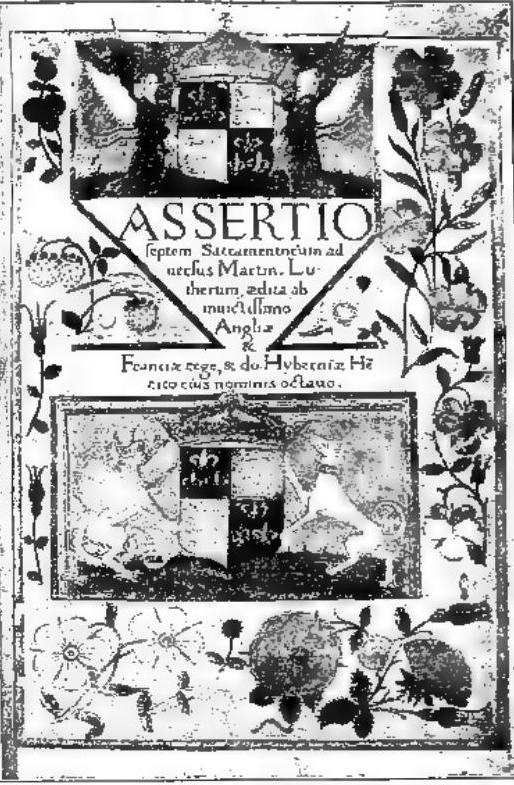
(courtesy of Mons. A. P. Frutaci)
ENRICO VIII, RE D'INGHILTERRA — Title page of the Assertio septem Sacramentorum by E. VIII d'I. — Vatican Library, cod. Vat. lat. 3731.
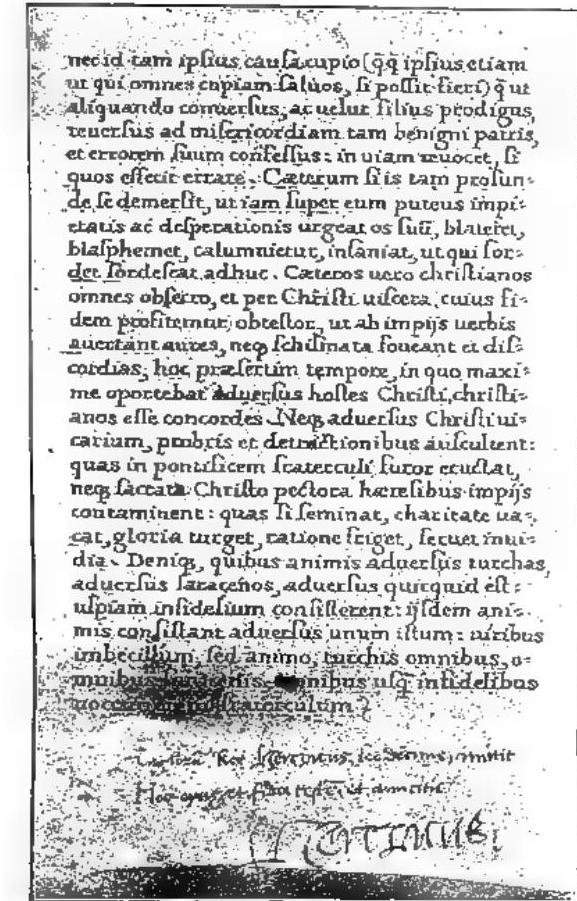
(Int. Sennini)
ENRICO VIII. RE D'INGHILTERRA — Explicit of the Astoria septem Sacramentorum of E. VIII d'I. with autograph signature. Vatican Library, cod. Vat. Ist. 3731.
There was some popular resistance in the counties of York and Lincoln, drowned in blood with the assistance of the southern counties and the capital, London, where the King’s anticlerical and anti-Roman policy enjoyed the greatest favor. Neither Parliament nor the docile secular clergy had difficulty sanctioning the King’s marriage to his second wife, Anna Bolena, legitimizing her daughter, the future queen Elisabetta, as heir to the throne (1534), and approving the Act of Supremacy, which defined as treason the denial of the King’s ecclesiastical supremacy. In July 1533 Clemente VII excommunicated the former fidei defensor. Minister of himself after Wolsey’s disgrace, he placed a certain confidence in Thomas Cromwell, but then had him executed in 1540; only Thomas Cranmer, whom he appointed archbishop of Canterbury, retained his confidence until his death.
But as the years advanced, the King, increasingly despotic, suspicious, selfish, and darkly cynical, spread death among those closest to him: such was the fate of the second and fifth of his six successive wives (Anna Bolena, 1536, and Caterina Howard, 1542); the third, Jane Seymour, who finally gave him a male heir (Edward VI), escaped, dying a natural death; the fourth, Anna di Clèves, escaped because he repudiated her; and the last, Caterina Parr, escaped because she knew how to deal with that man and, above all, had the good fortune to see him die before her. In the same way as he was tyrannical in his private life, he was intolerant in public life: although he had broken the centuries-old ties between the English people and the Church of Rome, and in this action had in fact found himself cooperating with the Lutherans and other Protestant movements, he was nevertheless entirely unwilling to tolerate Protestants in his kingdom. He persecuted them no less than the Catholics who did not accept the break with Rome; remaining, as regards dogma and canonical regulations, substantially Catholic—as the Six Articles Act demonstrates, imposing the Catholic doctrine of transubstantiation, Communion under one kind, and the celibacy of priests—he persecuted Protestants as heretics and Catholics loyal to Rome as rebels.