
BASILEA, DIOCESE of — In Switzerland; comprises the cantons of Aargau, B. city and countryside, Bern, Lucerne, Schaffhausen, Solothurn, Thurgau and Zug. The bishop resides in Solothurn. Immediately subject to the Holy See, it has 600,000 Catholics out of a total population of 1,850,000, 446 parishes, 900 secular priests and 170 religious priests. The city’s coat of arms consists of a black crozier on a silver field and derives from the ancient coat of arms of the ecclesiastical principality (red crozier on a silver field). Patrons: ss. Ursus and Victor, martyrs of the Theban Legion.
B. originated from an agglomeration formed in the territory of the Rauraci around a fortress erected by Valentinian I and designated from 347 by the name Basilia. The time of the Christianization of the place is unknown, but the first historically attested bishop is Justinian episcopus Rauricorum (346), who must have had his see in Augusta, situated approximately 10 km south of present-day B. A document from 620 subsequently mentions Ragnachar, episcopus Augu-
stanae et Basiliae (c. 620–50); this title shows that the episcopal see had already been transferred to B. Adalbero II (999–1021) received from Rudolf III of Burgundy the abbey of Moutin Grandval and the possessions dependent upon it, which formed the nucleus of the ecclesiastical principality. It reached its greatest extent in the 15th century, comprising, in addition to the lordship of B., the Bernese Jura and parts of Alsace, and lasted until the beginning of the 19th century. The Investiture Controversy had a strong impact on the diocese of B.: Bishop Burcard (1072–1107) took the side of Henry IV and was excommunicated by the Council of Quedlinburg (1085). During the Great Schism, which Constance (v.), the bishops took the side of Urban VI. The Reformation entered the diocese through the preaching of Johannes Oecolampadius (1482–1532), who, together with Erasmus of Rotterdam, had been called by Bishop Christoph of Uttenheim (1502–1527) to teach at the university. It rapidly gained ground, to such an extent that Bishop Philip of Gundelsheim (1527–33) was forced to withdraw to his castle at Porrentruy. The chapter fled to Freiburg im Breisgau, and Catholic worship was prohibited (1538). Many territories of the diocese embraced the new ideas, and only Bishop Johann Christoph Blarer von Wartensee (1575–1608) succeeded in recovering part of the rights that had been lost, as well as bringing the Lauffen Valley back to the Catholic faith. The principality suffered greatly during the Thirty Years’ War, and at the time of the French Revolution it was established as the Rauracian Republic, which was later annexed to France, becoming the so-called Department of Mont-Terrible. At that point Bishop Joseph Sigismund von Roggenbach (1782–94) left Porrentruy (1792) and took refuge in Biel. With the union of the department with the diocese of Strasbourg, effected by virtue of the Concordat of 1802, the episcopal principality of B. practically ceased to exist. The Treaty of Vienna (1815) subsequently assigned the Swiss portions to the cantons of Bern and B. The concordat between the Holy See and the cantons of Lucerne, Bern, Solothurn, Zug, Aargau and Thurgau (1828), and the bull Inter praecipua of 7 May 1828 by Leo XII, united most of the Swiss territory belonging to the diocese of Constance with the diocese of B., approximately within its present boundaries. Following the Baden Articles, a new conflict arose between ecclesiastical and temporal authority, which intensified (the expulsion of religious from convents and the Kulturkampf) after the First Vatican Council (1870). In 1883 a new agreement brought the dispute to an end. The bull Ad universam catholicam Ecclesiam of 7 September 1888 established Ticino as an autonomous diocese and united it with that of B., whose bishop consequently assumed the title, which he still bears today, of bishop of B. and Lugano.
Among the cultural institutions, mention should be made of the University founded by Pius II (1459) and reorganized between 1815 and 1818. The most important library is the University Library, containing 420,000 volumes, 240,000 pamphlets, 2,800 incunabula and 542 manuscripts.
COUNCIL of B. — According to what had been prescribed by the Council of Pavia–Siena, which concluded on 7 March 1424, the new council was to convene at Basel in 1431. It was to be presided over by Cardinal Giuliano Cesarini, who was serving as legate in Germany for the struggle against the Hussites. The council held its first solemn session on 14 December 1431; but Pope Eugenius IV, recently elected, fearing that it might degenerate into rebellion against the Holy See, and wishing to promote union with the East from Italy, dissolved it on 18 December. At its second session (15 February 1432), however, the council protested that, deriving its authority directly from Christ, it had the right to bind the Pope himself to its decisions and that therefore it could not be transferred or suspended by anyone.
This principle, repeated several times thereafter, formed the basis of its later claims; meanwhile, it continued its work with the support of Emperor Sigismund and the general approval of public opinion. In order to avoid a schism, the Pope, after much hesitation, recognized the legitimacy of the council by a bull on 15 December 1433, granting it the authority to eradicate heresies, pacify Christendom and reform the Church. The council, however, arbitrarily enlarging its powers and continuing to proclaim itself directly invested by the Holy Spirit, not only sought to limit the authority of the papal legates, but also to replace the Pope in the government of the Church, to restrict the financial resources of the Holy See, to establish its own curia for administrative affairs and to judge the most difficult matters, such as those concerning the return to the unity of the
The latter, meanwhile, dominated by a majority in which the bishops had very little part and guided by Cardinal Luigi Alleman, resorted to unheard-of acts of violence: it began a direct offensive against Eugenio IV, and on 31 July 1437 had the audacity to order the Pope and the cardinals to appear in Basel within 60 days; on 1 October it went so far as to proclaim Eugenio IV contumacious.
Meanwhile, in a bull of 18 September, he denounced the turbulent methods of its proceedings, the inability to bring the negotiations with the Greeks to a conclusion, and therefore transferred the Council itself from B. to Ferrara. The most authoritative figures who, like Cardinal Cesarini, had vainly hoped to keep the Council on a path of discipline and decorum, left B. While Eugenio IV first presided at Ferrara and then soon afterward at Florence over his Council, at B. the revolt broke out openly, with the definition “as an article of faith” that the Pope cannot transfer a council (15 March 1438); a few days later the Council pronounced a suspension against Eugenio IV; but only on 25 July 1439 did it dare to vote for the solemn deposition of Eugenio IV, and on 5 December to elect as the new pontiff Amedeo IV, Duke of Savoy, still a layman, under the name of Felice V.
After having himself consecrated, he was crowned at B. on 24 July 1440. Thus the schism that had subsided twenty-two years earlier reopened; it nevertheless had a very limited and conditional following: France and Germany declared themselves neutral in the dispute, while Italy almost entirely stood with Eugenio IV; despite this, the Council continued at Basel until, on 16 May 1443, in its 45th session, it decided to transfer to Lausanne, where Felice V resided, with the intention of opening a new council at Lyon after three years.
Thus ended a council which, for the period 1433–37, must be regarded as ecumenical, but which in reality, instead of benefiting Christianity, had done nothing but rekindle dormant disputes and keep alive those antagonisms that were to reawaken with greater force in the Protestant Reformation.
Monumental remains from before the Romanesque period are scarce; apart from reliefs, Roman inscriptions, etc. (in the Historical Museum), they consist essentially of the foundations of the Castrum of the Roman city; it is supposed that the first cathedral was erected on the site of the Roman temple. Even scarcer are the remains of Celtic and Gallic settlements, Alemannic tombs, and Frankish monuments. From the seventh and eighth centuries date the old Cathedral of S. Maria, the baptistery of S. Giovanni, and, among others, the churches of S. Brandano, S. Albano (with remains of earlier chapels), and S. Oswaldo, saints whose cult was introduced by Irish missionaries in the seventh century.
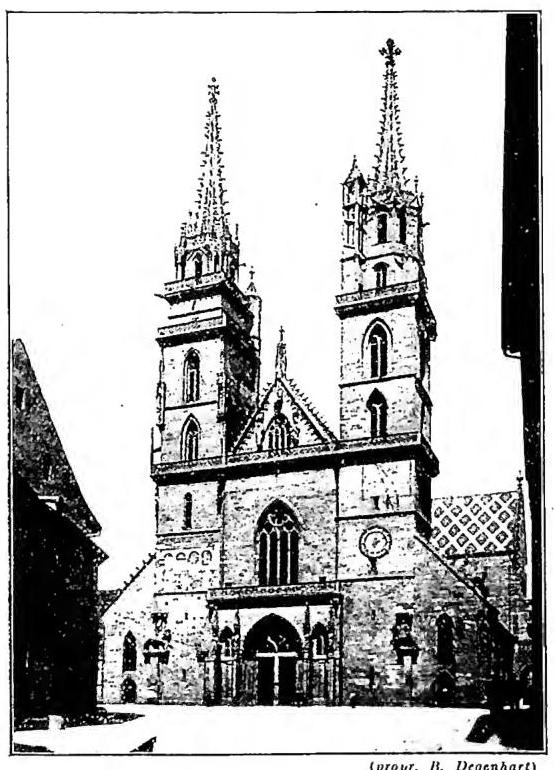
The present cathedral was consecrated in 1019. A large part of it dates from the twelfth century; restored and enlarged after the earthquake of 1356, it was completed in the fifteenth century with the finishing of its towers, one of which contains recognizable traces of the cathedral of Henry II. Its treasury was exceedingly rich; presented by this emperor to the church he had founded, it was dispersed only in 1856. It included the gold antependium now in the Cluny Museum in Paris, a cross-shaped reliquary transferred to the museums of Berlin, and other goldsmiths’ works divided among B., London, Leningrad, and New York. Famous for its sculptures is the Gate of S. Gallo (c. 1180), in the late Romanesque style; there are figures from the third quarter of the thirteenth century on the western façade; and the equestrian statue of S. Giorgio dates from 1374.
Among others, the following are buried in the cathedral: Queen Anna, wife of Rudolf of Habsburg, who died in 1289; Erasmus of Rotterdam; Oecolampadius; and Bernoulli.
Among the other churches still standing, the already mentioned S. Alban is particularly worthy of note (rebuilt by the Cluniacs in 1083 and later reconstructed in Gothic forms), of which the Romanesque cloister is preserved. In their present form, the churches of the Discalced (a Franciscan foundation, dating from around 1270, transformed into the Historical Museum), the Carthusians (fifteenth century), S. Chiara (a Franciscan foundation of the thirteenth century), S. Leonardo (consecrated in 1118), S. Martino (rebuilt at the end of the fourteenth century), S. Pietro (the same), the Dominicans (from 1260 onward, with a cloister), and S. Teodoro (fifteenth century) are essentially Gothic. With the Reformation, in 1523, and the transfer of the episcopal see in 1525, many frescoes of a religious character began to disappear.
Many streets and squares partly preserve a Gothic-Renaissance appearance; among the secular buildings, the Geltenzunfthaus (1578), the Spiesshof (1581), with Italian influences, and the town hall (late Gothic) stand out. The appearance of the city is
partly due to the course of the ancient walls, several fortified gates of which still exist (Spalentore, etc.), adorned with sculptures.
Two cycles of the Dance of Death are famous, although preserved only in copies: one from the convent of Klingenthal (end of the fourteenth century), the other from the Dominican church (mid-fifteenth century); some fragments are now in the Historical Museum. The painting of B. was brought to Witz (v.) (Basler Altar, c. 1440). In the fifteenth century, B. was celebrated for the art of painted stained glass, textiles, and the woodcut illustration of printed books: Dürer (v.) also left his first experiments with the burin in books produced by B. publishers. The painter and draftsman Urs Graf is characteristic of the city.
The activity of Ambrosius and Hans Holbein (v.) was of European importance; the latter came to B. in 1515. This is evident in the frescoes executed for the town hall in 1521 and following years (some remains are preserved in the museum), in the painted organ shutters of the cathedral, in the altarpieces, and in the portraits. For later periods, it will suffice to recall that the city gave birth to M. Merian, the great engraver of views of European cities (1593), the historian and art historian J. Burckhardt (1818), and the painter A. Boecklin (1827). The principal works of art are gathered in the Gallery, the Historical Museum, and the Cabinet of Drawings.