
DÜRER, ALBRECHT. – German painter, woodcut artist, engraver, draughtsman, and art theorist; born in Nuremberg on 21 May 1471, died there on 6 April 1528. His father (Albrecht) was a goldsmith in Nuremberg; after studying in his father’s workshop, the son entered that of Michael Wolgemut, where he worked from 1486 to 1490, and then travelled through Upper Germany, Switzerland, and Alsace. Having returned to Nuremberg, he married Agnes Frey and in the same year (1494) undertook the “first journey to Italy” (Venice). The following year (1495) he was back in Nuremberg, where he thereafter always remained, working and interrupting this activity with two journeys that were highly important for his artistic formation and for the vast diffusion of his art: 1505–1507, the “second journey to Italy”; 1520–22, the “journey to the Netherlands.”
D. is the most famous and the greatest German artist: under the influence of Italian models, his art leads from the late Gothic to the Renaissance; on the other hand, through his engravings, German artistic elements and his original compositions were disseminated throughout the world of his time.
His earliest works still reflect the late Gothic taste of fifteenth-century Nuremberg painting. The series begins brilliantly with the famous self-portrait of himself at thirteen (drawing in the Albertina, Vienna), followed by the youthful portraits of his father (Uffizi, Florence; and London, 1490 and 1497), the self-portraits of 1492–93 (painting in the Louvre, drawings in Lviv and Erlangen), and the drawing of his fiancée Agnes (c. 1495). The woodcuts for books by Basel publishers (1491–92) precede the 15 woodcuts of the Apocalypse (1497–98). Although he had already been subject in Nuremberg and subsequently in Venice to Italian Renaissance influences—especially those of Mantegna and Pollaiuolo, also through engravings, and later of Jacopo de’ Barbari—these are apparent in the portrait of Friedrich der Weise of Saxony (1496, Berlin) and in the triptych of the Madonna for the same prince (Dresden, now in Russia?). In the Apocalypse series, D. returns to his most characteristic and fantastic mode of expression, accepting only a few Italian elements. In the following years he finds a balance between Renaissance symmetry and monumentality and the expressiveness of the northern Gothic, transmitted to him especially also through the engravings of Schongauerl. Typical examples are, among the woodcuts, from 1496 onward, the Great Passion (which continues until 1510–11) and the series of the Life of Mary; among the paintings, the Self-Portrait of 1500 (Munich; following that of 1498 in Madrid), the triptych of the Baumgartner family (1503–1504, Munich), and the Adoration of the Magi (Florence, Uffizi, 1504); among the engravings, St Eustace, Nemesis, The Birth of Jesus (1504), and Adam and Eve (1504).
Having returned to Venice, he painted as an altarpiece for the Fondaco dei Tedeschi the Madonna of the Rosary (1506, Prague) and the delicately rendered Portrait of a Venetian Woman (Vienna, 1505); and, consequently closer than ever to the Venetian Renaissance and even to the great compositions of central Italy (Raphael and Leonardo), Christ among the Doctors (formerly Barberini, Rome), the Adam and Eve of 1507 (Madrid, copies in Florence), the Martyrdom of the 10,000 (1508, Vienna), the Trinity in the Clouds (1511, Vienna), and others.
The Heller Altarpiece for Frankfurt was destroyed (1509). There followed the series of his more mature period, the Little Passion (37 woodcuts, 1511), the Kupferstichpassion (16 engravings from 1513), and other masterpieces of the burin, such as St Jerome, Melancholia, The Knight, and Death and the Devil (1513–14). In the same years he produced major works for Emperor Maximilian I: the 92 engraved sheets of the emperor’s Triumphal Arch, a kind of triumphal arch with allegorical figures, etc.; the drawings for his Triumphzug (a kind of allegorical procession rendered in woodcut); and more than 40 drawings in the margins of the emperor’s Gebetbuch. At the Reichstag of Augsburg in 1518 he portrayed the emperor (drawing, Vienna), and subsequently produced the painted portraits in Nuremberg and Vienna, as well as the woodcut. During these decades D.’s most mature painted and engraved portraits came into being: Wolgemut (Nuremberg, 1516), the portraits made in Antwerp (1521: formerly Dresden, Boston, Gardner collection, Madrid), Hieronymus Holzschuher and Jacob Muffel (Berlin, 1526), as well as the Madonna with the Apple (Uffizi, 1526), all paintings; Pirkheimer, Friedrich der Weise (1524), Melanchthon (1526), and Erasmus (1526), engravings. As a theorist he propagated Renaissance ideas without in the least losing his own artistic personality; in this way he had a spiritual connection with Leonardo, a personal one with the Venetians (Bellini), and exchanged drawings with Raphael. He wrote a Unterweisung der Messung mit Zirkel und Richtscheit (Instruction in Measurement with Compass and Rule, published in 1525), a book on the art of fortification (1527), and Four Books on Human Proportion, unfinished. A kind of artistic testament are the two panels known as the Four Apostles (Giovanni, Pietro, Paolo, and the evangelist Marco), which he himself dedicated to the city of Nuremberg (1526). – Vedi tavv. CXXVII-CXXVIII.
(photograph by Colcografia italiana)
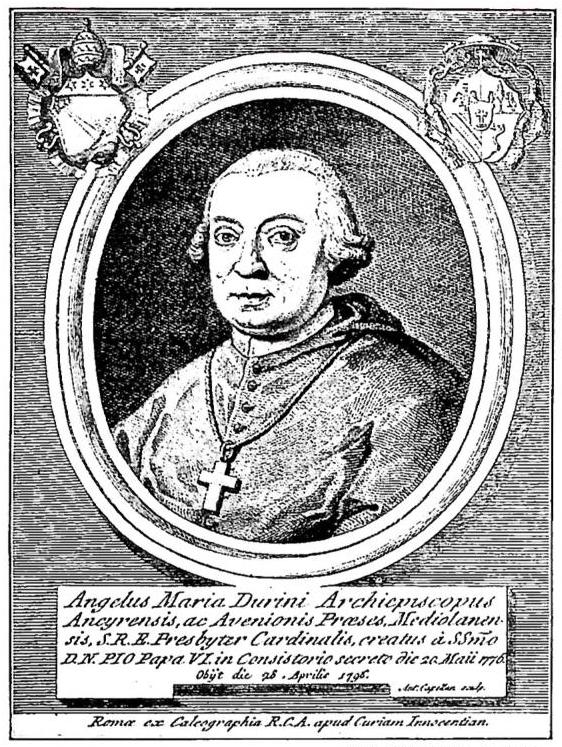
DURINI, ANGELO MARIA — Portrait engraved on copper by A. Capellan (late eighteenth century) — Rome.
in Repertorium f. Kev., 41 (1919), pp. 1–34; M. I. Friedlsender, D., Leipzig 1921; H. Woelflin, D., 3rd ed., Munich 1926; Klassiker der Kunst, edited by F. Winkler, 4th ed., Stuttgart 1928; E. Flechsig, D., Berlin 1928; H. Tietze, D. Kritisches Verzeichnis, Augsburg-Basel 1928–38; W. Wietzold, D., Vienna 1935; H. Bodmer, D., Novara 1942; E. Panofsky, D., Princeton 1943, 3rd ed., there 1948. For the drawings: F. Lippmann and F. Winkler, 7 vols., Berlin 1883–1929; K. Giehlw, Kaiser Max' Gebetbuch, Vienna 1917; H. Woelflin, D.-Zeichnungen, Munich 1918; F. Winkler, Zeichnungen, 4 vols., Berlin 1936–39. For graphic art: C. Dodgson, D. (The Masters of engraving and etching), London 1926; id., D. sämtliche Holzschnitte, Munich 1935; W. Kurth, D.-Holzschnitte, Munich 1927; J. Meder, D. Katalog, Vienna 1932.
Writings by D.: K. Lange and F. Fuhse, D.'s schriftlicher Nachlass, Halle 1893; R. Bruck, Das Dresdner Shizzenbuch, Dresden 1905; D.'s schriftlicher Nachlass, edited by E. Heidrich, Berlin 1908; E. Panofsky, D.'s Kunsttheorie, there 1915; W. Wietzold, D.'s Befestigungslehre, there 1919; J. Veth and S. Müller, D.'s Niederländische Reise, Berlin and Utrecht