EUSTACHIO and companions, saints, martyrs. - Of Εὐστάθιος Πλακίδας (Eustathius, Placidus, Eustasius), Theopista, his wife, and Theopistus and Agapius, his sons, no reliable historical information has been preserved. They cannot be localized in any way; if their historicity is admitted, one would have to think of martyrs of Eastern origin. That the scene of E.'s miraculous conversion took place on the high cliff (1,200 m), where the sanctuary of S. Maria in Vulturella, also called Mentorella, stands above Ciciliano (Tivoli), is a late-medieval legend that does not deserve credence.
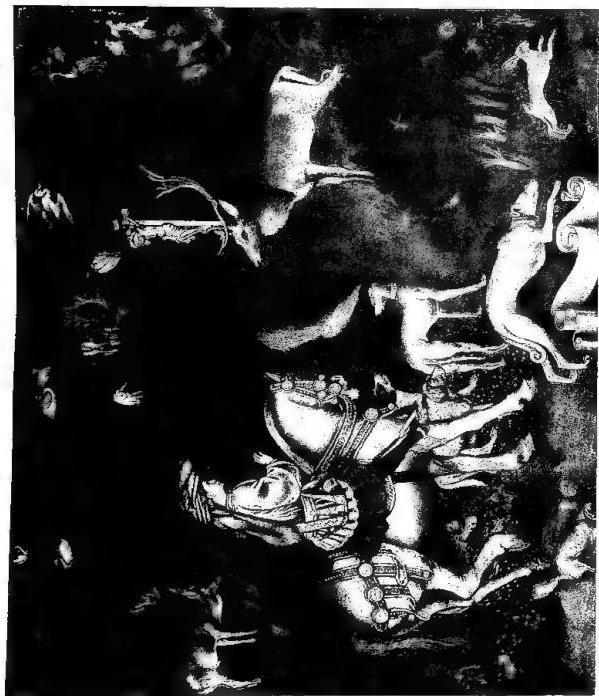
The hagiographic texts concerning them, in Greek, in Latin, in Armenian, in Syriac and in the vernacular (BHG, 641-43; BHL, 2760-71; supplementum, p. 116; BHO, 298-99; Monteverdi, II, pp. 27-101) are various recensions of a kind of romance of adventures, whose Greek-speaking author drew inspiration from tales of popular origin, some of which find parallels in Indian legends. The romance consists of three parts: the first comprises the conversion of the rich Roman general of the time of Trajan, Placidus or Placidas, and of his family. Placidas is converted after a vision had during a hunting party he sees between the antlers of a stag, which has taken refuge on a high rock, a luminous cross with the image of Christ, who speaks to him through the animal. At Baptism he takes the name Eustathius, later become E. The second recounts the ruin of his fortune and of his family and the adventurous vicissitudes of which the individual members of it are the object, who end by finding one another again, while E.,
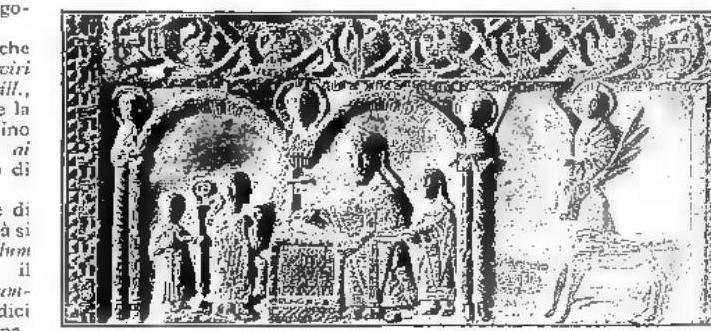
EUSTACHIO and companions, saints, martyrs. - The stag with Christ between its antlers appeared, according to the legend, to St. E. Wooden altar panel. Work of Magister Guilielmus (12th-13th cent.) - Tivoli, sanctuary of S. Maria in Vulturella.
having meanwhile been sought out by the Emperor, was conducting a campaign against the barbarians. The third is reserved for the martyrdom of E. and his family. E. refuses to follow the Emperor Hadrian, who intended to offer a sacrifice to Apollo in thanksgiving for the victory. The Emperor has E. and his family shut up in a red-hot bronze bull.
CULT
The veneration of E. comes alive in the late Middle Ages under the influence of the legend. The oldest attestation of it is the church erected in his honor at the beginning of the 8th century on the ruins of the Baths of Nero and Alexander, called the deaconry of S. Eustatii, basilica beati Eustatii Martyris (Lib. Pont., II, pp. 11, 75), to which was later added the appellation: in platana or iuxta templum Agrippae (cf. Ch. Huelsen, Le chiese di Roma nel medioevo, 1 June 1927, p. 251; R. Krautheimer, Corpus basilicarum Christianorum Romae, I, fasc. III, Vatican City 1940, p. 216; see also DIACONIA). In the ancient liturgical books, he appears on September 20 in only the pure Roman type of evangeliaries (Σ) of the mid-8th century (cf. Th. Klauser, Das römischen Capitulare Evangeliorum, Münster in W. 1935, p. 124; cf. also pp. 85, 181), while he remains unknown to the various types of Sacramentaries and to the Hieronymian Martyrology (with the exception of the Corbie codex of the 11th century, on November 1). The name of E. and of the members of his family appears in a litany of a private character contained in the Psalter of the monastery of Our Lady of Soissons, from the end of the 8th century (cf. M. Coens, Anciennes litanies des Saints, in Analecta Bollandiana, 62 [1944], pp. 133, 139). In the Martyrology of Usuard, he is registered on November 2 (cf. ed. by J.-B. Du Sollier, in Acta SS. Junii, VII, Venice 1756, pp. 644-45), the date on which he is commemorated in most missals (from the 11th century) and breviaries (from the 12th century) described by V. Leroquais (cf. Les sacramentaires et missels mss. des bibl. publ. de France, III, Paris 1924, p. 563 [index]; Les breviaires mss. des bibl. publ. de France, V, ibid. 1934 [index], on September 20 [8 breviaries], others on November 3, 4, 5, 9, some on May 20, one on September 16; cf. also A. Ebner, Iter Italicum, Freiburg in Br. 1896 [index]). In the Synaxaria the feast of E. and his companions is placed on September 20, and at Constantinople the synaxis took place in their church on Monday (Synax. Constantinop., col. 61); on the same date he is commemorated in the marble Calendar of Naples (cf. ed. D. Mallardo, Rome 1947, p. 155) and in today's Roman liturgical books, in which the date of September 20 prevailed only with the 16th century. He appears among the Holy Helpers (v.); in Paris there exists a magnificent church of the 16th century, already known in the 13th century; he is the protector of hunters and gamekeepers.