
DU SOLLIER, JEAN-BAPTISTE. – Bollandist hagiographer, born at Herseaux (Flanders) on 28 February 1669, died at Antwerp on 27 June 1740. He entered the novitiate of the Society of Jesus at Mechelen on 27 September 1687; he studied theology in Rome from 1697 to 1701. Ordained a priest on 27 September 1700, he was called to the Museum Bollandianum on 7 March 1702, where he worked tirelessly on the compilation of the Acta SS. until 1736, while never neglecting his apostolic work. In practice, he bore the burden of the colossal undertaking from
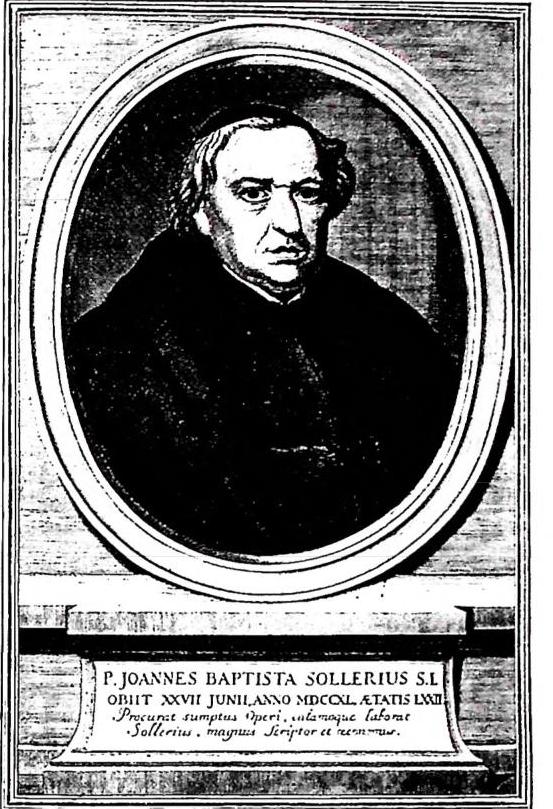
Of quick and penetrating intelligence, he distinguished himself through his balanced judgment and methodical way of life, of which a precious document was found after his death in the personal register of his correspondence, comprising no fewer than 12,000 entries. As a hagiographer, he followed the approach established by his teacher, Fr. Daniele Papebroch. He tackled and solved the problem of accelerating the complicated printing of the Acta SS. and introduced a new internal organization to the college of hagiographers.
The finest part of his scholarly production appears in the Acta SS., specifically from vol. V of June (Antwerp 1709) to vol. III of August (ibid. 1737). The commentaries he devoted to the lives of the Saints contained in the 7 volumes of July and the first 3 of August number in the hundreds (for example, in vol. I of July, 50 commentaries are his; in II, 80; in I of August, 25; in III, 30, etc.); he often reserved for himself the treatment of the most thorny and unpleasant problems, which exposed him to lively polemical attacks.
The following deserve particular mention: the Tractatus praeliminaris de Patriarchis Alexandrinis cum appendice, de initiis, erroribus, institutis copto-lacobiticis (in Acta SS. Iunii, V, Antwerp 1707, pp. 1-XX, 1-160), a chronological essay highly esteemed for its time, previously attempted by Papebroch; the Acta b. Raymundi Lulli (ibid., pp. 633-736), with an essay on the Saint’s works and doctrine; the *Martyrologium Uruardi monachi, hac nova editione ad excusa exemplaria quatuordecim, ad codices mss. integros decem et septem, atque ad alios ferme quinquaginta collatum, ab additamentis expurgantum, castigatum et quotidianis ob-
servationibus illustratum (in Acta SS. Iunii, VI and VII, ibid. 1715 and 1717; published separately, ibid. 1714, pp. lxvi-820). This is a careful edition based on 67 manuscripts and 14 printed editions, preceded by a long and learned introduction and accompanied by a commentary rich in erudition.
Although the study by dom H. Quentin (Les martyrologes historiques du Moyen âge, Paris 1908, pp. 7-10: note on D. S.’s edition) has by now clarified the problems relating to the medieval historical martyrologies, D. S.’s Martyrologium Usuardi still remains a model of its kind and an inexhaustible source of hagiographical information. The edition of the Martyrologium displeased the acerbic Benedictine dom J. Bouillart, but D. S. knew how tactfully to bring the useless controversy to an end. He had another controversy with the Dominicans for having denied that St. Dominic descended from the Guzman family, and concerning Bl. Bartolomeo of Braganza.
D. S.’s minor works are listed in Sommervogel (VII, cols. 1371-77).