
DIACONIA. — An institution of charitable assistance, well known in both the East and the West from the 4th to the 9th century; in Rome, the churches attached to the d. later became, in the Late Middle Ages, parishes and cardinalitial d.
SUMMARY:
I. Etymological and historical meaning of the word
II. Origin and development of the d. as an institution of assistance: Egypt, Palestine, Constantinople, Italy. — III. Transformation of the d. in Rome.I. ETYMOLOGICAL AND HISTORICAL MEANING OF THE WORD
From the classical διώχονος, διώχονεῖν, servant, to serve, in New Testament and Christian Greek it subsequently came to mean: a) almsgiving, charitable work (Act. 6, 1; 11, 29; II Cor. 8, 4; 9, 1. 12. 13; Acta Pauli et Theclae, 41; Didascalia Apost., III, VIII, 2; X [XIII], 6; IV, VII, 1; Cassiano, Collatio XVIII, VII, 8; hence διώχονεῖν, to place oneself at the service of the needy: Rom. 15, 25; I Cor. 16, 15); b) the totality of works of assistance (Erma, Pastor, similit. I, 9; IX, 26, 2; 27, 2); c) the order of the diaconate (Didascalia, III, XIII [XIX], 2; Constitutiones Ap., VIII, X, 9; XIII, 4; XVIII, 2-3); d) the office of the deaconess (ibid., XIX, 2; Giustiniano, Novellae, VI, 6); e) any monastic office to which a monk was appointed annually by the igumen or abbot or by the elders (Cirillo di Scitopoli, Vita s. Johannis, 6, 7, in Acta SS. Mali, III, Venezia 1738, p. 780), whence the word διώχονητῆς, meaning a servant of a monastery (Apophthegmata Patrum: PG 65, 100, 104, 393; Giovanni Mosco, Pratum, 138: PG 87, 3, 3001), or simply a monk placed in charge of an office (Giovanni Mosco, Pratum, 16, 39, 92: PG 87, 3, 2864, 2889, 2949); f) finally, from the fourth century onward, a special institution of charitable assistance.Whereas the pre-Jerome versions and the Vulgate translate διώχονία with the word « ministerium », without distinguishing its various meanings, Western authors from the fourth century onward generally limited themselves to transliterating it: « d. », with its derivative « diaconitae ». In the late Middle Ages at Rome, as at Naples, « diaconatus » was used instead of d. with the same meaning (cf. Ordo di Cencio Camerario, § 11 [end of the twelfth century], ed. L. Duchesne, in Le Liber Censum de l'Eglise romaine, I, Parigi 1889-1910, p. 293; Neapolitan inscription of 1084, cited by D. Mallardo, in Riv. di scienze e lettere, nuova serie, 8 [1937], p. 164).
II. ORIGIN AND DEVELOPMENT OF THE D. AS A WORK OF ASSISTANCE: EGYPT, PALESTINE, CONSTANTINOPLE, ITALY. - From the very origins of the Church, assistance to the poor was one of the principal duties of the Christian communities, to which the deacons attended as their proper office. This sustained assistance, often designated by the generic word d., took the most varied forms and had a character quite different from that of the State’s public distributions (frumentatio, panis gradilis, etc.: cf. G. Cardinali, Frumentatio, in Diz. ep. di antichità Romana di E. Ruggiero, III, pp. 225-315). In the second half of the fourth century, the generic term d. acquired a precise meaning and was used to designate a particular institution whose purpose was to distribute assistance in kind to the indigent.
1. Egypt
Cassiano was the first to specify its meaning, giving this name to the almonry of the Egyptian monastery of Diolcos, supplied by pious faithful and presided over by a virtuous monk elected by the elders (Collat., XXI, 1, 2-3; II, 1; VIII, 1; IX, 7). This monk, called in the Apophthegmata Patrum ὁ τῆς διακονίας, the person responsible for the d. (PG 65, 184, 237), would be called διακονητής in the papyri.On the basis of the evidence known until then, it was believed that d. had remained a purely monastic institution during its first centuries of existence. Unexpectedly, an Egyptian papyrus dating from approximately the fifth century, containing an interesting account of receipts for a d., revealed the existence of a diocesan d. in the district of Apollonopolites Heptahomias (cf. A. P. Frutaz, Una d. diocesana in Egitto, in Miscellanea liturgica in honorem L. C. Mohlberg, II, Roma 1950, pp. 71-74).
(from a watercolor by D. M. Crowfoot, in J. W. Crowfoot, Churches at Jerash, Londra 1931, fasc. IV, 6)
DIACONIA - Dedication inscription, found in the mosaic pavement of the atrium of the d. at Gérasa. In the center, verse 5 of Ps. 64, according to the Septuagint; in the circle, verses 1–3 of Ps. 85, according to the Septuagint, followed by the date, May 565.
They engage in commercial exchanges of oil and wine; they lease land; they have their own cells to provide lodging, even for men, when the monastery is under the strictest enclosure; they even receive certain grain contributions owed to the state annona, and collect fixed contributions in money or in kind. The various d. should not be regarded as peripheral branches of an institution with a centralized administration; rather, each d. lives and administers itself independently.
The direction of the d. is entrusted to a monk, when it is a monastic d., the διακονητής, assisted by other monks, διακονηταί, and sometimes also by pious laymen, such as that Flavius Dioscorus, curator “of the juridical person of the holy d.” of the monastery founded by Apa Apollo, in Aphrodite.
The Egyptian d. known to date are the following: the diocesan d. of the name Apollonopolites Heptahomias (ca. 5th century); the monastic d.: of Diolcos (mid-4th century); of Pharaus in the Thebaid (522); of the Metanoia near Canopus (527–30, 585; it receives the annona [ἐμβολή] of Aphrodite); of Psinabla, of the Oasites, of Apa Apollo, of St Michael the Archangel (reported by Bertolini), and of another monastery, all in Aphrodite, a pre-eminently monastic city (527–30, 552, 573–74, 585); the presbyteral d. of Thebes (8th century?), known through inscriptions engraved on pieces of liturgical silverware: ἐκ διακονίας Πραιποσίτου πρεσβυτέρου.

2. Palestine
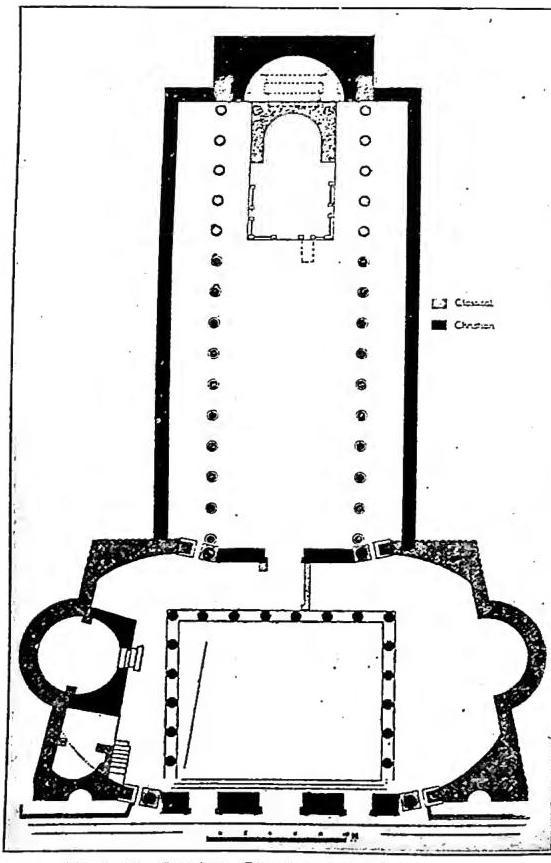
Outside Egypt, at Gérasa, excavations by the Anglo-American mission in the years 1928–30 (cf. J. W. Crowfoot, Churches at Jerash. A preliminary report of the joint Yale-British School expeditions to Jerash 1928-30, London 1931, pp. 13–16) brought to light a d. that occupied an ancient public building erected in A.D. 150. Its architectural equipment comprised: a church for the religious assistance of the indigent, an atrium for assembling them, various rooms for the offices of those assigned to the d., and storerooms. An inscription in the mosaic pavement of the atrium reveals its date: “By the grace of God, the d. was established in the month of Artemisius, indiction 13, in the year 627” of the Palestinian era, that is, in May 565.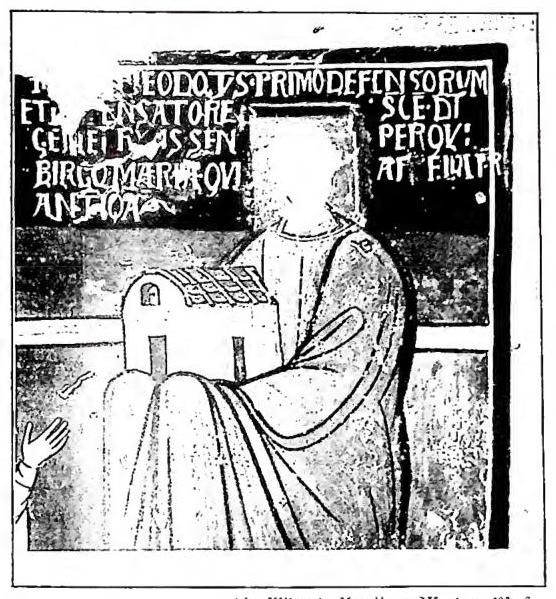
DIACONIA - Plan of the buildings of the d. of Gérasa, inaugurated in May 565; atrium with rooms for offices and storage, and a church, installed in the large propylaea located between the Main Cardo and the small bridge over the stream that crossed the city, built in A.D. 150. Drawing by C. S. Fisher—Palestine.
(du Wilpert, Monilien, IV, pl. 192, 5)
DIACONIA — Teodoto, primicerius defeniorum and dispensator of the d. of S. Maria Antiqua in the time of Pope Zaccaria (741–52), in the act of offering the chapel dedicated to the ss. Quirico and Giulietta, which he had had decorated. Fresco in the chapel of the same name. Rome, S. Maria Antiqua.
3. Constantinople
From one of the principal exponents of the Monophysite party in Constantinople, Giovanni of Ephesus, who wrote the third part of his Historia ecclesiastica in 581, we learn of the existence of several d. «viorum et mulierum» in the capital and in other cities of the Byzantine Empire, many of them established by the Monophysite patriarch of Antioch, Paolo, for the poor followers of his party. Of the Monophysite d. in Constantinople, one had been founded by the aforementioned Paolo and another by the cleric Cometa, attached to the church of S. Maria delle Blacherne. The former was directed by a certain Tallo, a prominent figure in the capital, who was assisted by clerics and monks. When the edict of Giustino II (571) against the Monophysites was rigorously enforced, Tallo was compelled to remove the clerics and monks from the d. and entrust its care exclusively to laymen. Upon Tallo’s death in 577, the direction of the d. was given to the money-changer Romano. The other d. had been established by Cometa in a house inherited for this purpose; here too a kind of community had formed, which was dispersed in 571 when its Monophysite founder was exiled. Nevertheless, the surviving friends continued it at another location (cf. Giovanni of Ephesus, Historia eccl., III, II, 15–16, version by E. W. Brooks, in Corpus Script. Christ. Orientalium. Scriptores Syri, 3rd series, III, Louvain 1936, pp. 55–56; V. also Michele Siro, Chronique, X, 7, French trans. by J.-B. Chabot, III, Paris 1906, pp. 305–306). These were evidently d. of private origin, a kind of hospices, in which «omne ministerium pauperum perficiebatur», with particular care for the poor sick abandoned in the streets, who were, among other things, «washed».4. Italy (Pesaro, Naples, Rome)
In the West, the oldest d. is that of Pesaro, which appears as a juridical entity on the model of the Egyptian d., capable of carrying out commercial transactions. Its existence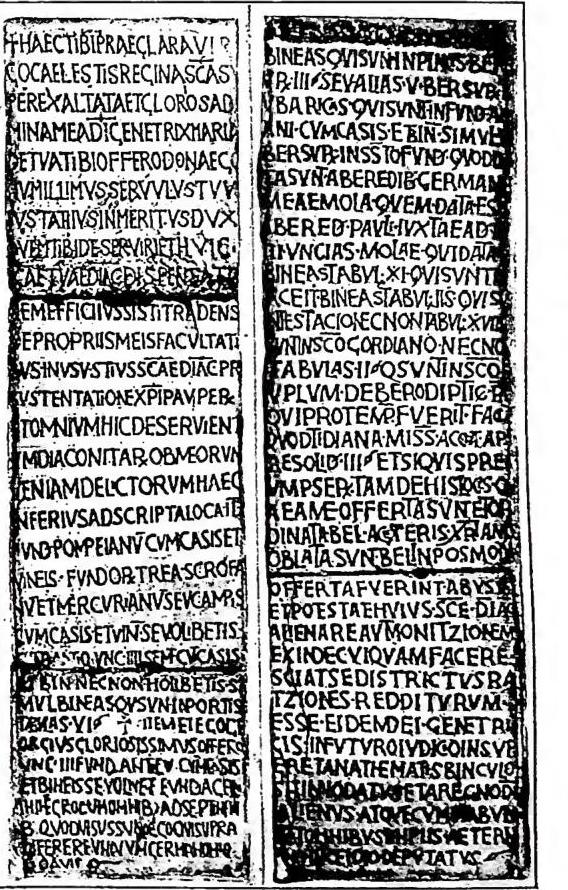
(from A. Sitrayni, Monumenta epigraphica Christ., 7. Vatican City 1915, pl. 27, 1–3)
DIACONIA - Donation made to the diaconia of S. Maria in Cosmedin “pro sustentatione Christi pauperum” by Duke Eustazio, during the pontificate of Stefano II (752–57). Original marble. Rome, Basilica of S. Maria in Cosmedin.
The testimony of Giovanni Diacono, who was writing between 873 and 875, cannot be adduced, since in his Vita of s. Gregorio (II, 24, 51: PL 75, 97, 109) he seems to depend simply on the third letter mentioned above, whose text he gives, rather than on the great paper register in which the Pontiff kept a record of his benefactions, and which still existed in his time. In Rome and Naples, no testimony speaks with certainty of diaconiae as charitable institutions in their own right before the second half of the 7th century. It is evident that their institution was due to Eastern influences.
In Naples, the first genuine diaconia was that of S. Gennaro, attached to the basilica of the same name “intus civitatem,” founded by Bishop Agnello (c. 675–96), who assigned the diaconia an adequate annual endowment of wheat and wine from the revenues of the episcopal table; at Christmas and Easter the diaconia also received one thousand silique of soap “pro labandis curis,” that is, for bathing the poor. The diaconia also possessed a certain number of cells to house the “fratres Christi,” that is, the poor (cf. Gesta Episcoporum Neapolit., 31, ed. G. Waitz, in MGH, Scriptores rerum Langobardicarum, Hannover 1878, p. 418). From the first half of the 8th century there is information about the diaconia of S. Andrea ad Nidum (the text of the epitaph of a certain Teodimo, regional subdeacon and rector of the Holy See, dispensator [administrator] of the diaconia) and of the diaconia of SS. Giovanni e Paolo (the original marble of the epitaph of the consul and duke Teodoro, founder of the church and restorer of the diaconia attached to it).
One should probably recognize a diaconia in the monastery of SS. Cirico e Giulitta, founded by Duke Antimo (801–18): “in quo duodecim statuit cellulas, quas hospitibus peregrinisque censuit habiteri, qui ex ipsius ecclesiae alerentur rebus” (Gesta Ep. Neap., 50, ed. cit., p. 428; D. Mallardo, in Riv. di storia della Chiesa in Italia, 2 [1948], p. 335). Of three other diaconiae, there is only very late information: those of S. Giorgio ad Forum (recorded on 30 March 936), S. Pietro (25 June 941), and S. Maria in Cosmedin (19 May 1018). There is no explicit information about the diaconia of S. Maria Rotonda (cf. B. Capasso, Pianta della città di Napoli nel sec. XI, in Archivio storico per le province napoletane, 17 [1892], pp. 475–84). It should be noted that all the churches with diaconiae stood in the center of the city, between the episcopal residence and the duke’s residence, that is, in the most densely populated area. The Neapolitan diaconiae independently provided for ordinary charitable distributions and, following the example of those in Constantinople, for the hygiene and shelter of the poor. They were juridical entities, as in Egypt, capable of owning property and receiving donations both from the clergy and from the laity. They arose beside churches in order to facilitate religious assistance, and enjoyed the confidence of the greatest benefactors. Some of them later became hospitals in the late Middle Ages, such as those of S. Gennaro, S. Andrea, and S. Giorgio.
(from A. Silvagni, Monumenta epigraphica Christi, 1, Città del Vaticano III, Inv. XIV, 3)
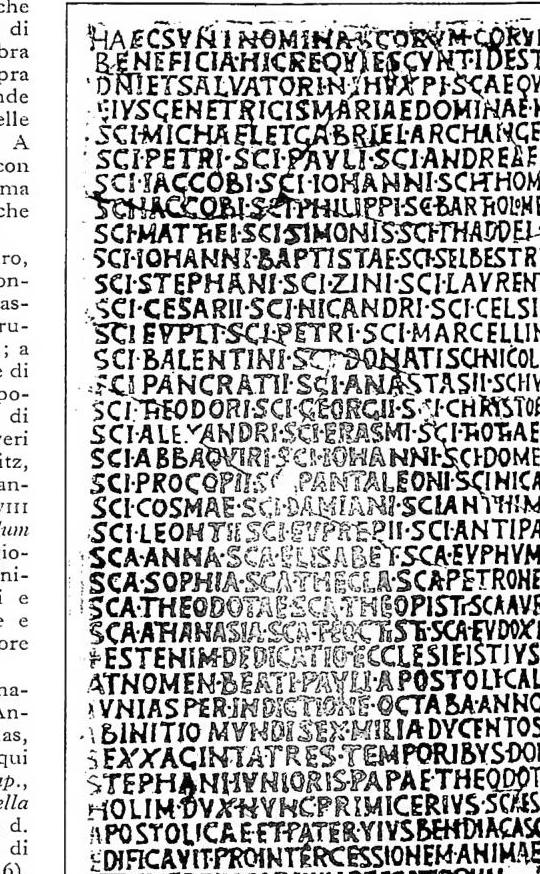
DIACONIA - Inscription commemorating the dedication of the church of S. Paolo, today S. Angelo in Pescheria, founded by the former duke Teodoro, primicerius Sanctae Sedis Apostolicae and Pater of the homonymous d. (1 June 725). Original marble - Rome, church of S. Angelo in Pescheria.
Further on. As in Naples, they arose in large numbers in the central part of the city, where the population had become concentrated at that time; generally, they were installed beside churches or oratories built up against them, or even in disused ancient public buildings, so as to make use, at little expense, of premises already completely prepared for warehouses and offices. The churches or oratories were necessary to ensure a certain regularity in the religious assistance provided to the beneficiaries. The documentary evidence as a whole shows: a) that the Roman d. had nothing to do with the assistance work carried out in Rome by the seven regionary deacons created by Pope Fabian; b) that their origin had no connection with the Byzantine military division of the city into 12 «scholae militiae»; c) that, autonomous in their administration, they remained active until, after the ninth century, they were replaced by other forms of charitable assistance more suited to the times and to the tastes of the faithful; d) that the adjoining places of worship continued to preserve their memory through the designation of cardinal deaconry churches.
In addition to religious and charitable assistance for the needy class of the Urbs (something quite distinct from cura annonae), the Roman d. were also charged with administering hospitals (cf. Lib. Pont., I, p. 441) and provided for the bodily hygiene of the poor by means of a weekly bath (on Thursdays), called in the sources, with a Greek word, Iusma (ἀνδάμωα): the poor went there in procession, chanting psalms (cf. Liber Diurnus, formula 95, ed. Th. E. von Sickel, Vienna 1889, p. 124, which must be interpreted in conjunction with the parallel notice in Lib. Pont., I, pp. 506, 510).
The administrative personnel of the individual Roman d. included: the Pater diaconiae (cf. Ordo Romanus, I, no. 26, ed. M. Andrieu, Louvain 1948, p. 75, and below the inscription of Teodoto), with functions analogous to those proper to a pater familias; the dispensator, that is, the administrator; the diaconitae (cf. Liber Diurnus, formula 95), that is, the monks who were in direct contact with the poor for distributions and religious assistance; and the priest for the celebration of the divine offices. The diaconiti and the chaplain received remuneration from the revenues of the d., as is shown by the donation of Duke Eustazio (cf. below, no. 9). The fragmentary nature of the documentation does not permit us to go into further details concerning the administrative personnel of the individual d.; indeed, it is not even possible to indicate from which monasteries the diaconiti came.
In Rome too, as earlier in Egypt (one may recall Flavio Dioscoro, curator of the d. of Apa Apollo) and in Constantinople, laymen could be placed at the head of the d., such as Teodoto «ex duca Pater uius benereabilis diaconiae» (cf. below, no. 6), the «primicerio defensorum» Teodoto, «dispensatore Scè Dei Genitricis semperque virgo Maria qui appellatur Antiqua» (cf. below, no. 5), and Duke Eustazio, «sanctae tuae diaconiae dispensatorem» (cf. below, no. 9): the three inscriptions cited are found in A. Silvagni, Monumenta epigraphica Christiana. Roma, I, Città del Vaticano 1943, plates XIV, 3; XXXIV, 5; XXXVII, 4-5).
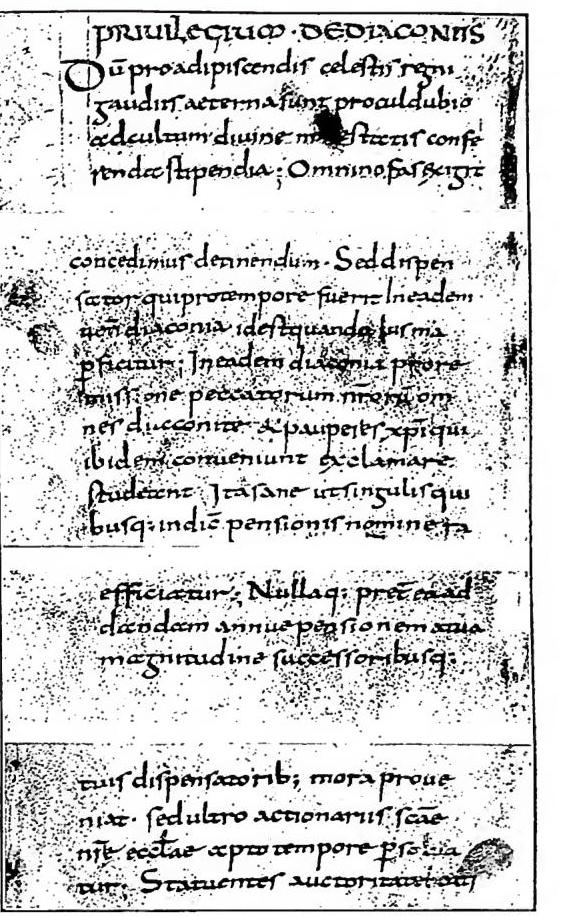
The Roman d. consistently preserved (from their beginnings, at the end of the seventh century, through their slow self-transformation after the ninth century) the specific character of public institutions of religious-social charitable assistance, and thus of juridical entities with all the associated legal prerogatives; various popes, the clergy, and the laity contributed to their operation through donations and provisions. The numerous notices in Lib. Pont. (late seventh–ninth century), the various formulas of Liber Diurnus (formulas 88, 95, 98 [this formula is intended to secure a d. founded by a bishop outside Rome], cited edition, pp. 115-17, 123-25, 129-31), and certain other documents of the eighth century provide evidence of the interest aroused by the d., which were intended to supply «fratribus nostris Christi pauperibus... alimonia», as we read in the «Privilegium de diaconiis» of Liber Diurnus (formula 95). From this it emerges that the Pope customarily granted the use of ecclesiastical landed property belonging to the Church of Rome to designated d., by means of an annual census to be paid by the dispensator of the d. to the actionarii of that Church, in order to acknowledge its title as proprietor.
The Eastern influence on the institution of the Roman d. is also reflected in the fact that they were often established near sanctuaries dedicated to Eastern saints, as will be seen from the list that follows. This list, arranged by pontificates up to the death of Leo III (816), has been compiled from information drawn from several documents of the period and from Lib. Pont. The asterisk
placed before certain names indicates that the d. is still cardinalitial.
BENEDICT II (684-85) leaves a donation «monasteris diaconiae», an expression that subsequently recurs in the biographies of John V (685-86), Conon (686-87), and Gregory II (715-731): Lib. Pont., I, pp. 364, 367, 369, 410.
GREGORY II (715-31):
1. *S. Eustachio: the Pope gives the d. land from the Labican and Tiburtine patrimonies: cf. P. Kehr, Italia Pontificia, I, Berlin 1906, p. 97.
A church founded shortly beforehand on the ruins of the Neronian-Alexandrian Baths. Regio Augustae IX.
GREGORY III (731-41):
2. SS. Sergio e Bacco near S. Pietro: the Pope enlarges the buildings of the d. and its small oratory: Lib. Pont., I, p. 420. No further trace of it is subsequently found.
3. *S. Maria Acryo (or in Ciro, in Aguiro): the Pope transforms the small oratory of the d. into a basilica and adorns it with paintings: Lib. Pont., I, p. 419. The Basilica seems to have been founded within the enclosure of the temple of Matidia. Regio Augustae IX.
ZACHARIAS (741-52):
4. *S. Giorgio in Velabra (ad Velum aureum): the Pope gives this d. the head of S. Giorgio: Lib. Pont., I, p. 434. The basilica of the seventh century seems to have replaced an ancient oratory dating from the end of the fifth or the beginning of the sixth century. Regio Augustae XI. Ecclesiastical region «secunda ad Velum aureum».
5. S. Maria Antiqua: Teodoto, «primicerio defensorum» and «dispensatore» of the d., has the chapel of SS. Quirico and Giulitta decorated there; Pope Zaccaria is depicted there with a square nimbus, indicating that he was still alive. The church, built between the fifth and sixth centuries, occupies the «atrium Minervae», where the discharge diplomas of the legionaries were kept; it was restored and decorated several times. Regio Augustae X. Leo IV (847-55), since it was in danger of collapse, transferred the d. to the church of S. Maria Nova (today S. Francesca Romana), which he built near the Via Sacra. Alexander VII, in the Consistory of 14 January 1664, transferred this cardinalitial d. to *S. Maria della Scala (cf. G. Novaes, Elementi della storia de' SS. Pontefici..., X, Rome 1822, p. 141).
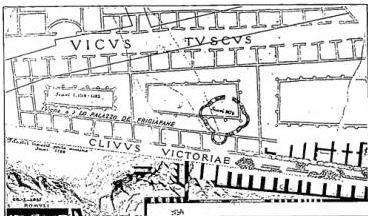
6. *S. Paolo Apostolo (S. Archangeli [806], then S. Angeli piscium venalium, de piscivendulis, in Foro piscium: S. Angelo in Pescheria): church and d. erected in the Portico of Octavia (1 June 755), as an inscription attests, by the primicerius Teodoto, «Pater uius benereabilis diaconiae», uncle of Pope Hadrian I. Regio Augustae IX. 7. S. Maria Foris porta (sic!) B. Petri or in caput portici.
8. S. Silvestro iuxta hospitale S. Silvestri: the Pope entrusts to these two suburban d. near S. Pietro the two xenodochia that he had erected in the vicinity of the same
Ida II, Lanciani, Forma Erbis Romac, Milan 1893-1963, fol. 39.
DIACONIA - Pianta degli Horrea Agrippiana con la chiesa della d. di S. Teodoro costruita nel secondo cortile dei predetti Horrea - Roma.
Lib. Pont., I, pp. 441, 506.
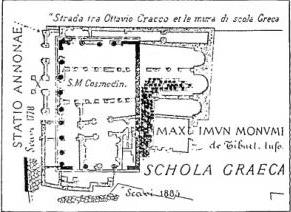
9. * S. Maria in Cosmedin: il duca Eustazio dona
beni fondiari alla d. di cui era « dispensator » come ri-
sulta da iscrizione originale. Era in principio una chiesetta
(sec. VI), costruita nella loggia dei mercanti (statio anno-
nae), trasformata in vera basilica da Adriano I: Lib.
Pont., I, p. 507. Regione Augustea XI.
ADRIANO I (772-95):
10. SS. Sergio e Bacco sub Capitolio: il Papa la rico-
struiace dopo che per l'imperizia del « dispensator » il
sovrastante tempio della Concordia si era abbattuto su
di essa: Lib. Pont., I, p. 512. La chiesa, oggi scomparsa,
si trovava tra i « rostra vetera », l'« umbilicus urbis » e
l'arco di Settimio Severo. Regione Augustea VIII.
11. * SS. Cosma e Damiano, d. eretta da papa Adriano:
Lib. Pont., I, p. 509; la Basilica, sorta dalla trasformazione
di un grande ambiente absidato profano, per opera di
papa Felice IV (526-30), fu restaurata da Adriano. Re-
gione Augustea IV.
12. S. Adriano, d. eretta da papa Adriano: Lib.
Pont., I, p. 509, presso la chiesa costruita da Onorio I
(625-38) nella « curia senatus » e restaurata da Adriano:
Lib. Pont., I, pp. 324, 508, 509. Regione Augustea VIII. La d. cardinalizia, a causa della distruzione della chiesa per
il restauro dell'antica Curia del Senato, è stata trasfe-
rita da Pio XII, il 25 genn. 1946, a S. Paolo Apostolo
alla Regola (cf. AAS, 39 [1947], pp. 54-55).
13. S. Maria quae ponitur in Adrianium (in Hadrianio,
o in Transpadina), d. eretta da Adriano nei pressi del
massoleo di Adriano: Lib. Pont., I, pp. 505-506.
LEONE III (795-816):
14. * S. Maria in Dominico, riceve dal Papa vari
donativi, in particolare nell'806: Lib. Pont., II, pp. 9,
14, 16, 19, 30; basilica costruita su ambienti della ca-
serma della V coorte dei Vigili; riedificata da Pasquale I
(817-20): Lib. Pont. II, p. 55. Regione Augustea II.
15. S. Lucia in Orphea (dopo il sec. X, in silice),
riceve donativi, come sopra: Lib. Pont., II, pp. 11, 21,
28; chiesa edificata da Onorio I nei pressi della fontana
monumentale « lacus orphei »: Lib. Pont., I, p. 324.
Regione Augustea III.
16. * S. Vito in Macello, riceve donativi, come sopra;
Lib. Pont., II, pp. 12, 21; chiesa edificata nelle immediate
vicinanze del « Macellum Liviae ». Regione Augustea V. Negli elenchi delle d. di Giovanni Diacono e Pietro Mallio
della seconda metà del sec. XII, la chiesa « S. Quirici » (SS.
Quirico e Giulitta) figura al posto di S. Vito (cf. ed. di R.
Valentini e G. Zucchetti, Cod. top. della città di Roma,
III, Roma 1946, pp. 361, 438). È difficile spiegare questa
sostituzione, che fu comunque temporanea.
17. S. Agata in Diaconia (o de Caballo oppure in
Equo Marmoreo), riceve donativi, come sopra: Lib.
Pont., II, pp. 12, 22, 28, 32; chiesa posta sul lato meri-
dionale dell'alta Semita, sito dell'odierno giardino pub-
blico del Quirinale. Regione Augustea VI. Questa d. non
va confusa con la basilica di * S. Agata de Subura, di-
ventata d. cardinalizia solo nella prima metà del sec. XVI,
epoca in cui la chiesa di « S. Agata in diaconia » era ca-
duta in rovina.
18. * S. Maria in via Lata, riceve donativi, come
sopra: Lib. Pont., II, pp. 12, 19; chiesa costruita su di un
« horreum »: antico oratorio con pitture della fine del
sec. V e principio del sec. VI (cf. E. Sjöqvist, cit. in
bibl.). Regione Augustea IX.
19. S. Teodoro, riceve donativi, come sopra: Lib.
Pont., II, pp. 12, 21; chiesa costruita nel secondo cortile
degli « horrea Agrippiana » (secc. VI-VII). Regione Augu-
stea X.
20. S. Lucia in Septem vica (o in Septem Solii), riceve
donativi, come sopra: Lib. Pont., II, pp. 11, 21; chiesa
costruita fra il « caput circi » (circo Massimo) e il Set-
tizonio. Regione Augustea X.
21. SS. Nereo e Achilleo, riceve donativi, come sopra:
Lib. Pont., II, pp. 9, 21, 33; chiesa titolare già nel sec. IV,
diventata d. (sec. VIII), poi nuovamente titolo presbite-
rale. Regione Augustea XII.
22. S. Bonifacio (dalla fine sec. X S. Alessio), riceve
(da R. Lucciani, Forma Cribis Romae, Milano 1833-1901, fol. 51)
DIACONIA — Plan of S. Maria in Cosmedin after the reconstruction by Hadrian I, with the remains of the underlying Roman monuments. The single nave of the little church of the diaconia occupied, transversely, part of the Merchants’ Loggia, that is, the Statio Annonae — Rome.
Donations, as above: Lib. Pont., II, pp. 9, 21; church built at the end of the sixth or beginning of the seventh century. Augustan Region XIII. These last two diaconiae were replaced, at an undetermined date, certainly before the beginning of the twelfth century, by S. Nicola in Carcere, which was subsequently entrusted with the care of prisoners, and by S. Maria in Porticu.
23. SS. Silvestro e Martino inxta Orphea, receives donations, as above: Lib. Pont., II, p. 22; this is the titular church of that name, temporarily made a diaconia. Augustan Region III.
24. S. Martino inxta B. Petrum (or de Cortina or de Porticu), receives donations, as above: Lib. Pont., II, p. 22; little church that disappeared when the Piazza S. Pietro was enlarged.
As can be seen, the golden age of the Roman diaconiae fell under the pontificates of Hadrian I and Leo III: at the death of the former there must have been 19; at that of the latter, 24, including those in the suburbs. The number of the urban ones, however, normally remained 18 from Hadrian I to Sixtus V. III. TRANSFORMATION OF THE D. IN ROME. — Throughout the tenth century and part of the eleventh, nothing more is known about the functioning of the Roman d.; only the names of certain persons who stood at the head of diaconal churches are known, such as the archpriest Giovanni, apparently of S. Giorgio in Velabro (cf. P. Batiffol, Inscriptions
byzantines de St-Georges au Vélabre, in Mélanges
d’arch. et d’hist., 7 [1887], pp. 426-29; A. Silvagni,
Monumenta epigraphica Christ. Roma, I, Città del
Vaticano 1943, tav. XXXIV, 4); Pope Giovanni XII
(955-64), formerly tituli (erroneously) S. Mariae qui vocatur in
Dominico, and Pope Benedetto VI (973-74), formerly dia-
coniae S. Theodori (cf. the list of the popes of the tenth
century drawn up in 989 and prefixed to the itinerary of
the archbishop Sigerico: Lib. Pont., II, p. XV and B. Pesci, L’itine-
rario romano di Sigerico arcio. di Canterbury e la
lista dei papi da lui portata in Inghilterra (a. 990), in
Riv. di archeol. crist., 13 [1936], pp. 49, 59).
populus sue parrochie concurrit ad ecclesiam » (cf.
the edition of L. Duchesne, in Le Liber Censuum, II, Paris 1905, p. 171). The archpriest could at times also be a cardinal, as in the case, between 1070 and 1081, of Pietro, chancellor and cardinal of the Holy Roman Church, prior atque rector, or rector ac auementator (= dispensator) of S. Maria « que holim vocabatur antiqua nunc autem nova » (cf. P. Fedele, Tabularium S. Mariae Novae, in Archivio della Soc. rom. di storia patria, 23 [1900], p. 224 ff.), and of Falco, cardinal of the Holy Apostolic See, rector et dispensator of the « venerabilis monasteri SS. Christi Martirum Cosme e Damiani quod nuncupatur Mica aurea » (cf. P. Fedele, Carte del monastero dei SS. Cosma e Damiano in Mica Aurea, ibid., 22 [1899], p. 412 ff.). Closely connected with this new character of theirs is also the fact, recorded in the Ordines of the twelfth century by Benedetto Canonico, Albino, and Cencio Camerario, that the clergy and people of the d., with their 18 standards (« exeunt XVIII imagines a diaconiis et cum clericis et populo veniunt ad sanctum Adrianum » [Benedetto], « deferuntur XVIII ymagines beate Marie ex XVIII diaconiis » [Albino]), took part in the solemn morning processions that proceeded toward S. Maria Maggiore for the celebration of the “station” of the Purification, the Annunciation, and the Nativity (cf. the ed. of L. Duchesne, in Le Liber Censuum, I, Paris 1889-1910, p. 293 [Cencio]; II, ibid. 1905, pp. 128 [Albino], 148-49 [Benedetto], 168 [Catalogo di papi con prescrizioni liturgiche]). There is more: with the reorganization of the College of Cardinals in the second half of the eleventh century, the churches of the d. began to be assigned to cardinal deacons, as is clear from a constitution of Urbano II, 1088-99 (cf. the ed. of P. Kehr, Nachträge zu den Papsturhunden Italiens II., in Nachrichten of Göttingen, 1908, pp. 228-29). Under Pasquale II (1099-1118), the eighteen cardinal deacons, following the example of the cardinal priests, added to their respective names in their subscriptions that of their church: e.g., « Gregorius S. Angeli card. diac.; Romanus card. diac. Scte Marie in Porticu; Guido diac. card. SS. Cosme et Damiani iuxta templum Romae » etc. (cf. P. Kehr, art. cit., p. 232 ff.; B. Katterbach-W. M. Peitz, Die Unterschriften der Päpste und Kardinäle in den « Bullae Maiores » vom 11. bis 14. Jhdt., in Miscellanea F. Ehrle [Studi e Testi, 40], Rome 1924, pp. 177-262; W. Klewitz, Die Entstehung des Kardinalskollegiums, in Zeitschr. der Savigny-Stiftung f. Rechtsgeschichte, 25 [1936], pp. 115-221, in particular pp. 176-204, 218-21). The Descriptio Lateranensis Ecclesiae, in its three recensions (late eleventh–twelfth century), refers to these cardinal deacons when it speaks of the 6 palatine deacons headed by the archdeacon and of the 12 regionary deacons who were to take part in the papal liturgy: « Isti decem et octo diaconi totidem ecclesias habent infra muros civitatis et tamen omnes sunt canonici patriarchalis basilicae Lateranensis » (ed. R. Valentini-G. Zucchetti, Cod. top. della città di Roma, III, Rome 1946, p. 345). The archdeacon’s church was S. Maria in Domnica (one deacon therefore had to remain without a church). Thus, in the twelfth century, the diaconal churches received the function that they still retain today. Their charitable function had by then passed away, and other charitable institutions had taken their place, such as the national « Scholae peregrinorum », which provided for the needs of pious pilgrims, and the numerous hospices and hospitals for the poor. A distant echo of this replacement is still found in G. Cassander (Ordo Romanus de officio Missae, Cologne 1561, p. 61)
(photo Enc. Catt.)
DIACONIA - Most characteristic passages of the Privilegium de diaconiis of the Liber Diurnus, fols. 97r, 98r (beginning and end of the page), 99r (manuscript dating from about the eighth century). - Vatican Archives.
when he writes that “Diaconiae sic dicta sunt hospitalia pauperum cum suis capellis”.
Sixtus V, by the constitution Religiosa of 13 April 1587 (§ 3), reduced the diaconal churches to 14 (cf. Cod. Iuris Can. Fontes, I, Rome 1926, no. 160, p. 295), and the number of cardinal deacons is still 14 (CIC, can. 231). However, the diaconal churches today number 16, since in 1600 Clement VIII declared S. Cesario de Appia a deaconry (erroneously called “in Palatio”; cf. V. Forcella, Iscrizioni, XII, Rome 1878, p. 253), a presbyteral title erected by Leo X in 1517 but suppressed by Sixtus V; and in 1725 (Consistory of 23 July: Diario di Roma, no. 1246) Benedict XIII erected as a deaconry S. Maria ad Martyres (Pantheon), a title transferred on 26 May 1929, following the Concordat with the Italian State, to S. Apollinare (cf. AAS, 21 [1929], pp. 308-309). - See pl. XCIII.