
CORNOMÀNIA. – A Roman popular festival that took place on Saturday afternoon in albis at the Lateran in the presence of the pope and then continued in the individual parishes of the City.
The name c. (also cornomannia) seems to derive from the words cornu and μανία, frenzy of the horns, from the frenzied appearance that the dancing of the individual mansionarii, who wore a horned crown on their heads, must have assumed. Mercati’s ingenious hypothesis that the name derives from κοφμός (trunk) and μανία does not seem convincing.
The origin of this sacred-profane festival is unknown to us; its first testimony is found in the prologue prefixed in 876 to the satirical comic poem entitled Caena Cypriani (v.) by Giovanni Diacono (cf. the critical text in A. Lapôtre, p. 319). It ceased under the pontificate of Gregorio VII “postquam expendium guerre crevit,” as Benedetto Canonico observes (cf. P. Fabre, p. 23), probably alluding to the struggles against Enrico IV. The oldest description of this festival has been preserved for us, under the title De laudibus cornomanniae, in the Cambrai manuscript 512 (12th century, second half), containing the Liber politicus of Benedetto Canonico (1140).
On Saturday afternoon in albis, as stated, the archpriests of the eighteen deaconries, having gathered the clergy and parishioners, went to the Lateran. The archpriest was dressed in a cope, while the mansionarius (sacristan) wore a tunic or alb and on his head a horned crown of flowers, “coronatus corona de floribus cornuta,” and held in his hand the finobolo, a concave copper instrument decorated with bells. When the people of the eighteen parishes or deaconries had assembled, the pope descended from his palace and went to sit near the “Follonia”; meanwhile, the archpriests, with the clergy and parishioners arranged in a circle, began the singing of the “laudes cornomanniae,” that is, acclamations, whose text is preserved in Latin and Greek. At the same time, the mansionarius began to dance and play the finobolo, “cornutum caput reclinando.” When the singing was over, one archpriest mounted an ass backwards and then, bending backwards three times, attempted to take three handfuls of coins from a basin held on the ass’s head by a cubicularius; the coins then remained his property. The archpriests and clergy next offered the crowns to the pope, with one curious exception: the archpriest of S. Maria in via Lata also offered an unrestrained fox cub, which naturally ran away; the archpriest of S. Maria in Aquiro offered a cock; and that of S. Eustachio, a young fallow deer. The archpriests received a gift from the pope, and the festival ended with his blessing.
(National photographic archive)
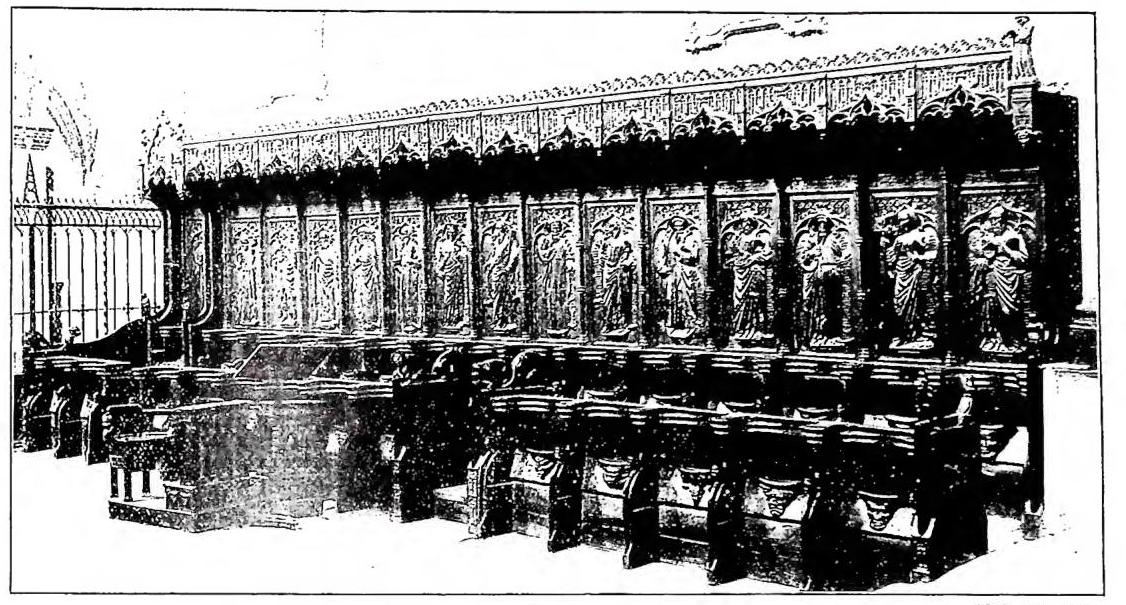
CHOIR - Left side of the choir stalls of the cathedral of Aosta (mid-15th century).