
CORO. – With the term χερός, the Greeks originally designated the group of dancers who sang the dithyramb around the altar of Dionysus; later, the term came to denote the song that accompanied the dances, and then also the place where the dances took place. The same occurred, in parallel, among Christians. The term chorus encompassed the group of singers, the sacred chant, and the place where the singers performed their chant.
I. SONG
In the beginning, the assembly of the faithful sang psalms and hymns in responsorial or antiphonal form, that is, it recited the verses of the psalms and intoned hymns and canticles in praise of God, either responding to the praecantor (first singer), or alternating its voice with that of another choir over the same recitation or melody, and ending together in unison with an acclamation or doxology. Nevertheless, antiphonal singing, or what is more commonly called choral singing, became established only at the end of the 3rd century or the beginning of the 4th in the Eastern Church, and subsequently passed from the East to the West; but, derived ab antiquo from the synagogue, it must already have existed in the time of s. Ignatius (beginning of the 2nd century), subsequently gaining importance as the liturgical needs of Christianity increased after the edict of Constantine (313). As early as the 3rd and 4th centuries, «hymnody» (the choral singing of hymns) became established as a formidable weapon against heresy, which had first employed the same means, so well suited to winning over the faithful because of its strophic simplicity and its new, more accessible rhythmic conception (accentual meter). After the definitive arrangement given bys. Gregory the Great, choral singing began its slow and difficult, though ultimately (11th century) victorious, penetration throughout Europe. But as early as the 9th century, symptoms of a crisis in choral singing became apparent, marking the beginning of the decline of religious music itself. The principal causes must be sought, on the one hand, in the practice of «diaphony» and its subsequent developments (discant, counterpoint, and great polyphony), and, on the other, in the introduction of instruments, which had already begun (7th–8th centuries) with the use of the organ in church. Organum or diaphony (end of the 9th century), that is, assigning to one of the two choirs the functions of the instrumental organ, following the principal melody at the fourth or fifth, represented the first step toward a more intimate and aristocratic choral style, which in its subsequent forms would attain greater complexity and difficulty of execution. discant (v.) and counterpoint, the place was subsequently yielded to a limited number of specialist singers. If it is added that, with the barbarian invasions, the people forgot how to speak Latin and therefore moved away from the liturgical language, giving rise to a flourishing of songs in the vernacular, and furthermore that, with the advent of Humanism and the Renaissance, the sense of the profane was intensified, one will have a fairly complete picture of the conditions in which the art of religious choral singing found itself up to Palestrina (1525–1594). Counterpoint passed from the Flemish and France to the whole of Europe and issued into great polyphony, which in reality represented an external intensification of the manifestations of religious faith, generally to the detriment of the inwardness proper to the primitive Christian monodic chant (gregorianus or cantus firmus), to which the liturgy had remained faithful. In Palestrina, however, one still finds proof that polyphonic (diatonic) choral singing can be reconciled with the liturgical requirements of the Church; and, contemporaneously with him and even earlier, it is permissible to discern signs of a renewed choral spirit in G. Oke-ghem (restorer of the ecclesiastical style for voices alone, in contrast with the practice, by then long established, of instrumental support and reductions), Josquin Des Prez, Orlando di Lasso, A. Willaert (who renewed in Venice, at S. Marco, the two antiphonal choirs in the ancient manner), A. and G. Gabrieli, etc. As one approaches modern times, choral music increasingly confuses the religious element with the profane and invades above all the concert hall and the theater. Instrumental choirs and choirs of human voices balance one another in importance: the same even occurs in church, and the former sometimes goes so far as actually to replace the latter,
II. LITURGY AND ART
By choir is meant that part of the presbytery which, depending on the position of the high altar, lies in front of or behind II. apse (v.) is always reserved for the choir; however, for particular reasons, the choir may also be located in another area, such as in side chapels (winter choir, summer choir). The choir is always furnished with stalls or seats from which the secular or regular clergy take part in the liturgy. The stalls are often to be numbered among the most distinguished products of the art of woodworking. The present-day choir combines within itself the elements of the ancient schola cantorum (v.), where the singers gathered, cantoria (v.) is reserved for them.In Italy there are important examples from the 14th century; such are the choir of Orvieto Cathedral, begun in 1325 according to a design by Giovanni Ammannati of Siena and executed by Lorenzo di Accorso, Giovanni Talini, Meuccio Nuti, and others; the side stalls of Siena Cathedral (1363–97), by Francesco del Tonghio, his son Jacopo, and other masters; and the choir of S. Domenico in Ferrara by Giovanni da Baiso. The following date from the 15th century: the choir of Pienza Cathedral, decorated with Gothic arches supported by twisted columns; that of the chapel of the Palazzo Pubblico in Siena, by Domenico di Niccolò (1428), inlaid and carved with representations alluding to the Creed, still Gothicizing in style; that of the lower church of S. Francesco d’Assisi, by Apollonio di Giovanni Petrocchi of Ripatransone (1471), Gothicizing, carved and inlaid; and that of S. Maria Nuova in Perugia, carved in the Gothic style by Paolino da Ascoli and Giovanni da Montelparo (1456). Domenico Indivini of S. Severino was the author of the choir of the upper church of S. Francesco d’Assisi (1491–1501); Giangiacomo Genovese completed in 1471 the choir of the cathedral of Piacenza, with its pointed-arch forms, derived from the art of Giovanni da Baiso; the Canozzi of Lendinara carved the choir of Parma Cathedral. The choirs of Reggio Emilia Cathedral, from the school of Giovanni da Baiso; that of S. Prospero in the same city; that of S. Sisto in Piacenza; that of S. Zeno in Verona; and that of the Frari in Venice are also worthy of mention—the latter, like that of S. Stefano in Venice, being the work of Marco da Vicenza. Echoes of French art resounded throughout Piedmont during the 15th century: outstanding is the choir of Aosta Cathedral, by Giovanni Vion of Samoëns and Giovanni di Chetro, whose backs are adorned with bas-reliefs representing apostles, prophets, and saints; equally noteworthy is that of the collegiate church of S. Orsola in the same city, by Pietro Mochet of Geneva, with backs decorated with Gothic ornaments and bas-reliefs of apostles and prophets, and seats and armrests with figures of monks, warriors, and animals, as well as hunting scenes. Also in Piedmont, mention should be made of the choirs of S. Giovanni in Asti, of Susa Cathedral, the work of Balbino di Suro of Pavia (1477), and of Staffarda Abbey, now in the Museo Civico of Turin.
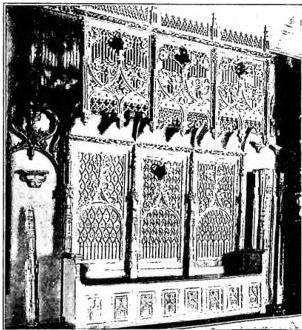
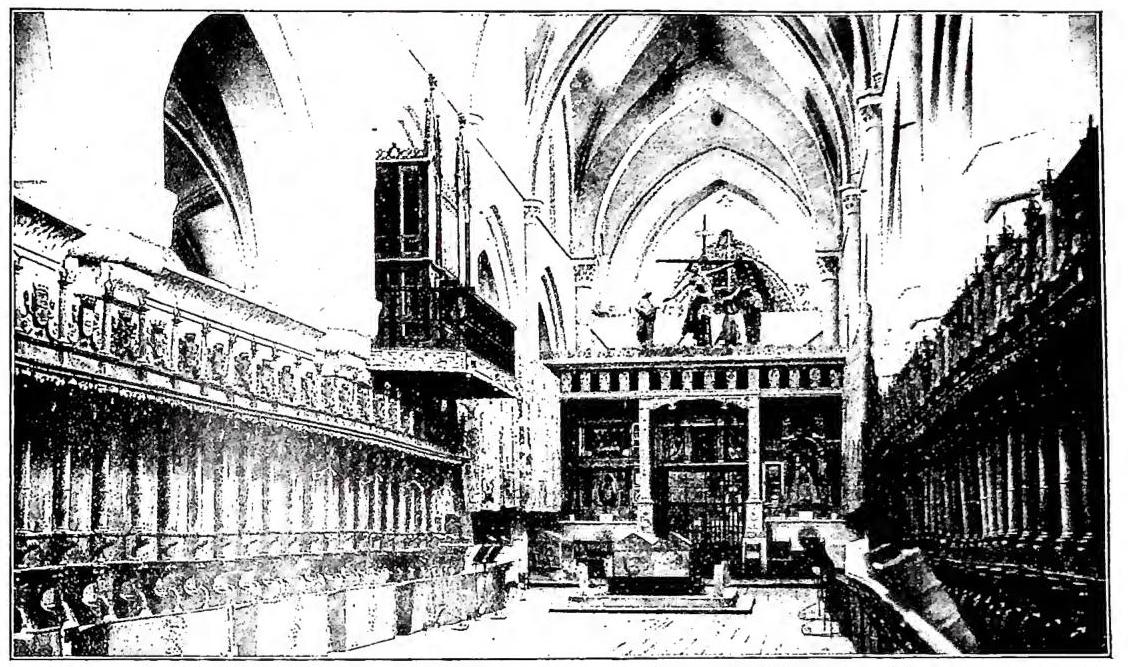
(courtesy of the Embassy of Spain to the Holy See) CORO - Choir of the church of the monastery of Las Huelgas (16th century) - Burgos.
Carving once again gained the advantage over intarsia in S. Maria delle Carceri in Prato, in S. Pietro in Perugia, and in S. Anastasia in Verona. In the cathedral of Siena, the central choir stalls are by Bartolomeo Neroni, known as il Riccio; they contain added intarsia work by fra' Giovanni da Verona, originating from the demolished church of S. Benedetto.
In the sixteenth century, one may also mention the choirs of S. Sebastiano in Biella, S. Giustina in Padua, S. Giorgio Maggiore in Venice, etc.
In the seventeenth and eighteenth centuries, choirs became sumptuous and elaborate, in keeping with the general tendencies of the period. One may mention the choir in the chapel of the canons in S. Pietro in Vaticano; that of the abbey of Montecassino, unfortunately destroyed, by G. A. Coliccio, richly carved; that of S. Domenico in Lucera, by Fabrizio Jannulo da Monopoli, who carved figures of Christ at the Column and of saints on the back panels; that of the church of S. Sigismondo in Verona, by G. Capra; that of the parish church of Mosso S. Maria, with its animated and elegant ornamentation; and that of S. Maria di Moncalieri, carved with refined elegance. Among the carvers of this period, Andrea Fontoni da Rovetta stands out; he was the author of the choir of the church of Sorisole (Bergamo), with images of saints within niches and other decorative figures.
Outside Italy, one may mention the choir stalls of Amiens Cathedral, begun in 1598; in Germany, the choir of Ulm Minster; in Spain, those of Seville Cathedral, by Nufrò Sanchez and the Flemish artist Dancart (ca. 1478), those of Léon Minster by Teodorico Tedesco (1481), those of Palencia Cathedral by Pietro di Guadalupa (1519), those of Toledo Minster by Rodrigo Alemán, the Biguernys, and A. Berruguete; in Portugal, the choir stalls of S. Croce in Coimbra and of the church of the convent of Belem.
Among modern works, one may mention the choir stalls in the church of the Immacolata in Genoa, inlaid with ivory and metals. - Vedi tavv. XXIV-XXV.