
UMANESIMO. — It is impossible to understand the meaning of the word humanism unless it is historically circumscribed, that is, referred to the values it represented and expressed in the age to which it ultimately gave its name: the age of the Renaissance. The many other meanings, sometimes strangely remote from this one, that it may still bear are part of everyone’s daily experience and may for the moment be seen summarized in M. M. Rossi’s essay: Note sulla modernità del Rinascimento (in Nuova riv. storica
, JanAug. 1950). These amplifications, distortions, and mythologizations are not at all surprising: they are analogous to those that occur with the words historicism, Epicureanism, Pyrrhonism, and also Cartesianism, encyclopedism, and criticism, as soon as they cease to refer to a specific and clearly circumscribed ideological fact. In the specific case of humanism, the historical and also ideological core is represented by the revival of classical studies and their irradiation throughout the culture and thought of the nascent modern world.
But from what year or century should this revival be dated? More than that: how long had classical studies been dead when this revival began? Among the episodes illustrating how early in the Christian world the cult of ancient poets and writers tacitly allied itself with pietas, amid the incomprehension and astonishment of the uninitiated, the most remote—or the most vivid—may be that of Julian the Apostate, who, unable to justify the Christians’ love of the classics, believed himself entitled to prohibit it on the basis of a dilemma that later became famous: if they speak falsely, you cannot read them because you would sin; if they speak the truth, you have no right to profit from them (Rufinus of Aquileia, Hist. Eccl., I, 32). That resistance among Christians was already an incomprehended humanism, just as Julian’s opposition was already anti-humanist; and he would have been a good prophet who, in Julian’s incomprehension before the so-called paganism of the fourth century, had foreseen that of Luther before the so-called paganism of the Church of the Renaissance. The fact is, in short, that, despite apparent eclipses, this syncretism, as a distinctly orthodox state of mind, never ceased. It is well known: in the Iron Centuries, the breviary alone ended up counting (when anything counted); but at that point the decline of the classics resulted not so much from an aversion to reading them as from an aversion to reading. Today, on this point, people hold views different from those of the last century, and certainly better founded. One may or may not follow Gilson, an authentic master, all the way when, tempering certain traditional contrasts imagined between the Middle Ages and the Renaissance until he virtually annuls them, he sees in the implicit humanism of the former a foreshadowing of everything—including the naturalistic vein—of the explicit humanism of the latter; but it is an established fact of history that Pier Damiani himself, and many others of his age who were most severe, ex cathedra, toward profane poetry, were not ashamed in other settings to show themselves learned in II. When we reach the twelfth century, modern scholars (Bertin, Brezzi, Monteverdi) are unanimous in recognizing it as characterized by a renewed study of profane poets and moralists. This study was indeed part of a more universal awakening of life and was fostered in the episcopal schools by the growing favor of the lay world, but always as a component of theological doctrine, not as its antithesis; and it produced a state of mind that already contained, in more than embryonic form, that of the great Italian humanism. There is more. From the fourteenth century onward, what is still regarded as the chief hallmark of humanism is the wandering of humanists through decaying buildings and beneath the dripping eaves of monastic libraries in search of Ciceros, Livys, and Virgils; but if the dripping eaves derive from the romantic fervor that characterized the history of the century which takes its name from it, the nineteenth century, the miraculous discoveries of manuscripts in the first place derive from a misunderstanding and, in any case, had already begun in the twelfth century. Petrarch’s famous words, « haec nostra studia multi neglecta saecula, multorum me ingeniis per Italiani excitasse et forsitan longius Italia » (Sen., XVIII, 2), have their precedent in those of Goffredo da Viterbo (1120–91): « Quando ogni altro merito mi mancasse, questo solo dovrebbe bastare a conciliarmi alla fama: l'aver divulgato le Muse che già da molti secoli vivevano occulte e non esavano uscire dai chiusi penetrali; l'aver reso ai carmi l'antico splendore e incitato i tardi poeti ». In short, the matter was not precisely one of discovering; it was one of discovering in a very particular sense. In the monastic libraries, these manuscripts were not abandoned and forgotten; they were guarded only too carefully, with a particular jealousy toward the growing lay culture, which then needed them and, in order to reach them, or at least obtain permission to copy them, had to discover not the manuscripts themselves but, « per mediatores », as Bacon says, who their custodians or jailers were, and how they might be requested without receiving a refusal. It was therefore natural that, during the Renaissance, and especially under the great humanist popes, the principal center of this information should have been the Roman Curia, that the most fortunate discoverers should have set out from there, and that, in convent libraries, it should have been advisable to arrive with good letters of recommendation or with the charm of fame and personal presence, precisely in the manner of Petrarch.
And yet how did it happen that this revival of classical culture toward the end of the twelfth century came almost to an abrupt halt? In the following century, traces of Latin works merely refreshed by the chlorophyll of literary sentiment almost disappear until Dante, the Paduan Circle, the precursors of Petrarch, and Petrarch himself. It is the long silence of Virgil, as Boccaccio explains. Arrigo da Settimello’s Elegia dates from 1192 or earlier, Pietro da Eboli’s Liber ad honorem Augusti from 1195, and the De Balneis Puteolani from 1197; Goffredo da Viterbo died in 1191, while Alessandro Neckam, born in 1157, lived until 1211; but his De Naturis Rerum—already, in any case, so characteristic of the thirteenth century in taste, with its dry naturalism—even if transferred into verse in 1212, came into being in the twelfth century. After that, silence. Why? And what is there so exceptional and transfiguring in this rupture of the thirteenth century that the classical revival of the fourteenth, however full of analogies with that of the twelfth, can no longer be connected to it, and deserves the name of humanism above all because of a new polemical ardor that characterizes it?
The old nineteenth-century scholars of the Middle Ages, fond as they were of an axiomatic and convenient continuity of the Latin tradition, ended by almost forgetting what a great event, culturally as well, the arrival of the Arabs in the West had been in the thirteenth century. Precisely as a reaction against those scholars, there is a tendency today toward the opposite extreme, and some do not hesitate to speak of an “Arab miracle”: an evident abuse of the word, first of all because there is nothing miraculous in the matter, and then because, since the supreme merit of these Arabs lay not in their originality but in that of the Greek culture they preserved and perpetuated, in the end one always comes back to the usual “Greek miracle.” Implicit in this exaggeration, however, is the great truth that at that moment in the thirteenth century (in reality, in the second half of the twelfth), the so-called modern thought took its departure from that awakening of Greek cosmological sensibility brought about by the Arabs. The West, in possession of the whole of Aristotle’s Organon by about 1150, of nearly all of Averroes’ important works by the middle of the thirteenth century, and a translator and interpreter of the Greek medical treatises together with the Jewish Arabists of the Schools of Montpellier and Salerno, moved precisely from such an awakening of scientific rationalism and from its incompatibility with the Latin tradition to attack the u. of the twelfth century, which instead depended entirely upon that tradition, that is, upon the moralists of Rome. The most characteristic witness to the overwhelming crisis that consequently arose from the very beginning in these studies, and hence in classical culture itself—a crisis entirely swept along by an irreligious tremor—remains Giovanni di Salisbury, with all his extensive work and especially with the Polioraticus and the Metalogicon. He describes the nascent phenomenon as Petrarch would describe it in its full development and therefore, both for this reason and for the very clarity of his prose, unquestionably deserves the name of the first humanist. The picture he gives of thirteenth-century irreligion, despite its disconcerting realism, may perhaps suffer from passionateness (the passionateness of the humanist) and be excessive. There is no doubt, however, that once armed with arguments drawn from the study of nature and transformed into outright naturalism, this Aristotelian rationalism turned against the great Platonic-Augustinian tradition with a kind of fury. It was then that, between the two logics, one belonging to Rhetoric and the other to Dialectic, according to Plato’s distinction, there began
a misunderstanding whose resonance the Renaissance would carry through the centuries.
And just as Latin literature, with its poets and its
historians, with its psychologists and with the weakness of its
cosmological sentiment, depends entirely upon the logic of
Rhetoric, places itself under the banner of the Socratic Know
thyself, and has for its object nothing but man in the perspec-
tives of good and evil, so the logic of Dialectic, armed with
Aristotelian physics, lumps everything together:
rhetoric, literature, Latin, Platonic idealism; and, attacking
or devaluing them in the name of science, it begins, with
the motives of the eternal Socratic drama, the religious drama
of the second millennium. For the rationalists of naturalism—
Salisbury recounts—it was a matter of not allowing themselves
to be put among those paracchi (= parum curantes quid philoso-
phia doceat, quid appetendum fugiendumque denuntiet »), with
which they found the poets, historians, and Latin moralists so
well supplied; hence their irreverent irony toward them. “Poets
and historians were considered unworthy; and if anyone dared
to linger over their study, he was pointed out and, as more
backward than an Arcadian donkey, duller than lead or
stones, became an object of derision to everyone.”
And these are not empty words. In this multiplying antithesis
between the Greek world (science, pure logic, progress) and
the Latin world (poetic fables, critical incapacity, static
moralism), the first to suffer was the divine language of
Rome; nor did it any longer help that it had unified the world
in the Word. There was immediately someone who thought
of repudiating it and teaching in the vernacular, or in a
vernacular barely Latinized (something no one would dare
again, after the humanist resurgence, until the eighteenth
century, and certainly not comparable to Galilei’s exception).
Yet was this naturalistic rationalism, emerging from
the Arabist gust of wind, really so corrosive, so irreverent
toward every pious tradition, and so widespread that even
conventual life itself was literally polluted by it? It cannot
be denied that, because of the mocking tone of their
disbelief, these monks without u. would call to mind
the Newtonian abbés before the French Revolution; and even
if we admit that, in the Salisbury-like manner of representing
and humiliating them, the now enfeebled first u. was exacting
its final revenge, one fact remains certain: the upheaval
produced by their Aristotelianism in theology was, for the
time being, terribly ambiguous, and culminated in Averroist
heresy. The collusion between rationalistic impiety and
anti-humanistic impiety that Salisbury describes as emerging
in the second half of the twelfth century is already the
one Petrarch would describe in De sui ipsius; nor can it be
denied that the last layman in whom rationalism was reconciled
with u. was the first who, in a certain sense, invented it,
namely Abelard. Thereafter, the man of science raises his
banner: neither rhetoric, nor poetry, nor Latin: “eloquentiae
negat esse studendum; ipsamque, sicut visum non caeco, auditum
non surdo, asserit pervenisse ei, qui mutus non est.” The
silence of Virgil begins. And where would this Aristotelian
rationalism have arrived in its slide toward impiety if
s. Tommaso had not come to reform it by making it his own,
with the only modernism ever to succeed in taking root in
the history of the Church, in Gilson’s fine expression? For,
despite such a great and adverse transformation of scientific
circumstances, the reconciliation between critical reason
and pietas, as it took place in s. Tommaso, always retains
an immanent value of its own. Yet the world was far from
immediately realizing what Thomism represented. More time
still had to pass before even this profane, pious, and
authorized Aristotelianism could present itself as readily
distinguishable from heretical Aristotelianism and its
corollaries. This was precisely the case with the humanists,
who, in their aspiration to place Reason upon the throne of
Wisdom as a religious value, not as a dissolving critical
value, had been shown the way by s. Tommaso, but did not
realize it and were not grateful to him. There were naturally
exceptions; but for every Bruni and Pontano, who called
themselves or believed themselves Aristotelians and vaguely
Thomists, most did not even suppose that to reform the
antithesis “Aristotle-science-impiety” and “Plato-Wisdom-
pietas,” a s. Tommaso would have sufficed; they could arrive
at distinguishing him from the others, but not at loving him.
It is clear, then: this patristic pietas of the humanists
would scarcely be transplantable from the soil in
which gave it birth and by which it was fertilized, namely, the reaction against thirteenth-century rationalism and its epigones; but this does not make it any less genuine, nor can it be regarded with suspicion. Not without reason did it become passion, and even emotionalism and fanaticism, when scholars devoted themselves to watching over their codices as sacred objects, preachers measured out the elements of the two Bibles as equivalent to one another, and the crowds rose up to defend the alleged relics of the Romans and Trojans as the relics of saints; but where could there be clearer proof that u. could be anything except the aestheticizing and paganizing dilettantism of philologists? Nothing is created by that, least of all the spiritual movement richest in consequences and most glorious that the history of Italy recalls.
Indeed, if anything, the opposite is true: this reborn love of the classics truly deserved the name of u. only when, joined to religious feeling through the merit of the figurative arts, it succeeded, from palaces and Churches and along the roads of Italy, in permeating to some extent even the consciousness of the people. For this reason alone, finally, even after Dante and Albertino Mussato had already been acknowledged as equal to u., and after Dante—an inexorable judge of his Averroist Guido—had been credited with that enlightened discrimination between s. Tommaso and the other Aristotelian physicists and diviners, which the humanists later lacked, the age of these men must nevertheless always be considered to have begun with Petrarch; not because of his style without cursus, or because of codices discovered, perhaps, while sitting in an armchair, but because of the impetus he gave to the “priest” of Wisdom, collaborating with the priests of theology in the salvation of the world, in a mission of the learned man that lasted almost until Fichte’s reform.
He had certainly had a precursor in Ruggero Bacone, who, however, by linking only science to an initial illumination or pre-revelation, and by making scientists alone its priests, had produced an Augustinianism turned upside down. A genuine Augustinian, Petrarch appealed not to democratic Greece, “which places the world at random,” but to the Platonic and Homeric Greece that Cicero, an unwitting herald of God, had begun to transfer into his own universal language, and which the poets, historians, and moralists of Rome had inherited in spirit. Yet there was another, more suggestive difference between Bacone and Petrarch: the precipitous crudeness with which the former speaks of pre-revelation on the level of Science is answered in the latter and in his successors, on the level of Wisdom, by a profound sense of discretion, reserve, and mystery, capable of leaving unspoken the hope in Cicero’s salvation, but also of making Romanitas the sanctuary of the cardinal virtues and of a Justice wholly oriented toward Charity.
As the architects of this spiritual renewal in the eyes of everyone—the learned, the unlearned, and the half-learned in the figurative arts—the humanists sometimes grew proud of II. It is therefore unsurprising that, with their tendency to isolate themselves in a certain consciousness of caste, of which their correspondence bears witness—first that of Petrarch, last that of Erasmo—they ended by presuming themselves necessary to the salvation of the world; and not without quarrels and rivalries with the priests of the Church. One of these degenerated into an obscure, ill-defined, and perhaps indefinable episode: Leto (v.) and Platina against Paolo II.
What may surprise one, instead, is that this patristic one-sidedness also concealed from them the fact that the scholasticism of s. Tommaso diverges toto caelo from the Arabist school at least on one point, namely, that of Roman pietas, and that it was from nowhere other than the De Regimine Principum that Dante had drawn the great Augustinian themes of the Divina Commedia. Here they are: “Because among all the Kings and Princes of the world the Romans were the most solicitous for the things mentioned, God inspired them with good government, so that they deservedly merited the empire, as Agostino proves with various arguments (De Civ. Dei, l. V, chap. 15), which we may here reduce to three: ‘love of the Fatherland, love of Justice, civic benevolence.’” “Love of the fatherland is founded on the root of charity, which places common things before one’s own, and not one’s own before common things, as Agostino says in expounding the words of the Apostle of Charity” (l. III, chap. 4). “There is another reason why the Romans deservedly acquired dominion, and it was their love of justice; hence they acquired the principate by a certain natural right from which every just dominion takes its beginning, as…
Yet some lesser figure may perhaps have been exempt from misunderstanding such Augustinianism in Tommaso’s humanism: none of the greatest was—not Petrarca, not Erasmo; blame also lay in the excessively superficial theological learning on the one hand and literary ignorance on the other. In any case, it is not for us to sit in judgment as arbiters in the long and at times abusive dispute between theologians and humanists, the leit-motiv in the history of the Renaissance. But even if, with regard to certain humanists, one were to accept the accusations of the Fraticelli, reciprocated, moreover, ad abundantium by the celebrated Contra hypocritos, the humanist ideal of entrusting to Truth the shield of Wisdom, making it forever impregnable and capable of unifying the world through the Word rather than through arms, remains the highest fact of the Renaissance and remains a great event in the spiritual history of Italy and the world. Nor should one seek to diminish it by saying that, in the final analysis, these scholars did indeed repeat the words of the Phaedo: “We recover a truth that is already ours,” and that, in Platonic fashion, they spoke of learning as a return to things already possessed by human beings; for, in reality, they loved their authors insofar as they had rediscovered and rethought them and brought them before the scrutiny of their own subjectivity. Such a limitation is either true and valid for people of every time and place, since the assertion of one’s own personality and moral independence is in every individual and every act the very presupposition of life; or it applies to no historical fact less than to u. That reaction against a stable wisdom was one and the same with the reaction against thirteenth-century rationalist criticism, and it expressed itself in many forms, but most clearly—or, one might say, most tangibly—in the idea that its instrument too should be stable and unique: Latin. Thus, when one centers u. on the fact of the relative but astonishing revenge of dead Latin upon the already victorious and triumphant vernaculars, one does not reduce it to a secondary episode; rather, one discovers it at its ideal core. The humanists could oscillate between an almost mystical identification of the Logos with its verbal instrument (this was the case with the utterly unprejudiced Valla) and a prudent distinction between them (as with Erasmo); for all of them, however, the unity of the one was a corollary of the unity of the other. Nor were those few an exception who at times, as an act of charity, offered the unlearned the treasures of wisdom on the vernacular table. For this reason, even after demonstrating how weak a foundation the distinction between a first and a second period of u. may have, since Erasmo at the epilogue always moves within the ideal orbit of the initiator Petrarca; even after recognizing that, in the thirteenth century, cosmological Greece had given thought an impulse to which the Platonic Greece discovered in the fifteenth century added little—the idea cherished by Foscolo that true u. should be dated from the exodus of the Greeks for the Councils of Constance and Basel and for the fall of Constantinople, from the arrival of Crisoloro in Florence in 1397, retains a certain legitimacy. Only then, in fact, did that immense dream seem close to becoming reality, the dream for which, in a willful surge, a Petrarca and a Boccaccio had brought themselves to spell out Homer under the instruction of some Levantine: to establish, beside the one Sacred Bible, a single profane Bible from which wisdom might release its almost salvific power through the universality of Latin. What spread through the West with the disciples of Crisoloro—first among them Bruni—was a genuine fever: translation. And with what result? Very little. Too readily accepted, the Platonic premise of a wisdom to be recovered could also encourage laziness and haste. Without taking much trouble to revise the text, without any genuine stylistic research, without the support of I know not what academic aestheticism, not a few scholars—sometimes scholars only through their knowledge of Greek—translated “by the piece,” only to take offense intemperately if they were called not wise men but grammarians. This profane Bible, in short, failed because it was chimerical. But despite those who still today, influenced by crude nineteenth-century distortions, see in them nothing but cynicism and mercantilism, the truth is quite otherwise: the most active character of the culture of which they were the symbol was that profoundly mystical enthusiasm by which the most pious Niccolò V could repeat that translating a work from Greek was equivalent to freeing a soul from Purgatory, and spirits as different from one another as the small-scale Ermolao Barbaro, devoted entirely to pure philology, and Lorenzo Valla, devoted entirely to ideological problematic, could agree in admitting almost without criticism (or outside criticism) that, once brought from the barbarism of Arabizing vernacular translations to Ciceronian clarity, Aristotelian thought would automatically find itself close to Christian thought; and rulers, inspired by scholars, could exchange among themselves, “as a pledge of peace,” codices of ancient sages. Confirmation of this is also found in the two great exceptions, Marsilio Ficino and Pico della Mirandola, who sought through this philology to rise to a supreme challenge to the impious Peripatetic school in a new and Platonic theology, and who thereby attracted both the condemnation of the Church and that of the supreme pontiff of u., Erasmo da Rotterdam.
Returning, then, to the beginning, humanism, as the opposition of what is within us to what is outside us, of the study of man to the study of nature, and as the emancipation of ethical values from critical rationalism, is a Socratic state of mind that can re-emerge at any moment in generations and individuals. But its heroic moment, its supreme synthesis with Christianity, was the Italian Renaissance; and from then on it has remained in the classical tradition as a formidable remnant. The Reformation rejects everything in this humanistic synthesis: Latin, which had been its emblem, becomes a luxury and a plaything for men of letters; the sacred Bible and the profane Bible become vernacular almost simultaneously. England, more on guard against the excesses of individualism, seeks a middle way between Catholicism and Lutheranism; but even there humanism fails to survive; the Moro, the Fisher, and the Pole bring it to a close
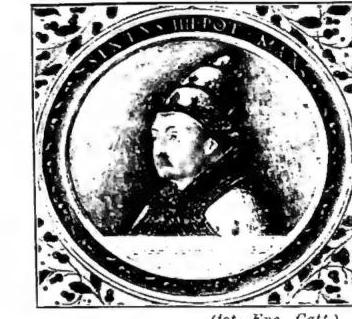
(phot. Enc. Catt.)
HUMANISTIC WRITING AND MINIATURE — Sixtus IV. Tondo decorated with heraldic motifs of the Della Rovere family. Miniature from the Roman school, with influences from Melozzo da Forlì, adorning the Vite dei Romani Pontefici by Bartolomeo Platina (1474–1484) — Vatican Library, cod. Vat. lat. 2044, fol. 2v.
Catholic humanists the reason for their dissent. And they may be summarized as follows: «Little by little, you have ended by placing the Sacred Bible on the same level as the profane one, without specifying, however, upon what foundation. And the dilemma remains open. Either these wise men attained such heights because they were inspired by God, in which case you must place them beside the prophets and the Apostles; or they reached them through their own virtue, in which case you cannot prevent the conclusion that the heart of man alone suffices for the discovery of the eternal Logos and that Grace is superfluous». It cannot be denied either that these words contain an element of truth or that they strangely resemble those with which Julian the Apostate had begun his battle against humanism.
For the pedagogy of humanism and the Renaissance: V. PEDAGOGIA, history of.