Machine translation of the 1948–1954 Italian original. The original text is authoritative.
SANNAZARO, JACOPO. – Poet, born in Naples on 28 July 1456, died there on 24 April 1530. He belonged to Pontano’s Academy under the name of Azio Sincero; he lived at the court of the Aragonese, utterly devoted to the infante Federico, whom, when the monarchy fell in 1501, he followed into exile and never left until Federico’s death (1504). He then returned to his villa at Mergellina. He was buried in the adjoining little church, in the tomb he had had prepared for himself and which is still preserved.
Whatever is singular in his figure as a man of letters does not, however, constitute an exception; rather, it belongs to a tradition to which Boiardo and Castiglione likewise belonged, though on different levels. Like them, he was at once a humanist and a gentleman; he possessed the humanists’ almost religious feeling for Latin; but he also shared the tastes and curiosities of the secular world of the court, which was also his own world, and he catered to these through his pen, especially in the famous Gibomneri, bizarre compositions in the vernacular verse: a kind of frottola, a true “ball” (such is the meaning of the word), or tangle of subjects utterly disparate from one another, sometimes in the form of a riddle, held together by jest. Among these concessions to secular taste, the most successful was Arcadia, the story of Azio Sincero (his pseudonym), who, in order to escape the pains of an unrequited love, migrates in search of oblivion and peace to the land of the shepherds. There he confides in one of them, receiving in return confidences no less painful. Then, one fine day, inspired by a dream and guided by a nymph, he plunges into the bowels of the earth, reaches by that route the native Sebeto, and here learns that the maiden who was the cause of his sorrows has died. This was the work’s first version, of 1485, consisting of ten eclogues and ten prose pieces, which circulated for a long time in manuscript. In 1501 he sent it to press, enriched with two eclogues and two prose pieces. What, then, is Arcadia? It is probable that at first S. thought, as Boccaccio had already done in the Ninfale Fiesolano, or even in the Filocolo, of taking as his starting point familiar old classical themes and allegorizing in their development the events of courtly life. In fact, this is what he did, for the book is filled with such allusions, almost to the point of gossip. Yet he was genuinely a humanist; and for this reason the classical material that in his predecessors, especially Boccaccio, immediately lost its seriousness and, contaminated by Petrarchan and Provençalizing tones, could end in an perhaps unconscious caricature of itself, preserves with him to the very end its dignity and its charm. He might well have reflected that he was writing in the vernacular and that his public was foreign to this culture; the Latin poets continued, one after another, to suggest their reminiscences to him, and he could not help chiseling them with a prose that is undoubtedly artificial, but that ultimately became the closest approximation to the sound Tuscan tradition ever written in Naples. In the history of vernacular literature in southern Italy, the prose of Arcadia represents a dramatic turn. In short, what emerged was a strange, composite, refined, soft and cold work at the same time, and the first to perceive within it a contrast between intention and culture, between form and content, was probably none other than he himself, S. Perhaps he already expressed it in the words, “uncertain is that fame which has no other foundation than the judgment of the common people.” Despite all this, the work enjoyed enormous success: it was translated into all the newly emerging vernaculars and represented the Italian Renaissance throughout the world. This is not surprising: without knowing it, in the midst of full classicism and several decades in advance, it anticipated the tendencies of the classical age. Perfect-
(from G. B. Crispo, Vita di J. S., Rome 1952)
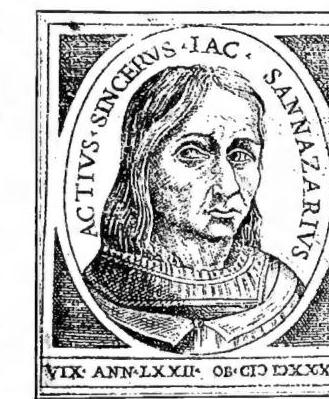
SANNAZARO, JACOPO - Portrait. Engraving.
In perfect harmony with his own aesthetic, S. felt at home instead in the De partu Virginis, in which the task was to bring Virgil’s language back to the glorification of the Christian manger. When the great bucolic poem in three books and approximately a thousand verses was completed, in 1513, Leo X, through Bembo, complimented its author as follows: « We had eagerly awaited your work, and now rejoice to see it completed. It would have been dear to us at any time; but it is particularly dear to us at this time. We need writers like you today, when the Christian tradition is being attacked inigno stilo ». Certainly the distance between the simplicity of the Gospel narrative and the splendor of Sannazaro’s evocation, enriched by mythological intrusions, is great; Christ, around whom the angels gather, may resemble Jupiter; the Joy that descends upon the earth may resemble Mercury; it may be surprising that Proteus is introduced to prophesy the Baptism of Jesus, and that the prophecy is evoked precisely by the cerulean king Jordan. Nevertheless, in this florid and warm Alexandrianism, one must be cautious in speaking of discordance. As for speaking of insincerity, that would be ridiculous. The piety that emanates from it possesses an unmistakable gentleness: the gentleness of the humanistic Renaissance. S. also wrote occasional eclogues, elegies to Cassandra Marchese, and epigrams, some of which would hardly seem to have been written by this gentle gentleman, so bitterly do they sound.
BIBL.: the most complete bibliography up to 1949 is provided by V. Rossi, Il Quattrocento, Milano 1933, pp. 330-23, and by the compilation of A. Vallone, Supplemento bibliografico 1933-49, there 1940, pp. xvii-xviii. The most recent edition of the Arcadia is that of E. Carrara, Torino 1926; of the De partu Virginis, that of A. Altamura, Napoli 1948. See also G. Folena, La crisi linguistica del Quattrocento e l'« Arcadia » di I. S., Firenze 1952. Giuseppe Toffanin
Cite this article
“SANNAZARO, JACOPO.” Enciclopedia Cattolica, vol. X (1953), p. 1066. Azione Romana digital edition, https://azioneromana.com/article/sannazaro-jacopo.