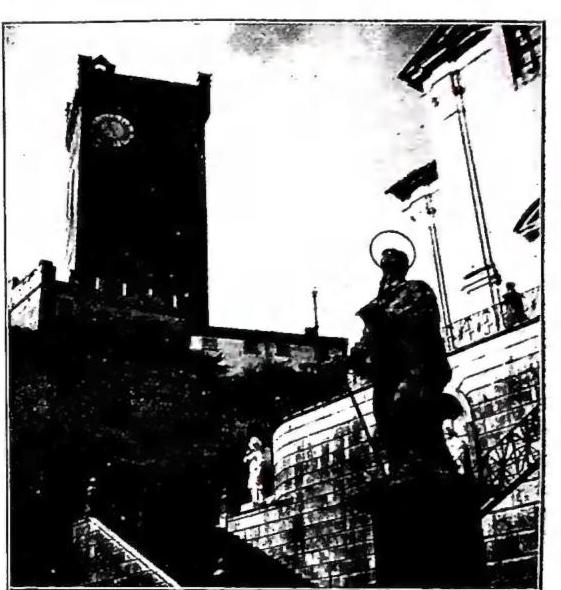
SAN MINIATO, DIOCESI of. — City in Tuscany, a diocese since 1622; suffragan of Florence. Its territory, extending over the hilly and flat lands of the valleys of the Elsa, Evola, Arno, and Era, borders the dioceses of Florence, Pisa, Pistoia, Pescia, and Volterra. Before its establishment as a diocese, S. M. was the residence of a vicar general of the bishop of Lucca, to remedy the difficulty that clergy and faithful might encounter in communicating with that episcopal curia, situated in territory politically distinct from the Florentine dominion, to which S. M. was subject. Its area is approximately 600 sq km; the population, numbering 133,000 souls, is distributed among 102 parishes, in turn grouped into 8 forane vicariates. Priests: 145; religious houses for men: 5; for women: 45. It has a diocesan seminary. The patron of the diocese is s. Genesio; his feast is celebrated on 25 August.
I. CIVIL HISTORY
The city of S. M., which perhaps owes its origin to Otto I or to the Lombard Desiderius and was already a walled settlement in the 12th century, stands on a flourishing hill between the confluence of the Elsa and the Arno. It is dominated by the ancient fortress, the work of Corrado di Spira, which was damaged in the last war. It was there that Pier delle Vigne was made to be « blinded » by the Emperor Frederick. In more remote times, the inhabitants of S. M. destroyed the village of S. Genesio in a « feud »; their territory was set ablaze by the people of Lucca. Subsequently protected and visited by Otto IV, Henry II and Frederick II, it was the seat of a German judge, of courts of appeal, of an imperial court and of a vicar of the Empire; hence the appellation of S. M. al Tedesco, which lasted until recent times. Under the communal regime it was governed by a podestà, a captain of the people and twelve buonomini. Its position, which made it suitable for both attack and defence, kept it constantly active and involved in the struggles between the Guelphs and Ghibellines. At times it joined the Guelph league; at others it was the centre of a Ghibelline league. It fought against the Ghibellines of Arezzo; its men fought at Montaperti; at Campaldino they were on the side of the Florentine Guelphs. Situated midway between Pisa and Florence, it suffered more than once from the consequences of hostilities between the two rival cities, more often siding with the Florentine Guelphs, until in 1389 it became permanently subject to Florence. Once the Grand Duchy had been established, S. M. became part of it and received from it its expansion and, through the agency of the Medici, its elevation to city status. In 1838 Leopold II established a collegiate tribunal there and made it the residence of a grand-ducal commissioner. After Tuscany was annexed to the Kingdom of Italy, it became the seat of a district of the province of Florence. Its Accademia degli Euteleti is known as a cultural institution.II. RELIGIOUS HISTORY
The church erected in 738 by twelve devotees in honor of s. Miniato the martyr, from whom the place took its name, was originally subject to the parish church of S. Genesio, situated a short distance away, near Vico Wallari. This parish church, which belonged to the jurisdiction of the bishops of Lucca, witnessed in 1074 a synod against the simoniacs, convened there by Bishop Anselmo. Celestine III granted the parish church of S. Genesio his protection, confirmed its possessions, forbade the erection of new churches in its territory, and granted permission for the divine offices to be celebrated there in the event of a general interdict. But S. M. was tending to assert its autonomy. Among the religious glories of S. M. in this period, the passage of s. Francesco should be recalled: the local inhabitants received him with great honors, meeting him in 1211 at a place called Catena, and made donations to him that facilitated the establishment of a Franciscan convent. Thereafter, on the day sacred to the city’s eponymous Saint, the leading citizens of S. M. would solemnly go to the church of S. Francesco to make an offering. Meanwhile, in 1248, the parish church of S. Genesio was seized and destroyed by the people of San Miniato, and the honors(phot. Enit)