
SANMICHELI, MICHELE. — Architect, son of Giovanni, a military architect, probably originally from Ticino, born in Verona in 1484, died there in 1559.
In 1509 he was master builder at the cathedral of Orvieto, as an assistant to his uncle Bartolomeo. His works there include the principal pinnacle of the façade, in which Renaissance motifs are grafted onto a Gothic design harmonizing with the rest of the building, and the altar of the chapel of the Magi, in a classicizing style. Also in Orvieto, he erected the Petrucci chapel in the church of S. Domenico, which, in its sobriety of line, recalls works by G. da Sangallo. A
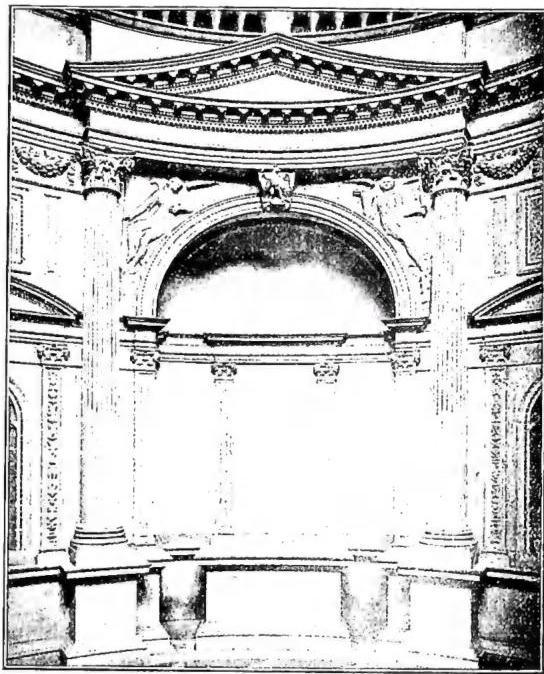
Returning in 1523 to his native city, he engaged there in an exceedingly fruitful architectural activity: his first work was the Pellegrini Chapel in S. Bernardino, conceived as a freestanding building following the Raphael-like example, and which—for its circular plan covered by a coffered dome and for its adoption of the architectural orders—demonstrates a full adherence to the classical forms and proportions to which he would conform throughout his artistic production. For the church of S. Giorgio in Braida he erected the dome above a high drum with large arched windows and began the bell tower, left unfinished at the first order, above which three others were to have been superimposed, similarly to the one he designed for the Cathedral (it too interrupted at the lower part). In Venice he built the church and convent of S. Biagio alla Giudecca, demolished in the last century.
Back in Verona once again, he finally supplied the designs for the chapel of the Lazzaretto (1548) and for the church of the Madonna di Campagna, begun in the year of his death and completed by others, with modifications to the original design. In both these works S. attests to his predilection for the central plan and for classical proportions.
His activity in civil construction was also extensive, carried out likewise mainly in Verona, where the Pompei, Bevilacqua, and Canossa Palaces are to be noted; the Grimani Palace in Venice is also noteworthy, its façades consistently dominated by the architectural orders.
But S.’s principal fame rests on his works of military architecture, found not only in the Veneto but also in the eastern Mediterranean, where he received important commissions for fortifications from the Venetian Republic, introducing new conceptions in this field. It is above all in Verona, however, that S. left his most famous works: the Porta Palio and the Porta Nuova, masterpieces in their genre. Indeed, it may be said that Verona owes chiefly to S. the Renaissance character that dominates its architecture as a whole.