
LAZZARETTO (OSPEDALE). — As epidemics spread during the second half of the fourteenth century, people began to isolate those suffering from contagious diseases, so that they would not transmit their illnesses to others.
Venice was the first to establish a hospital for those suffering from contagious diseases; in 1403, in fact, the Venetian Signoria took the island of S. Maria di Nazareth from the Hermits of the Order of S. Agostino, where those friars had built a monastery and a church, on the site of which there already stood a hospital for pilgrims, and converted it into a hospital for those suffering from contagious diseases. The name “l.” given to it seems to have derived from a corruption in the pronunciation of Nazarethum, or from its proximity to the island of S. Lazzaro; the designation subsequently passed to all institutions of this kind. The subsequent decrees of 1448 and 1476 confirmed the institution, which was administratively maintained through the revenues of the salt office and by means of private donations, until the idea arose of a moral duty to make testamentary bequests in favor of the l. Within a short time, l. multiplied in the Italian cities. In 1488 Milan had one built of its own, with considerable improvements in its internal arrangement; it was surrounded by a moat 10 braccia wide.
The l. were built at a distance from inhabited areas, neither too close, in order to avoid contagion, nor too far away, so that they could be easily reached by the sick. Care was taken not to orient them toward the western winds, which were considered harmful because they were putrid and were thought to cause the spread of epidemics.
As a means of isolation, they were built in elevated places and on islands, preference being given to the isolation created by water; for this reason, broad moats were constructed whenever this was not otherwise possible. Thus, in Rome, in 1636, Cardinal Gastaldi had the l. built on the island of the Tiber. The sick, insofar as this was compatible with overcrowding, were accommodated in well-ventilated rooms; but during epidemics, porticoes and auxiliary huts served as shelters; a chapel for the Divine Offices was situated at the center of the l. The air was purified by fumigation inside the rooms, strongly aromatic substances being poured onto a live fire; the belongings of the deceased were burned.
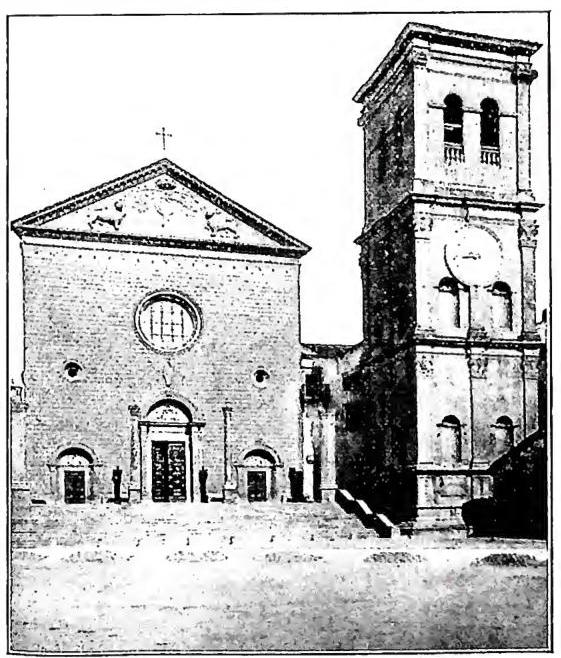
(Alinari photograph) LAZIO - Church of S. Maria della Quercia, by Carlo di Maristeo and Domenico da Firenze (beginning of the 16th century) - Viterbo.