
BARLETTA. – In the province of Bari, on the Adriatic Sea.
I. THE DIOCESE
Called Baretum by Strabo, and Barulum by the Latins. In Roman times it was the port of Canusium and often served as a refuge for the inhabitants of that city,especially after its destruction. B. itself, however, was in turn contested by the Goths, Byzantines, Lombards, and Normans. It was the refugees from Canusium who established the borough of S. Antonio in B. B. acquired considerable importance during the period of the Crusades, because its port, the only well-defended one south of Ancona, served as a base for expeditions and journeys to the Holy Land. The Knights Hospitaller and the Templars built residences there; the city also flourished under the Angevins. There are no documents concerning the penetration of Christianity,
which came by sea or from nearby Canusium. When the latter was destroyed, B., after a period of a certain autonomy under the archpriest of the church of S. Maria in Auxilio, founded by the refugees from Canusium, came under the jurisdiction of the archbishop of Trani, as attested by the bull of Alexander II of 1063 and by those subsequently issued by Urban II, Callistus II, Adrian IV, Alexander III, and Celestine II. The two churches of B. in the borough of S. Antonio, the Santo Sepolcro and S. Maria di Nazareth, date from the beginning of the 12th century. The former was a filial church of the basilica of the Holy Sepulchre and was served by a Chapter of regular canons.
The latter was the principal church of the archbishop of Nazareth in Galilee. At the fall of Palestine in 1187, the archbishop of Nazareth took refuge in B. and remained there until 1229. Later, Pope Alexander IV granted the archbishops of Nazareth permission to reside in Acre, and Pope Clement IV permitted them the use of the pallium and the Cross, especially in the churches subject to them in Italy. After the fall of Acre in 1291, the archbishop of Nazareth settled once again in B. with full episcopal jurisdiction, retaining the rights and privileges of the churches of Nazareth. In 1455 Callistus III united with the see of Nazareth in B. Canosa (v.), a union confirmed by the subsequent bulls of Clement VII (3 July 1521) and Paul III (3 Nov. 1534), which also added the diocese of Monteverde. With his bull of 29 Apr. 1566, S. Pius V granted the three united dioceses the church of S. Bartolomeo within B., in exchange for the ancient basilica of S. Maria; the new cathedral of S. Maria di Nazareth was consecrated on 4 Nov. 1571. From 1604 to 1608 the archbishop of Nazareth was Maffeo Barberini, later Urban VIII. In 1818 Pope Pius VII united Monteverde with the diocese of S. Angelo dei Lombardi, while Nazareth and Canosa were united with Trani. Leo XII merged the Chapters
of S. Maria di Nazareth and S. Maria Maggiore in B. By the motu-proprio of 21 Apr. 1860, Pius IX separated the territory of B. from that of Trani, erecting a new diocese with the archiepiscopal title, with its residence in the palace of the former archbishops of Nazareth. In fact, from that time the archbishop of Trani has also been archbishop of B. In the church of the Holy Sepulchre, after the suppression of the regular Canons (1489), the Knights of the Order of Malta established their priory of S. Giovanni there in the 16th century.
Enrico Jesi
II. ART
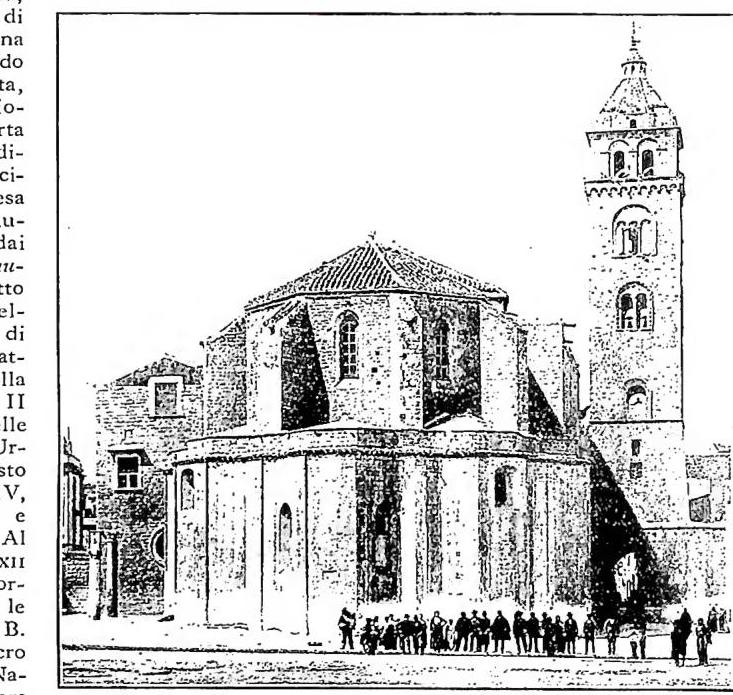
The Cathedral is the city’s most prominent monument. Its construction was begun before 1150 by a Simiacca and his son, Luca di B., but it was not consecrated until 1267; it was subsequently enlarged toward the presbytery in the early years of the fourteenth century, and the apse was completed in the fifteenth.The façade, whose central section is very high, is adorned with beautiful traceried bifora windows. The interior, with three naves, reflects in the arrangement of its parts the history of the building’s construction. Indeed, the first four bays, resting on monolithic columns, belong to the Romanesque building; then follows the enlargement of the fourteenth century, with groin vaults and piers. This second part of the church is joined to the Romanesque section by means of a round arch, followed by three pointed arches.
The pulpit and the ciborium, similar to that of the church of S. Nicola at Bari, are noteworthy; the latter, however, has capitals enriched with exuberant decoration. In the apsidal ambulatory, in a small altar, there is preserved a panel painted on both sides by Paolo Serafini da Modena (signed 1387): on one side the Redeemer is depicted, and on the other the Madonna with the Child. This image is called Madonna della Disfida, because it is said to have been carried in procession to meet the thirteen victorious Italians on the day of the famous battle.
Not far from the Cathedral stands the sixteenth-century church of S. Pietro. That of the Holy Sepulchre, dating from the eleventh century but rebuilt at the end of the thirteenth, is of much greater interest.
The façade originally had two quadrangular bell towers; only the truncated one on the left remains. In the left side wall there is a fine portal with pointed arches, like the small arches in the crowning of the three apses. The interior reflects, in addition to the pronaos, in the ribbed vaults and in the tower over the transept, elements of Burgundian Gothic architecture, which at that time also enjoyed some diffusion in southern Italy. Near the church stands the famous Colossus of B. It is a bronze statue
The church of S. Andrea, too, which boasts very ancient origins (6th cent.) but which in its present form dates from the Romanesque period, is of considerable interest. On the portal there is a relief of Christ blessing between the Madonna and the Baptist.
In the altered interior there is a fine wooden choir, carved in 1599 by the Neapolitan F. Ferrara; in the sacristy there is preserved a Madonna with Child, signed and dated by Alvise Vivarini in 1483.
Various other buildings in B. preserve Romanesque elements. Among the monuments of a civil character, the Castello deserves particular mention; its origins date back to the 11th cent., but it was repeatedly remodelled and enlarged, especially during the 16th cent.
Also of interest are the sixteenth-century Palazzo della Marra and the Baroque Monte di Pietà. B. also has a picture gallery containing works by modern painters, above all by Giuseppe De Nittis, a native of the city.
III. MASSACRE OF B
This was one of the episodes most exploited by Protestant propaganda, occurring in March 1866. The Protestants appear to rely solely on the account written by their coreligionist Gaetano Giannini (who witnessed only the very beginning of the “massacre”) and subsequently published in Eco della Verità, a Waldensian newspaper, on 31 August of that same year. But from the account of a witness who attended all the events—Antonio Marana—it may be inferred that matters unfolded very differently from Giannini’s narrative. That is: the few Protestants of Barletta, led by Giannini, had with impunity offended the religious sentiments of the Catholics of Barletta, especially with regard to the Most Holy Sacrament of the Eucharist. Having appealed unsuccessfully to the mayor and the sub-prefect, the Catholics decided to stage a protest demonstration. While this proceeded peacefully and calmly, led by Canon Gorgoglione, another was formed under the leadership of the peasant Raffaele Fiorella, nicknamed Annita, who bore grievances against the Protestant Decuratolo. Fiorella, having found his enemy in the house where Giannini was, immediately killed him, while Giannini, assisted by Canon Rizzi, was able to save himself. After this crime, the same group led by Fiorella killed a young Catholic, Ignazio Lanza, believing him to be a Protestant. Gorgoglione’s group, at a certain point, having abandoned the canon, proceeded to a house where two Protestants lived, threw their belongings into the street and burned them, allowing the men time to escape.In the trial that was instituted, the authorities sentenced the guilty parties; but they acted unjustly in also sentencing two innocent priests to twenty years of hard labour. These appealed to the court of Lucera, by which they were acquitted for lack of evidence. The author of the memorandum adds: “anyone wishing further particulars must read the records of the trial held at Trani and then at Lucera.”
The continuator of Foxe’s Protestant Martyrology, W. Bramley-Moore, following an unclear indication in Giannini’s letter, asserts that there were thirteen victims; whereas there were only two, a poor young Catholic and the Protestant Decuratolo, the latter killed more out of Annita’s personal vengeance than for religious reasons. In the same author we find a macabre description, the fruit of his imagination. He says that the inhabitants of the Protestants’ houses were thrown from the windows and quartered; that the mutilated victims, some already dead and others dying, were burned in the streets; that enraged women stoned and stabbed many of those unfortunate people and, with demoniacal (unearthly) cries, danced around the pyre of the victims. Moreover, the claim that this whole affair was directed by Rome in order to prevent the French troops from withdrawing from the Papal States is so evidently absurd that it does not even deserve refutation. It was indeed blameworthy that popular anger should have vented itself in bloodshed, but its cause was the public insult and provocation offered by a few Protestants to the faith of the city’s great majority. - See Plate LVIII.
For the modern diocese of B. V. TRANI.