
BALBINA, saint. — She is unknown to the Martyrologium Hieronymianum; she appears not as a martyr, but as a virgin and daughter of the tribune Quirinus in the legendary Passio of Saints Alexander, Eventius, and Theodulus (Acta SS. Maii, III, p. 375); the place of her burial is not indicated. Because of a misunderstood topographical indication, Florus introduced her into his Martyrologium on 18 June; Ado, instead, on 31 March, adding that she was buried in the cemetery of Praetextatus with her father Quirinus. She is listed under the same date in the present Roman Martyrology.
A suburban cemetery and an urban titular church bear her name.
The former was situated on the Via Ardeatina; Pope Marcus built a basilica there, in which he himself was later buried (336), as attested by the Depositio episcoporum and the Liber pontificalis, in the biography of
Two inscriptions concerning the purchase of burial places mention, one, in Balbinis basilica sub teglata (E. Diehl, Inscr. Chr. lat. vet., no. 2143), and the other, a new gallery of the subterranean cemetery, in cymiteriu Balbinae in crypta noba (E. Diehl, ibid., no. 2149). De Rossi believed that he could identify the cemetery of B. not far from that of Callistus (Roma sotterranea, I, Rome 1864, pp. 221, 265, 269); Wilpert likewise, in his topographical study of the Christian monuments on the Via Appia and the Via Ardeatina (in Römische Quartalschrift, 15 [1901], pp. 32–49); but the identification remains doubtful, both because it has not been confirmed by monumental discoveries and because the ancient Via Ardeatina left the Porta Ardeatina of the Aurelian walls, destroyed in the sixteenth century, at the place where Sangallo erected his bastion (C. Huelsen, in Bull. dell’Ist. archeol. germanico, 9 [1894], p. 320), while its course, much farther to the right than the present road, was discovered in 1933, during the laying of the foundations of the Ospizio di San Michele, to the right of the cemetery of Domitilla.
The titulus sanctae B. appears for the first time in the Roman Synod of 595; it is not known whether it existed earlier or under another designation. The titular church is situated on the Small Aventine, near the Baths of Caracalla and the house of Cilo. The building consists of a large rectangular hall made up of three different structures, with niches and a semicircular apse. It is uncertain whether the present church is a profane building from approximately the middle of the fourth century A.D., subsequently adapted for worship. The present portico (late sixteenth century) is an enlargement of the earlier one; in 1928 a thorough restoration of the entire building was completed.
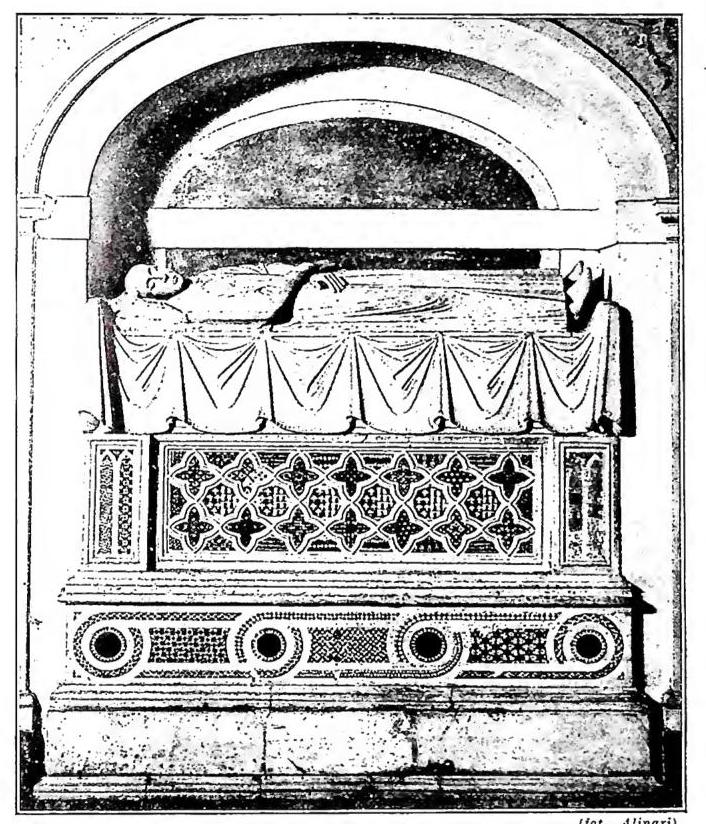
The large arched windows, six on each side, three in the façade and four in the apse, were reopened. Votive paintings dating from between the ninth and fourteenth centuries were found on the walls, representing the Madonna enthroned between the Apostles Peter and Paul, the Crucifixion of Saint Peter, Saints, and donors; traces of the schola cantorum were found and it was reconstructed at the expense of Cardinal Verdier, then titular. An earlier conservation restoration had been carried out in the second half of the fifteenth century by Cardinal Marco Barbo. Of particular note is the funerary monument of Stefano de Surdia (d. 1300), the work of the Roman marble sculptor Giovanni di Cosma, transported there from the ancient Vatican basilica in the seventeenth century.
It is among the churches served by the Vatican Chapter. — Vedi Tav. XLV.
BIBLI: Martyr. Romanum, p. 119; J. P. Kirsch, Die römischen Titelkirchen im Altertum, Paderborn 1918, pp. 94–96; A. Muñoz, in Capitulum, 6 [1931], p. 34 ff.; H. Delchaye, Etude sur le légendier romain, Bruxelles 1936, p. 31; R. Krautheimer, Corpus Basil. Christ. Romae, I, Città del Vaticano 1937, pp. 84–93.