
IVORY (ART). — Artifacts in ivory are frequent in the funerary furnishings of early Christianity; they were often affixed to loculi in underground cemeteries as identifying signs or decorative elements. For the most part, these consisted of tesserae, disks or cubes for games, often jointed dolls, plaques, small valves, combs, etc. Later, however, ivory objects appear as decoration for cathedras (v.), caskets, capsellae (v.), reliquaries (v.), diptychs (v.), Gospel-book covers, pyxides (v.), croziers (v.), etc., with representations drawn from the Old or New Testament or other iconographic scenes. The craftsmen belonged especially to the Hellenistic schools of Alexandria, Antioch, and Constantinople, and the ivory cathedra of Bishop Massimiano of Ravenna (545–56) is, by the number of its scenes, their most distinguished product.
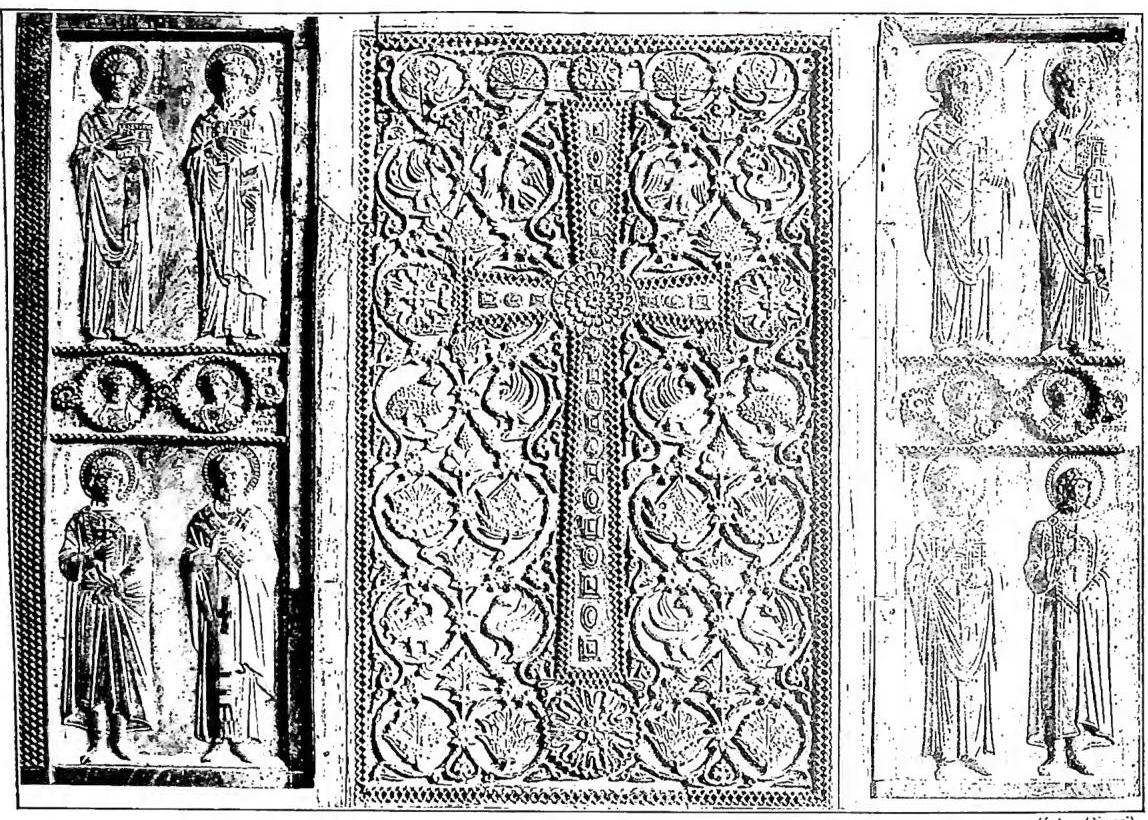
Between the 10th and 11th centuries and then in the 12th, while in the East the Byzantine style reappeared in ivory carvings of religious subjects in all its noble compositional grandeur (the Harbeville triptych in the Louvre), this type of sculptural activity also flourished in Germany. A group of ivories, perhaps Lombard, is associated with that Ottonian flowering; the most famous is the bucket of Bishop Gotifredo (974–98) in the cathedral of Milan.
During the Romanesque period, works in ivory reflecting the new stylistic currents were produced in Germany, with Cologne as its center, in Spain, and also in Italy—here especially in the south (the Paliotto of Salerno) and in Sicily, where the influence of Eastern art was more vigorous.
The Gothic taste restored the practice of ivory carving to great favor in France, and works of the highest quality were then produced.
From this point onward, the characteristics of ivory sculpture no longer differed stylistically from those of other sculpture, as they had, for various reasons, during the early Middle Ages. Such is the case with Giovanni Pisano’s Madonna in the cathedral of Pisa (1299). And not only in Italy, but also in France, ivory was often replaced by bone (v. EMBRIACHI).
The masterpieces of Italian Renaissance ivory sculpture are the reliefs in the cathedral of Graz, which translate designs by Mantegna. By now the working of ivory was reserved for specialized craftsmen who translated models or copied the works of major sculptors, and it is futile to try to assign illustrious names to works that are technically perfect but lack originality of conception. Admirable examples of Renaissance and Baroque ivories are found in Florence, in the Museo Nazionale and the Museo degli Argenti; in Munich, in the National-Museum; and in Vienna, in the Kunsthistorisches Museum. — Vedi Tavv. XXXV-XXXVI.