
ALESSANDRO, EVENZIO and TEODULO, saints, martyrs. — The Hieronymian Martyrology, the Gregorian Sacramentary, and the Gelasian Sacramentary of the eighth century commemorate them on 3 May: Romae, Via Nomentana, miliario VII, natale sanctorum Eventii, Alexandri et Theoduli (Martyr. Hieronymianum, p. 227).
The history of this group of martyrs is not known to us from trustworthy texts. Without foundation, the authors of the Liber Pontificalis (ed. L. Duchesne, I, pp. XLI–XLII, 127) and of the Passio Alexandri (BHL, 266) identified this A. with the homonymous Pope, name (v.), and made Evenzio and Teodulo two members of the Roman clergy. The two authors are not interdependent, but reflect a common tradition concerning the identification, the date of the martyrdom, and the place of burial. They nevertheless differ on other points of considerable importance: whereas the Liber Pont. has A. die by decapitation and declares E. a priest and T. a deacon, the Passio has A. die after various tortures, following the infliction of wounds by puncturing his entire body, and assigns priestly dignity to his companions. In reality, however, these were three martyrs, probably victims of the Diocletian persecution, belonging to the community of Ficulea or Nomentum.
They were buried in two different galleries of a modest rural cemetery: Evenzio and A. together, and Teodulo alone at a site that has not yet been identified with certainty.
Two small shrines were erected over their tombs toward the end of the fourth century. During the following century they were repeatedly joined and enlarged without adherence to any overall plan, resulting in a monumental complex that was grandiose but irregular in form. The principal altar, now almost entirely reconstructed, was erected over the tombs (a two-person burial place that remained off-axis and oblique to the hall) of Evenzio and A. by Bishop Orso of Nomentum at the beginning of the fifth century, as may be inferred from the dedicatory inscription. It should be noted that A.’s name appears after the others in the oldest documents—the aforementioned inscription and the Mart. geron.—whereas it precedes them in the Passio, in the two Sacramentaries cited, and in the Notitia of Guglielmo di Malmesbury (ed. Valentini-Zucchetti, Roma 1942, p. 145). The shrine, which fell into ruin after the seventh century, was rediscovered in 1854 and completely restored in 1936. Of the original cemetery, only a few galleries remain, with some crude painted decoration and a fair number of graffiti and inscriptions, some of them dating from the fourth to the sixth centuries.
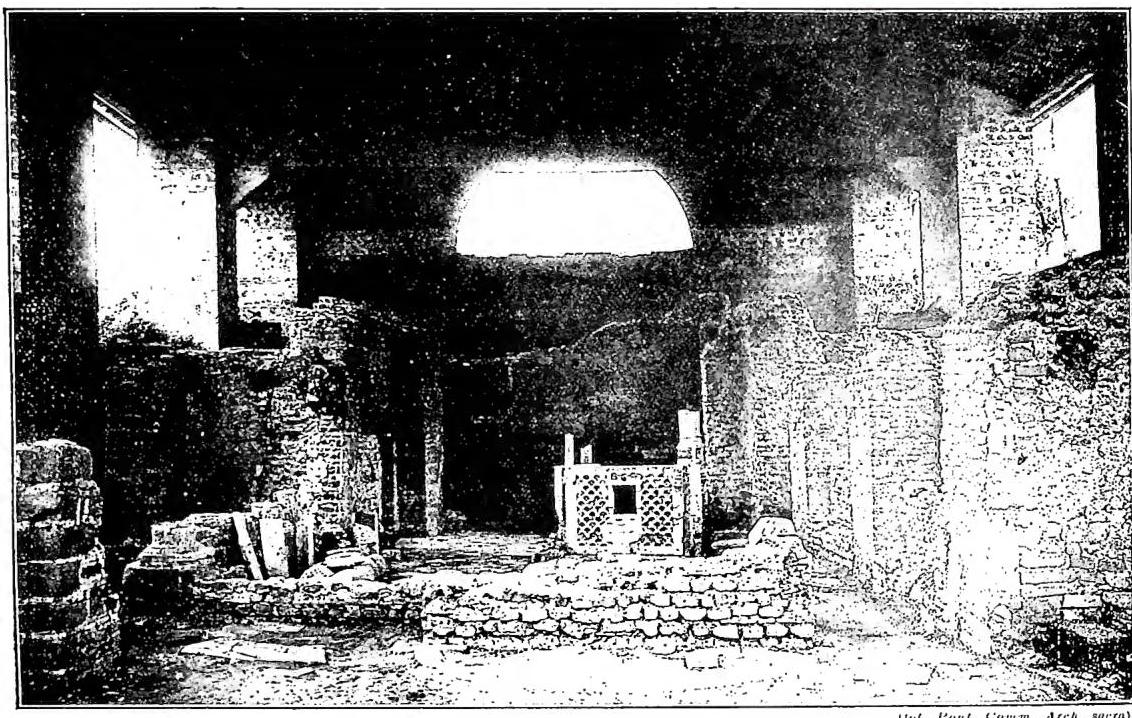
(Int. Pont. Comm. Arch. sacra)
ALESSANDRO, EVENZIO E TEODULO, saints — Southern interior of the Basilica dedicated to the martyrs, with altar and presbyteral enclosure (fifth century) — Roma, Cemetery of S. Alessandro on the Via Nomentana.
basilica di S. Alessandro al VII miglio della via Nomentana, Roma 1922; id., Le Catacombe Romane, ed. E. Josi, Roma 1933, pp. 412–23; G. Belvederi, La basilica e il cimitero di S. Alessandro al VII miglio sulla via Nomentana, in Rivista di Archeologia Cristiana, 14 (1937), pp. 7–40, 199–224; 15 (1938), pp. 19–34, 225–46 (detailed description of the monumental complex). A. Pietro Frutaz