
BAYEUX. — City on the Aure River, department of Calvados; it had various names in antiquity: Ptolemy calls it Arigenus Biducosiorum, the Peutinger Table: Arogenne, then Baiocum, Iulobona, Biduatium. Conquered by the Romans, it formed part of the province of Lugdunensis Secunda. Taken by Clovis, under the Franks it constituted the comitatus Baiocensis. It was devastated several times by the Normans.
The origins of the diocese of B. are uncertain. Neither the two earliest recensions of the Hieronymian Martyrology nor the Martyrology of Ado mention any saint of this diocese; in the incomplete Martyrology of Usuard, only the bishop St. Vigore is mentioned, who is also found in a tenth-century manuscript of the Hieronymian Martyrology together with Bishop Giovanni. As for tradition, it may be summarized in three legends, the oldest of which may date back to the eighth century. The episcopal lists that have come down to us date from the twelfth century; the first bishop mentioned is Esuperius, whose name is engraved on a silver platter that he donated to the church (cf. G. Morin, Missorium de Saint-Exupère. Note sur un plateau offert à l'Eglise de B. par son premier évêque, in Mélanges d’arch. et d’hist., 18 [1898], pp. 363–79). In the modern age B. is often called the diocese of the Saints, because it numbers more than thirty among them, including the recently canonized St. Giovanni Eudes.
The Cathedral, built in the sixth century, burned down in 1105; the capitals of the crypt and of the façade towers, dating from the twelfth century, have survived, and to the same period also belong
ida J. Clédat, Le monastère et la nécropole de Baoult, in: Mémoires publiés par les membres de l'Inst. franc. d'arch. orient., XII, Cairo 1911
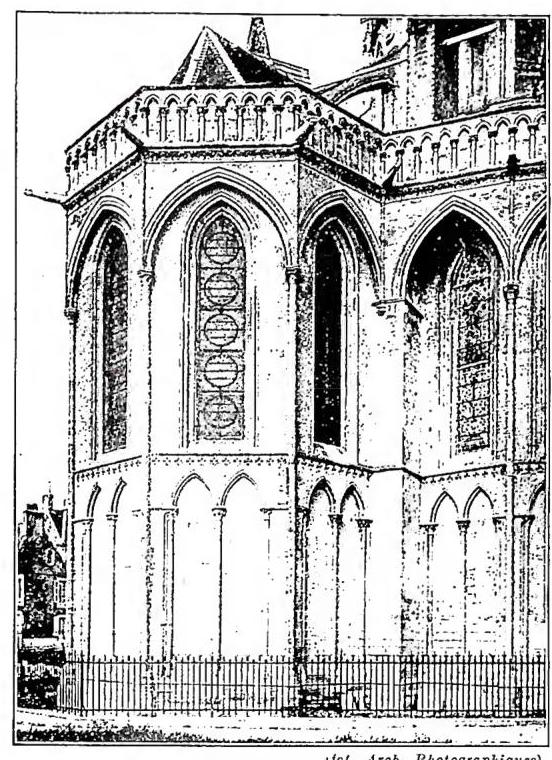
(phot. Arch. Photographiques) BAYEUX - Apse of the Cathedral (13th–14th centuries).
The diocese comprised twelve monasteries for men, including five Benedictine ones (the oldest was that of S. Vigore at Cerizy-la-Forêt), as well as two abbeys and five convents for women.
Since 1855 the bishop has also been Lisieux (v.).
At present the diocese of B. has 380,000 Catholics out of 396,318 inhabitants, 718 parishes, 7,488 diocesan priests, and 50 religious priests (1948). It is divided into two archdeaconries: the first of B., Caen (v.), the most important center of the diocese; and the second of Lisieux. It has a major seminary at B. and the minor seminary of La Maladrerie at Caen.