Machine translation of the 1948–1954 Italian original. The original text is authoritative.
CAEN. – Currently the capital of the department of Calvados (France). It is first mentioned in 1027 under the name Cadomum, but was still merely a village 12 km from the English Channel when William the Conqueror and his wife Matilda, in atonement for the wrongs they had committed, erected the Abbaye aux dames, with its adjoining church dedicated to the Most Holy Trinity (1066), and the Abbaye aux hommes, with its adjoining church consecrated to St. Stefano (1077). It may be said that the true foundation of C. dates from the construction
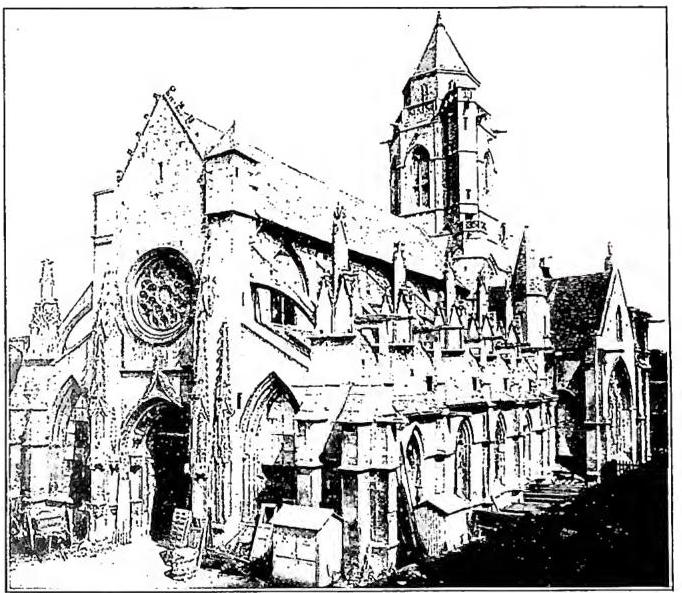
CAEN – Church known as the “Old S. Stefano” (15th century). The construction of these two abbeys gave the city a considerable impetus.Other noteworthy churches are: S. Nicola (1083–93); S. Pietro (1521–35); S. Salvatore, with two apses, one Gothic and the other from the seventeenth century; Notre-Dame-de-la-Gloriette (1609). It forms part of the diocese of Bayeux and has seven parishes. It has been the seat of a university since 1436, as well as of an Académie des arts, sciences et belles lettres and the Société des antiquaires de Normandie. Above all, however, the Institut du Bon Sauveur should be mentioned, founded in 1712 at St-Lô by a small group of «sœurs associées pour les petites écoles»; from 1726 the institution took the name «Sœurs du Bon Sauveur», after the small adjoining oratory dedicated to the Most Holy Saviour. Anna Leroy and Margherita Lecouvreur de la Fontaine established a house there in C. in 1720. In 1790 the priest Pietro Jamet was appointed its confessor; born at Fresne (Orne) on 12 September 1762 and died at C. on 12 January 1845, he brought the institution to such prosperity that he is regarded as the second founder of the Institut du Bon Sauveur. His very special achievement was the establishment of a new method of education for the deaf and dumb (G. A. Simon, L'abbé Pierre-François Jamet, Caen 1935). – Vedi Tav. XIX.
BIBL.: R. Ruprich, L'église de la Ste-Trinité et l'église de St-Etienne, Caen 1864; G. Vanel, Une grande ville au XVIIe et au XVIIIe siècle, ibid. 1910–12. Enrico Josi
Cite this article
“CAEN.” Enciclopedia Cattolica, vol. III (1949), p. 183. Azione Romana digital edition, https://azioneromana.com/article/caen.