
TOLOMEO (TOLEMEO), CLAUDIO. — Astronomer, geographer, and mathematician, born perhaps at Ptolemais in the Thebaid around 100 A.D., he lived in Alexandria in Egypt and died at Canopus around 178 A.D.
His principal work is the great treatise in 13 books, Μεγάλη Σύνταξις (“Great Compendium”). The Arab translators, perhaps out of admiration, changed μεγάλη (= great) into the superlative μεγίστη (= greatest), whence the Arabic Al Magisti, the Latin Almagestum, and the Italian Almagesto. The work acquired great renown in the East and the West, and for approximately 14 centuries remained the principal treatise on astronomy. It went through many editions and was translated from Greek into Arabic around the year 827 A.D. by order of the caliph of Baghdad, Almamon; and into Latin around 1230, so that Dante learned of it and perhaps drew from it his knowledge of the Southern Cross, mentioned in the Purg., I, 23 ff. The treatise is for the most part a compilation. After a trigonometric introduction, it proceeds to describe the order of the Universe; the movements of the sun and moon, eclipses, and the movements of the planets, with a catalogue of 1,028 stars.
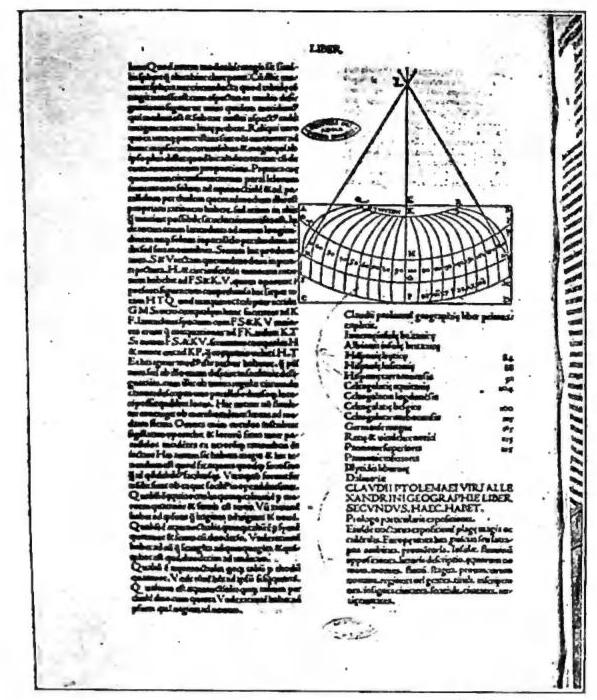
TOLOMEO, CLAUDIO – End of Book I and beginning of Book II of the Latin version of the Cosmographia, Rome, Pietro de Turre, 4 Nov. 1490, fol. 45v – Rome, copy in the Biblioteca nazionale.
The Ptolemaic system is based on the theory of Hipparchus, with the spherical Earth placed at the center of the celestial sphere. The Earth is of such insignificant dimensions that any point on its surface may be regarded as the center of the universe. The Sun and the Moon move along circles of which the Earth occupies a point very near the center. In this regard T. completed Hipparchus’s explanation of the Moon’s motion by introducing a new irregularity, the variation, which has been confirmed by celestial mechanics; he also determined approximately the mean distance between the Moon and the Earth. To account for the complicated apparent motion of the planets, which seem to move among the stars now in one direction, now in the opposite direction, and at times seem to stand still, T. imagines that each of them moves by describing a circle called an epicycle, a point very near whose center in turn moves, always in the same direction, upon another circle called the deferent, which has the Earth nearly at its center.
T.’s contribution to geometry and trigonometry is noteworthy: worth recalling are the rules he proposed for constructing a table of chords, T.’s theorem on the quadrilateral inscribed in a circle, and the applications of the stereographic projection devised by Hipparchus.
Gabriella Armellini Conti
T.’s geographical work had less resonance than his astronomical work, although he shared with Marinus of Tyre the merit of having scientifically established the geographical heritage of classical antiquity; moreover, while the work of Marinus (who lived in Alexandria and flourished no later than A.D. 120) was lost, that of T. survived throughout the Middle Ages to the present day.
As can be inferred from T. himself, Marinus, author of a Τοῦ γεωγραφικῶ πύκλους διόροσις, taking up the theories of Hipparchus (one of the greatest astronomers of antiquity, born at Nicaea in Bithynia and who carried out much of his activity at Rhodes between 161 and 126 B.C.), had departed from the Eratosthenian model, maintaining that the position of places could be calculated by the same method used to establish the position of the stars on the
celestial sphere, using only latitude and longitude: he nevertheless imagined that the ecumene extended from the Canaries to China over 225°, an excessively exaggerated extent, and his map, constructed on the basis of a network of straight parallels and meridians, according to an equidistant cylindrical projection and without taking account of the convergence of the meridians toward the pole, displayed very great distortions in the peripheral regions. T. intended to reduce the errors of Marinus of Tyre, but although he remained essentially bound to his predecessor’s system both in the Almagest and in the Μαθηματικὴ σύνταξις πετράβιβλος, a complement to the former, and in his minor astronomical works, he instead demonstrated original conceptions in the more properly geographical field and particularly in cartography by compiling the Γεωγραφικὴ ὑφήγησις. He reduced the extent of the ecumene to 180°, approaching its actual extent of 125°; he accepted the cylindrical projection only for representing small portions of the earth’s surface (chorographic maps); he proposed a simple conical projection in which the meridians are straight lines converging toward the poles and the parallels are concentric arcs of circles; and on these foundations he constructed, or at least laid the foundations for constructing, a general map of the known world comprising the entire territory from N. to S. between Thule and Agisymba, and from E. to W. from the Canary (Fortunate) Islands to Sera Metropolis, capital of the country of the Seres (China). Scholars indeed debate whether the 27 maps (one general and the others regional) inserted in the medieval manuscripts of his work (foremost among them Urbinate Greek 82, in the Biblioteca apostolica Vaticana, from the 12th century) derive directly from T., albeit with inevitable distortions in the development of the tradition, or were instead constructed later on the basis of T.’s text, which, moreover, consisting essentially of a long list of localities with their respective latitude and longitude, was particularly subject to corruptions.
The (erroneous) value assigned to the measurement of the earth’s greatest circumference, 180,000 stadia (approximately 33,000 km, considerably less than the actual 40,070 km), exerted an influence, perpetuated through the Middle Ages, even on the calculations of Cristoforo Colombo and on the discovery of the New World. Other errors by T. also affected later cartography, especially Arabic cartography, such as the exaggerated east-west stretching of the Mediterranean Sea, the orientation of the Italian peninsula, and his closing of the Indian Ocean south of Zanzibar, where the African coast is made to turn decisively eastward.
While T.’s astronomical work, disseminated chiefly through the Arabs, remained the foundation of all medieval cosmography and scholastic philosophy, his geographical work had little success, especially in the West, where only in the 15th century did a first Latin translation, in 1409, mark the beginning of a new era in the history of cartography.
T. also wrote on chronology, mechanics, optics, music, and so forth.
TOLOMEO, GNOSTICO. 7 Representative of the western branch of the Valentinian school.
He probably lived in Rome. He was the author of an Epistola to a certain Flora, otherwise unknown. The letter has been preserved in Epiphanius (Panar. haer., 33, 3–8: PG 41, 558–68).
The subject is the evaluation of the Law of Moses. T. seeks a middle way between the position of the Church and that of Marcion. The law comes partly from God, partly from Moses, and partly from the traditions of the elders of the people. The Law of Moses is the work of the Demiurge, who stands midway between the good God and the devil. Although the epistle presupposes Valentinian speculation, it does not directly express the doctrine of the sect.