
LUNA. – Satellite of the Earth, from which it probably originated through the subdivision of the still-fluid terrestrial mass (v. COSMOGONIA). According to the theory of the astronomer G. Darwin (son of the naturalist Ch. Darwin), in the earliest times the L. was very close to the Earth and would have completed its revolution around it in only five hours. It would then have moved away from it as a result of the tides, and would in fact still be continuing to move away, until reaching a distance approximately one and a half times the present one, at which it will complete a revolution in fifty-five days. It can be demonstrated that at that time the Earth too will rotate in the same period, so that eventually the day and the lunar month will become equal to 55 present-day days. Probably, even when the L. solidified, its distance was less than it is today. Armellini has indeed demonstrated that this would precisely explain the slightly elongated ellipsoidal shape (resembling an egg) of the lunar globe. At present the L. revolves around the Earth from west to east (direct motion), along an elliptical orbit whose focus is the terrestrial centre of gravity, at a mean distance of 384,440 km., completing one revolution in 27° 7' 43' 11'.
This interval of time is called the sidereal revolution, and must not be confused with the synodic revolution, which is the time the L. takes to return to conjunction with the Sun (the interval between two consecutive new moons = 29° 12' 44' 3'), determining the phases of the Moon and the consequent movable feasts. The point of the lunar orbit nearest the Earth is called the perigee and lies at a distance of 363,000 km.; the most distant is the apogee and lies at 406,000 km. The line joining the perigee to the apogee is called the line of apsides and rotates on the plane of the lunar orbit from west to east in 8 years and 310 days. The plane of the lunar orbit intersects the plane of the ecliptic along a line called the line of the nodes, which rotates on the plane of the ecliptic from east to west in 18 years and 219 days. The L. revolves while presenting always the same face to the Earth, which means that it rotates about its own axis in a time equal to the duration of the sidereal revolution. However, since the lunar orbit is slightly elliptical, according to the law of areas (v. REPLER), the speed of revolution is not uniform, whereas the speed of rotation is uniform; consequently, the lunar disk seems to undergo small oscillations (which astronomers call librations in longitude), revealing and concealing regions near the edges over an extent of approximately 8°. Moreover, since the lunar axis of rotation is inclined by 83° 30' to the orbit of the L. around the Earth, there is a libration in latitude, by which one or the other of the two lunar poles can be seen at different times, over an extent of approximately 6°. Finally, because the observer is on the surface and not at the centre of the Earth, there is a third form of apparent oscillation, called diurnal libration, over an extent of approximately 1°. All these librations (discovered by Galileo) make it possible to observe approximately 6/10 of the lunar surface. In its revolution around the Earth, the L. is twice aligned with the Earth itself and with the Sun: once in conjunction (that is, between the Sun and the Earth), when it presents its shadowed face and there is a new moon; and once in opposition (that is, on the side opposite the Sun), when it presents its illuminated face and there is a full moon. The quadratures (that is, the first and last quarters) occur when the line joining the Earth and the Sun forms a right angle with the line joining the Earth and the L. If new or full moons occur near the line of the nodes, there may be an eclipse of the Sun or of the L.
The diameter of the lunar globe is approximately 3,470 km.; that is, slightly more than one quarter of the Earth’s diameter, which is approximately 12,700 km. The lunar mass is approximately 1/81 of the terrestrial mass, so that the mean density of the L. relative to water is 3.33, that is, considerably lower than the terrestrial density, which is 5.52. Gravity at the surface of the L. is approximately 1/6 of gravity at the Earth’s surface; thus a man weighing 72 kg. would weigh approximately 12 kg. on the lunar surface. The L. has no atmosphere, or has traces so minimal that they cannot be detected by our instruments. This is shown through the telescope by the absolute absence of clouds, by the sharpness of the lunar relief even near the edges, by the absolute absence of refraction phenomena during solar eclipses, by the instantaneous disappearance, without any change of colour, of stars that may be occulted, and finally by spectroscopic examination of the light reflected from the lunar surface. It is nevertheless believed that the L., given its probable common origin with the Earth, initially had an atmosphere similar to the terrestrial one, which was soon dispersed into space, also because of the weak attractive force of the lunar globe. Consequently, there is no water on the L., since otherwise it would evaporate and form an atmosphere of vapour.
The L. reflects the light of the Sun, and modern photometric research has established that its albedo (reflective power) is approximately 0.07; that is, the full L. reflects approximately 7% of the light it receives from the Sun. Its luminosity decreases very rapidly with the phases and as elongation increases (the angular distance of the L. from the Sun), which suggests a considerable roughness of the lunar soil. It has also been found that the surface temperature of the L., examined with a thermoelectric pile placed at the focus of large telescopes, varies from approximately 80° above zero during the lunar day, which lasts for half a lunation—that is, 14 terrestrial days—to approximately 200° below zero, and perhaps even less, during the lunar night. This considerable temperature variation is explained by recalling that the lunar rocks are exposed to 14 days of continuous sunlight, not attenuated by the shielding of an atmosphere, and to 14 days of night, during which the radiation of the stored heat is impeded by no atmospheric obstacle; and also by recalling that the considerable porosity of the planet’s surface makes conduction of the absorbed heat, both inward and outward, slow.
When examined with the naked eye or with small telescopes, the L. displays bright regions of a citrine-yellow colour, called Lunar Lands; and darker regions, grey in colour, which Galileo called Lunar Seas and which the ancients considered to be less dense regions—an opinion refuted by Dante (cf. segni bui in Dante, Paradiso, II, 49 ff.).
Its proximity to the Earth and the absence of an atmosphere have facilitated telescopic and photographic observation of the lunar surface, which modern means of investigation bring within an apparent distance of approximately 50 km. Even modest telescopes, moreover, suffice to reveal the rugged form of the lunar mountains, whose height has been deduced from the shadows they cast and has in some cases been found to reach approximately 7,600 metres. Indeed, observation of the lunar surface is extraordinarily evocative, both in the dazzling brightness of the full moon, which makes its smaller craters shine like silver basins, and in the raking light of the first and last quarters, which brings out the mountains and the elevations of the ground.
Lunar topography appears very different from terrestrial topography, since mountain ranges are scarce, whereas craters are extremely numerous, resembling terrestrial volcanic craters in part, but being far more numerous and extensive and having different characteristics. Indeed, while the largest terrestrial craters rarely exceed 12 km. in diameter, some lunar craters exceed 200 km.
Moreover, these extremely numerous craters, often grouped together and superimposed, generally have their floors situated at a level lower than that of the surrounding terrain (unlike the majority of terrestrial volcanoes); they often present a central cone, or even several cones, are enclosed by a ring of more or less precipitous rocks, and are completely lacking in any trace of volcanic activity. Indeed, these characteristics lead a number of astronomers to doubt the volcanic origin of the lunar craters; some of them (such as, for example, the American astronomer J. J. See) instead believe them to have been produced by the fall of large meteorites.
The dark areas of the lunar surface, called mari by Galileo, probably consist of great expanses of cooled lava. This was confirmed by research carried out at the Observatory of Rome, where, through a long series of photometric measurements, the albedo of the lunar continents and seas was determined; it was found that, whereas the albedo of the continents was very similar to that of the lighter volcanic materials (pumice or trachyte), the albedo of the seas could be compared with that of the basaltic lavas of Vesuvius. Later, the Russian astronomer Barabascheff found that the angle of polarization of the rocks constituting the lunar seas was also almost equal to that of lavas and basalts, thereby confirming our view. It should be noted, however, that these expanses of cooled lava appear to be furrowed by deep fissures, probably caused by contraction phenomena. Moreover, radiating streaks often begin at certain lunar craters and extend over great distances, forming a kind of ray system. Particularly characteristic is the ray system of streaks emanating from the crater of Tycho, near the lunar north pole, which can be seen when observing the full L. even with a simple pair of binoculars.
No manifestation of animal or plant life has ever been observed on the lunar surface; indeed, such life would be impossible because of the absence of water and atmosphere and the very considerable fluctuations in temperature.
Various atlases exist reproducing the appearance of the lunar surface, both in freehand drawings and in photographs. One of the first astronomers to draw a map of the L. was Hevel of Danzig, who gave the lunar seas names derived from the belief that the L. influenced meteorological conditions and other phenomena. Thus, on the L., there are the Mare Serenitatis, the Mare Tranquillitatis, the Mare Imbrium, etc. The lunar craters were given by Fr. Riccioli the names of great astronomers and philosophers: Aristotele, Platone, Copernico, Tycho, etc. The few mountain ranges were given names drawn from terrestrial orography: thus, on the L., there are the range of the Apennines, the Alps, etc.
Today the best lunar maps, made visually with the telescope, are those of Schmidt of the Observatory
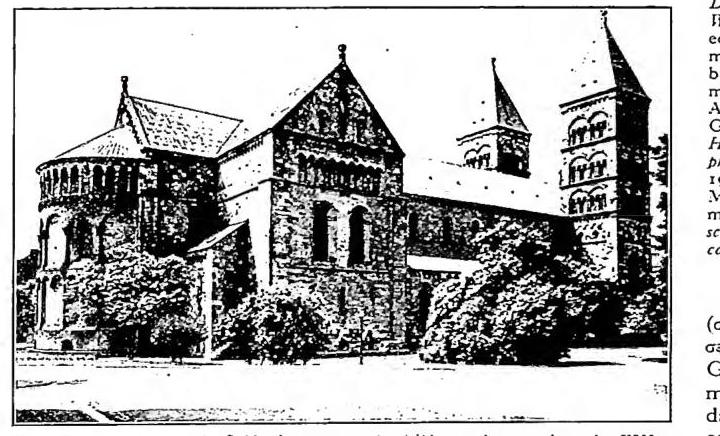
(from Guide des monuments visités par les membres du XIIIe Congrès International d'histoire de l'art, Stoccolma 1922, fig. 36)
LUND — Cathedral of L., erected in 1080, consecrated in 1145, destroyed by fire in 1234, and rebuilt immediately thereafter. The two bell towers date from the 12th century.