
COSMOGONY. - It is the complex of doctrines that explain the origin and formation of the universe.
The problem of the origin of the world and of man has occupied the human mind since the earliest stages of culture known to us today. Cosmogony and anthropogony, as a rule closely linked to each other, are traced back to the action of supernatural beings preexisting nature or the current cosmic order. Such action is mostly presented in mythical form.
I. "PRIMITIVE" CULTURES. - In the great variety of versions concerning cosmogony, it is possible to identify a certain number of fundamental motifs, handed down by tradition, which are however variously colored and enriched with legendary or poetic details by the imagination of each culture, each people, and often even each group within the same people. Like all cultural elements, these myths spread and migrate, and may also decay, impoverish, transform, and disappear. Modern historical-cultural inquiry has nevertheless allowed, through the critical examination of the rich materials known so far, to ascertain the undeniable antiquity of the notion of a personal supreme Being, creator, who in the majority of cases constitutes the central figure of myths about cosmogony. This Being, mostly conceived anthropomorphically but at the same time with supernatural attributes, sometimes creates ex nihilo, or, more often, fashions from preexisting materials the earth, the stars, animals, and man, operating either alone or with the collaboration of other beings or animals dependent on him. Mostly, the Creator begins his work within or above an informe chaos (sea, current, primordial swamp, darkness) from which he draws the world. The first men are created (in a single couple, in multiple couples, sometimes only the first male) from clay, wood, reeds, etc.; in some versions, the first man is made from the rib of the supreme Being (Cheyenne of Canada), and the first woman from the rib of man (Cheyenne, Nandi of Kenya, Vute of Cameroon, Bubi of Fernando Poo). Versions such as these, to which other motifs widespread among primitive peoples are added (sin of the first men, universal flood, etc.), raise the question of the relationships between the myths of natural peoples and the biblical tradition, a problem that is not always to be clarified by invoking direct or indirect missionary influences, at least as regards Asia and Africa.
While myth is the most universally widespread form in which the version of cosmic and human origins is handed down, the set of animological conceptions of a people may sometimes document among them the presence, albeit faded, of a notion of cosmogony even when that people has not developed (or preserved) explicit myths on the subject. And, on the other hand, myth may not be simply a narrated tale but may be "represented" symbolically in the initiations of the young and in the so-called "mysteries of cosmogony" (Arapaho, Cheyenne, Central Australians, etc.); which demonstrates how the problem of origins in some primitive cultures assumes vital importance at the very basis of sociological formation.
Among the Pygmies, recognized as the most primitive of the current inhabitants of Africa or even (according to the school of p. W. Schmidt) of the entire globe, some beautiful cosmogonic myths have been collected, in which motifs of naive primitiveness are united with relatively elevated conceptions; and this especially among the western groups (Pygmies of Gabon). Knumm (the supreme Being), existing at the beginning of time, created the world with his word; he then sits on the bank of a stream near the great village of animals and molds statuettes in human form from earth of various colors (red, black, white, whence the various races), then commanding them to walk. According to another myth, at the beginning, the Creator, alone in the village, is bored, there is no one to prepare his food; therefore he thinks of making men. Having gathered many nuts, he places them in his canoe on the shores of the ocean and has them towed out to sea by the crocodile; having reached the open sea, he blows and spits on the nuts and throws them one by one into the sea, ordering them to become men and women. Equally vivid myths are not found among the other major group of Pygmies (of the Ituri, Belgian Congo), who nevertheless possess the notion and the cult of a supreme Being (Tore), creator of nature and of the first man. A multiplicity of conceptions is observed among the Asian Pygmies. The Semang of the Malay Peninsula do not possess clear notions about cosmogony; however, the idea of an indirect creation seems to prevail, either through the work of two mythical brothers, fashioned by the supreme Being, who in turn would have made the mountains and the stones from which men would then have arisen, or by means of an animal (the dung beetle), which would have drawn the earth from the primordial swamp. Contrasts are also presented by the conceptions of the Andamanese. Among the northern groups, there is the concept of a "self-creation" of man, born from the knot of a large bamboo or a tree (a singular parallel with the Melanesians). The name of this proto-ancestor is "the only one": indeed, he has no wife but cohabits with an anthill (a lunar symbol, as in certain Sudanese cosmogonies), and from this he has various children, who according to one version are the wind, the storm, the sky, the sea foam. Among the southern Andamanese groups, the figure of a supreme Being (Puluga, elsewhere called Biliku and sometimes conceived as female) stands out, who creates the first human couple.
Still in the field of peoples comparable to the Pygmies for extreme ethnological primitiveness, the concept of cosmogony does not seem to have been foreign to the Tasmanians, now extinct. The only brief myth collected on this subject among this people recounts that men were formed (it is not said how) by a benevolent Being; but at the origins they had physical imperfections until another merciful being descended from the sky to remedy them. No notion of cosmogony is found among the Vedda, pygmoid of Ceylon; but notable ethnological antiquity in the field of the primitives of India may perhaps be attributed to the beautiful myth of the Bhila (pre-Dravidian and pre-Munda?): original solitude of God, who reflects "whom shall I create?"; creation of minor deities bearing light, who, through the intervention of the Evil Spirit, are induced to neglect God's will; God's anger, who strikes and banishes them to earth; his new solitude and reflection, and finally the creation of man.
Reliable data on the existence of a concept of cosmogony are lacking for the Australian peoples recognized as the most archaic (Kurnai, Cepara), who nonetheless believe in the existence of a Supreme Being (Mungan ugana = "our father") preexisting the proto-ancestors of humanity. Such a figure, however, acquires greater prominence among the tribes—also quite primitive—assigned to the "boomerang culture" (southeastern Australia). The creator being of the Kulin, called Bungil or Pungel, is the author of the earth, trees, animals, and also of man. For this last work, Bungil prepares himself with his large knife, with which he cuts two slices of tree bark; he places mud upon them and molds two human beings of male sex; with other fibrous bark, he makes their hair, straight for one and curly for the other; he gives them two names, smooths them with his hands, and finally lies upon each one, breathing his breath into the mouth, nose, and navel of the creatures, which thus come to life. Before them, he expresses his joy by dancing around them at every successive stage of fabrication. Bungil, however, is not the creator of women, who are instead made (also in a number of two) by Paliyan, brother (or son) of the Supreme Being, who claps his hands upon the water of a deep pool until it thickens, taking human form. Here, with transparent symbolism, the generative value of water is adumbrated (in analogy with the waters of childbirth), a conception widespread among more than one primitive people. The Wiradyuri have the notion of a Supreme Being, Bayma (= Bayame), self-created, arisen from the crystalline mountain that serves as his throne, and creator ex nihilo of all things, including the first man, Daramalum. Daramalum, on the other hand, is also the name of the Supreme Being of the Yuin-Kuri, creator of men and trees: a typical example of a proto-ancestor elevated to divine dignity.
At an ethnological level akin to that of the Paleo-Australians, the Bushmen in Africa and the Fuegians in America may be assigned. Among both these groups, the figure of a creator god is not absent and sometimes holds considerable prominence, though it does not have a clear or exclusive function in the work of cosmogony. Among the northwestern Bushmen, the "great captain" Klu (XU) often shares creative functions with another figure, Nawa (Gawab), supreme among the evil spirits gawab, who in turn is more of a demiurge than a true creator. Among the Bushmen of the Maluti Mountains (southeastern group), the creator of the human race is Caug or Kaang, "lord..."; a primordial being with magical faculties who became evil over time. Elsewhere (among the Kham), Kaggen is the name of the mantis, who creates the moon by throwing a sandal or an ostrich feather into the dark sky. In general, semi-animal figures, demons of the bush and the hunt, dominate the myth here, their exploits overshadowing the clarity of cosmogonic versions. The notion of a Supreme Being is clearer among the Fuegians, but the creative activity of this being is mostly ignored or at least not reflected in explicit myths.
The Warawinewa of the Yahgan (as well as the Köl'ash of the Halakwulup) is recognized as lord of creation, particularly of animals, conceived as his possessions; to him, men declare themselves indebted for their existence. But whether he is the creator of them and of the world, the Yahgan cannot affirm, though they declare they have long been concerned with the question. More defined conceptions in this regard are held by the Sheik'nam (Ona), who form the most continental Fuegian group and the most influenced by the matriarchal culture of the Tehuelche. Their Supreme Being, Tendinkel, living beyond the stars, is the creator of the earth and the empty firmament but then cedes the formation of the world to Kenda, his agent and progenitor of humanity.
Among the primitive cultures of America, that of the Central Californians deserves special mention for the richness of its cosmogonic myths. According to a myth of the Yuki, in the beginning, all was water. Upon this floated a patch of foam, on which a feather drifted; and from the feather came a voice and a song. This is the Supreme Being (Taikomol = "he who goes alone"), who proceeds to the creation of the earth (from a piece of basket, which he reinforces with pitch), the sky (by means of the skin of four whales), and men (by means of sticks, which Taikomol places in his house at night and which rise in human form in the morning). To humans, the Creator teaches customs and respective languages. The creation of mountains, rivers, etc., follows, for which he mostly uses condor feathers (a totemistic element?). A variant of the Uchnom group tells of mistakes made by Taikomol, which cause the newly created world to sink and be submerged by the primordial sea; he then creates a second one, but this too, without sun, light, or game, fails and is set ablaze; the third attempt, after various difficulties, meets with greater success. In these myths appears a character typical of North American mythologies, who stands beside the Supreme Being, sometimes as a collaborator and completer of his work (among the Yuki, he is the giver of fire, sun, food, etc.), sometimes as his mocking antagonist: the Coyote. Typically American is also the motif of the creation of the first men by means of sticks (or trees), which, combined with the motif of successive failed attempts at creation, is found among the higher civilizations of Central America (Maya). According to the Maidu (central California), upon the primordial ocean, in darkness, a raft floated, on which were the turtle and the cultural hero (Peheipe, "father" of the secret society); from the sky, a rope made of feathers is lowered, along which the Creator descends, his face covered and his body radiant, who enters the raft and, at the turtle's request, consents to fabricate dry land. The turtle dives to procure the necessary earth and—after an immersion lasting six years—brings back a few crumbs between its nails; the Creator makes a small ball of them, which grows until it forms the earth, upon which the raft then runs aground. Still at the turtle's request, the creation of the "sister" sun and the "brother" moon follows, then of the stars, which light up in the sky one by one as the Creator calls them by name. Anthropogony here is presented as the result of a challenge proposed by the devil Héllokaich (a figure equivalent to that of the Coyote) to the Creator: the latter procures two sticks, which, as in the Yuki myth, become a man and a woman. The devil wants to do the same, but at the moment when his sticks are about to come to life, he laughs, and the new creation turns out imperfect; the Creator refuses to correct II.
A similar dualism in creation is found among various primitive populations of America and Asia. The Eastern Algonquins explain the coexistence of good and evil on earth by attributing part of creation to the "Great Spirit," dwelling in the primordial mist (who creates the earth, the sky, the stars, and then the wind that clears the sky and drains the waters of the primitive chaos), and part to Manito, the spirit of evil, also conceived as a powerful sorcerer, to whom is due all that is bad in the world (flies, sin, misfortunes, diseases, death). The function of the "devil" assumes greater prominence in the cosmogony of the (primary) culture of the nomadic herders of Central Asia, among whom—through numerous variants—the anthropogonic scheme is as follows: the Supreme Being creates man with the earth but abandons him before perfecting creation.
Cosmogony is the complex of doctrines that explain the origin and formation of the world. In this regard, the figure of the devil in the (primary) culture of the Central Asian nomadic herders—through numerous variants—assumes the following anthropogonic scheme: the Supreme Being creates man from earth, but before perfecting the cosmogony, he abandons him, returning to heaven to fetch his soul, and in the meantime entrusting the dog with the custody of the unfinished creature and the task of assisting its awakening; then the devil approaches, who, having induced the dog with flattery to yield man's body to him, breathes the soul into him, or otherwise proceeds to corrupt him. Hence human mortality and imperfections. Moreover, according to some Siberian peoples, the devil also intervenes in cosmogony, assuming the role of "fishing" the earth from the primordial sea, a task that in more archaic cultures is mostly performed by seabirds, the mouse, or (as in the aforementioned myth of the Maidu) the turtle, etc. This motif of "fishing" the earth, or "refishing" it after a first submersion, also recurs frequently among more recent peoples, for example, in India and Slavic folklore. In the Arctic cultures of Asia, cosmogonic myths are scarce, except among the Samoyeds, who have a version strikingly similar to certain ones from North America (Algonquins); and among the Ainu, among whom the motif of collaboration between a waterfowl and the Supreme Being in cosmogony also reappears. In other versions of this latter people, the notion of a divine creation of man from wood and earth recurs; in still others, creation is entrusted to the proto-ancestor, or to two inferior deities. In one of the Ainu anthropogonic myths, human imperfection is due to the carelessness of the otter (as it is to the dog among the Siberians). Among the neighboring Koryaks of Kamchatka, cosmogony is no longer the work of the Supreme Being ("the one above," "the master above"), but of "Great Raven," a figure with the character of a cultural hero or proto-ancestor.
The plurality and diversity of conceptions found within the same people demonstrate how the belief in a Supreme Being is not sufficient to always identify the Creator in him. In general, the preponderant function attributed to a Supreme Being as creator by the ethnolinguistically oldest peoples diminishes among many peoples of "primary" and "secondary" cultures or disappears altogether.
Where, for example, influences of (later) matriarchal culture intervene among the primitives of North America, a conception entirely different from those seen emerges; it is the earth itself, conceived as female, that generates the first humans (Iroquois, Indians of the Thompson River, etc.). This is the predominant conception among most African Negroes, of agropatriarchal ("paleonegritic") culture, for whom the earth is thought of as the abode of ancestors and the bestower of all life; thus a typically manistic anthropogonic conception, with the prominence of the proto-ancestor figure, who brings forth the first humans from the earth (or from caves, ponds, rocks, etc.). Even among most Indians of South America (Patagonians, Indians of the Gran Chaco, Bororo, Caingang, Ges-Tapuya group, etc.), the figure of a Supreme Being as creator is almost unknown: instead, astral mythology (the sun is sometimes vaguely conceived as creator) and especially the figure of two mythical twins, cultural heroes and sometimes fabricators of individual animals, stand out.
Totemism, where it is most pronounced, sometimes colors myths in a highly characteristic way. Among the Dieri of southeastern Australia, it is told that in the beginning the earth opened at the center of a lake and pre-human beings (incompletely formed totemic animals) emerged, which, having lain down in the sun, rose transformed into men. Also in the version of the Aranda (central Australia), the creation of totems precedes that of human beings. The latter received their present form through the work of two celestial beings, the Ungambikula ("coming from nothing" or "existing of themselves"), who did nothing but perfect formless creatures, plants, and animals already in the process of transforming into men, freeing limbs from the amorphous mass and carving facial features with stone knives.
The Melanesians (of the "sky of the two classes") believe in two creators of unequal rank: one, a benevolent deity (Tagar or Tagaro), the other (called Qat in the Banks Islands, Suge in the New Hebrides, etc.) playfully mischievous and harmful, always in disagreement with the first in the creation of the first men and in decisions about their fate. A myth from the Island of the Lepers tells that Tagar made the first two human beings both male: one of these threw a yam tuber at the other, which instantly transformed into a woman, shouting loudly that many men would perish in the future because of women. In other versions, it is Qat who fabricates the first woman from flexible reeds to make her his wife. The Melanesians of the Gazelle Peninsula (New Pomerania) imagine God in the act of drawing two figures, both male, on the ground, then wetting them with his own blood and covering them with two leaves: they become two men. These then climb two palm trees, detach coconuts, which, thrown to the ground, split and turn into women.
II. "SECONDARY" CULTURES. — With the transition to "secondary" cultures, accounts of cosmogony become more complex, enriched with intricate details within the framework of often highly evolved polytheistic mythologies. That in certain cases there has been an actual transmission of mythical elements from higher cultures to those of geographically distant regions is now considered a certainty. Asia offers the greatest abundance of evidence, but examples are also found elsewhere (Africa, Polynesia). A famous example is the motif of the "cosmic egg," known to high Indian cultures as well as Polynesian ones; from it, the world would have developed, and in it, according to the Polynesian conception, the god Tangaroa himself would have lived for long ages. This motif is also found, quite singularly, in West Africa (Yoruba, Pangwe). However, Asian derivation is not always to be accepted. The Australian versions of this motif may be independent of it, such as that of the Bad (from the egg are born the rainbow and the flood) or that of the Wimmera (from an emu egg the sun is born, and from that moment humanity originates).
Typical examples of elevated "secondary" cosmogonies are found in Polynesia. A celestial god (Tangaloa in Samoa and Tonga, Tangaroa in New Zealand), conceived in the form of a bird, has the sun as his eye, and for a wife an enormous rock (O-te-papa), from whom he has as children other gods, the planets, the sea, and the winds; he also generates the first men or molds them from red earth. According to other myths, the "maker of the sky" is Raitubu, son of Tangaroa. On Mangaia (Cook Islands), it is imagined that from an original chaos of mud an invisible powerful agent evolved the present world. The progenitress of creatures and gods is Vari-ma-te-takere, the "great mother" (vari = "principle" but also "mud"), who produces them from pieces of her own body. The earth is not "created" but "drawn up from the shadow": above it are ten or more superimposed heavens, to which correspond various subterranean worlds (another parallel with Indian conceptions). The Maori of New Zealand believe that at the origin of things stood the sky and the earth (Rangi and Papa), adhering to each other in primordial darkness in which a pair of human proto-ancestors already lived. It is a son of the divine couple, Tane-mahuta, "father of the forests," who, after a council held with his divine brothers, struggles against his parents, pressing his head against the mother-earth and his feet against the father-sky, and separates them despite their cries of pain: whence light and the present cosmic order.
The Indonesian cosmogonies, particularly those of Java, are extremely rich. Here, Indian influences are even more evident—and historically traceable—than in Polynesia, and not only among the most civilized peoples. The Batak of Sumatra possess the notion of an anthropomorphic Supreme Being, owner of a fabulous blue hen, Manuk-manuk; from the eggs laid by this hen, a triad of gods is born, one of whom, Batara Guru, creates the world by having a swallow place a handful of earth on the sea, and then populates it with plants and animals. On Nias, belief centers on a celestial Being, Lovolani, who descends the first man and his companion from the sky.
In Africa, it is the "Atlantic" cultures of Upper Guinea (Ashanti, Edo, Yoruba, Ibibio) that develop a highly complex mythology, exhibiting points of affinity with Polynesian cosmogonies: a sky-earth couple from which the world originates, a multitude of minor gods (of the firmament, of man, of the sea, etc.) in conflict with one another or against the father-sky god, esoteric myths such as that of the birth of hundreds of deities from the body of a female goddess "mother of fishes," and so on. Humanity is often conceived as genealogically descending from the gods. Still within the Sudanese world, mythological and cosmogonic conceptions revealing a refined and complete metaphysical thought are found among the peoples of the Upper Niger (Bambara, Dogon, Bozo, etc.). According to the Dogon cosmic vision, Amma, the unique and omnipotent god, creates the stars by hurling clumps of earth into space, the sun in the form of pottery fired to white heat and surrounded by a spiral of copper, and the moon using a similar technique. The earth, also created by Amma, is conceived as female and is fertilized by water, the divine seed; from this union, among other things, two twin genies of divine essence are born, possessors of the Word—the foundation of the universal system according to a complex symbolism—and participants in the divine force that is water. This pair of genies, a perfect unity, transmits the original verb to the earth through speech, a bearer of force and initiator of things; and they trace upon the ground the souls, male and female. Over both these "shadows," the first man and the first woman, created by God independently of the Earth as clay globes cast from the heights of the sky, extend themselves, assuming them together.
1. Mexico and Peru. — In pre-Columbian America, two cosmogonic myths stand out, one from the Maya and the other from the Peruvians. The former held that in the beginning, all was sky and water, stagnant and dark. Gucumatz, Tepeu, and Hurakan took counsel and created the world, formed of mountains, plains, and rivers. First appeared the vegetable kingdom, then the animal; subsequently, the gods fashioned man from clay. But man dissolved in water. Then the gods sought the aid of Xpiyaco and Xumcam and created man from the wood of a tree, woman from the bark of another. Yet these lacked intelligence. After a flood, four perfect and intelligent men were created. They could see far and near. But the preexisting race, out of envy, struck their eyes, so that they could see only up close. While the men slept, the gods created four women who made the multiplication of the race possible.
For the Peruvians, it was Con, son of the sun and the moon, who made the world and man through his supernatural power. Con lamented with the inhabitants of the coast and transformed the region into a desert, but mitigated the punishment by creating rivers in the region and herbs and fruits for men to nourish themselves. At this point, Con disappeared and was replaced by another son of the sun and the moon, Pachamac, who transformed the men created by his brother into animals. He substituted them with new ones, the Indians of historical times, whose occupation was the cultivation of fields and the gathering of fruits.
Another Mexican cosmogony states that «in the times of darkness, the world was a chaos swirling in obscurity, where foam and mud flowed. The animal-god and the animal-goddess planted a rock upon the abyss of waters, upon which they placed the sky. Here they dwelt for many years and established worship, such as the cultivation of flowers and fruit. With prayers and vows, they implored the spirits of their parents to reveal the light, to separate the earth from the waters, and to free the dry ground from the celestial vault. The earth was populated, and after a universal flood that destroyed the first humanity, the world was reestablished by the creator of all things».
2. China. — The ancient Chinese religion, in all likelihood, had neither a doctrine of creation nor cosmogonic myths. However, from the examination of certain legends—whose extraordinary fragmentation makes dating impossible—and in analogy with similar legends of Indochina, a modern scholar, Maspero, has sought to discern the echo of an ancient cosmogony. The earth, originally covered with water, was populated by one of the sons of the Lord of Heaven, sent expressly for this purpose. Heaven and Earth, the greatest gods, thus explain the origin of all. A scientific explanation is instead represented by the monist-materialist theory of Wang Ch'ung (1st century A.D.), who posits that all things derive from a homogeneous, vaporous, and nebulous chaos. The lighter and heavier elements separated spontaneously: the warm and luminous (fire) remained above; the cold and dark (water) below. Another celebrated doctrine is that of Sing-li (11th century), founder of Neo-Confucianism: the Great Ultimate generates in activity the Yang (active principle), in repose the Yin (passive principle); this generation repeats itself for all eternity, since one is the cause of the other. From the union of Yang and Yin arise the five elements, the masculine and feminine principles, and so on.
3. Japan. — Japanese cosmogony is known to us from the Kojiki and the Nihongi (composed in the 8th century A.D.), works aimed primarily at demonstrating the supernatural origin of Japan through the collection of numerous myths. The Nihongi asserts the existence of a primordial chaos from which heaven and earth would have formed (the Chinese influence is evident). Then, through spontaneous generation, certain deities appeared (five according to the Kojiki, three according to the Nihongi), followed by other divine couples. Of all these, only the last two, Izanagi and Izanami, are important, for they became the cosmogonic couple who descended from heaven upon a floating bridge to an island emerging from the ocean to receive them. There, Izanagi and Izanami created the islands of Japan and various deities, through whom one arrives Amaterasu (v.), who with magical arts produced many children: the ancestors of several noble Japanese families.
4. Babylonia. — Of Babylonian cosmogony, we are informed chiefly by the Enuma Elish, a poem recounting the struggle of Bēl (Marduk) against the monster Tiāmat (the poem, as it has come down to us, is in an Assyrian recension of the 7th century B.C.). It appears that the origin of all things was the primitive aqueous chaos, represented by the triad Apsū-Tiāmat-Mummu, who initiate the theogonic cosmogony. The third divine couple emerging from the chaos is that of Anšar and Kišar, the upper and lower parts of the universe not yet ordered. Other gods are born, and fearing for their threatened peace, the primordial triad plans to destroy them. However, Marduk defeats them and, having thus attained supreme power, with one half of Tiāmat’s body makes the firmament to contain the waters of the sky, and with the other half the earth as a cover for the underworld. The sky, constellations, and lunar phases are ordered. At this point, the poem is mutilated; but it can be reconstructed (also from the testimonies of Berosus) to mean that Marduk creates men so that they may venerate the gods. Various allusions to creation are also found in other documents.
5. Egypt. — For Egypt, too, the origin of all is attested from a primordial aqueous chaos, from which the divine Ennead would have evolved. According to the systematization of the priests of Heliopolis, Atum R'ā, the solar god, with the magical power of the word creates the air (Shu), the rain (Tefnut), the earth (Geb), and the sky (Nut). Once heaven and earth were separated by the force of air, Isis and Osiris, Nephthys and Seth were born, the couples of fertility and sterility.
6. Phoenicia. — For the Phoenicians, according to the version of Philo of Byblos, at the origin of all was the gloomy chaos, without limits in time and space, which produced from itself the muddy slime (mōt) from which all things were born. Evidently, this idea of primordial chaos was a common heritage of the ancient Middle East, if a trace of it is also found in the Mosaic cosmogony.
7. India
Various cosmogonies can be traced in the sacred books of India. Beginning with a famous hymn of the Ṛg-veda, we are transported to a time in which "there was neither non-being nor being; there was neither atmosphere nor the sky above. What moved? Where? Under whose protection? What was the unfathomable, deep water?... Without producing wind, that One breathed by its own force; beyond it there was nothing else... Whence did this creation come? Whether it was produced or not, he who is the overseer of this world in the highest heaven, he surely knows, or perhaps he does not" (Ṛg-veda 10, 129; trans. by V. Papesso, Bologna 1931). Elsewhere, the origin of the world is attributed to Viśvakarman (Ṛg-veda 10, 81 and 82) or to Prajāpati (Ṛg-veda 10, 121). Elsewhere still, Prajāpati is called Viśvakarman ("creator"). In the Brāhmaṇas, it is usually Prajāpati who shapes the universe from his own essence, and through ascetic exercises produces the earth, the atmosphere, and the sky. Other somewhat similar descriptions of creation appear in other texts; in all of them, the priestly preconception is evident that cosmogony is the work of the magical power of religious ceremonies. As speculation refines, in the Upaniṣads everything appears to proceed from Brahman, the absolute existing in itself, which creates the gods and assigns them the governance of the worlds. The Puranic texts will not deviate much from this interpretation.In Jainism, there is no place for a cosmogony, as the universe has neither beginning nor end.
Nor does the cosmogonic problem hold great interest for Buddhism, in relation to the Buddha's doctrine on the finitude or infinity of the world. Buddhists reject the supreme personal creative power attested in the Brāhmaṇas; nevertheless, the Buddha himself provides a cosmogonic interpretation when he responds to Ānanda, who questions him about the causes of earthquakes (Dīgha, II, 107), stating that the earth is built upon the waters, the waters upon the wind, and the wind upon space, and that, therefore, the earthquake is due to the blowing of the wind that stirs the waters and causes the shaking of the earth. Even before the appearance of Mahāyāna texts, a cosmogony had certainly formed, attested by various works, but more systematically by the Prajñaptiśāstra of the Sarvāstivāda school.
8. Iran
Among the Iranians, the most important texts on the creation of the world are the Vendhādā and the Bundahišn. According to these, Ohrmazd (Ahura Mazdā, v.) and Ahriman (Angra Mainyu) existed from all eternity. The two were divided by the ether, and Ohrmazd reigned in endless light, while Ahriman dwelt in the abyss of infinite darkness. A conflict having broken out between them, Ohrmazd creates beautiful lands, and Ahriman seeks to ruin them by bringing against them physical and moral evils (here the Zoroastrian dualism already manifests itself). The period of creation, according to Zarathustra's systematization, covers twelve thousand years, divided into four periods: in the first, the spiritual creation is established, while Ahriman creates demons and refuses the peace offered by Ohrmazd. In the second epoch, the Ameša Spenta (v.), the sky, water, earth, plants, animals, and man are created. The third period is characterized by Ahriman's offensive, while in the fourth, the demonic enemies are defeated.9. Greece
Greek soil proved particularly fertile for the development of cosmogonic myths. In Homer, Oceanus, the great river flowing around the earth, is the progenitor of all beings: Ὠκεανός, ὅσπερ γένεσις πάντεσσι τέτυκται (Iliad, XIV, 264), which, according to Aristotle, was conceived "as the humid element in general, a ring of moisture circulating around the earth in continuous flux." Elsewhere (Iliad, XIV, 201), Oceanus is the father and Tethys the mother of all things; Tethys, whose name would be connected with θῆσθαι (to suck), would symbolize the nourishing mother, the Earth. Alongside them is the goddess Night.After Homer, Hesiod, who, like Homer, places theogonic interest at the center of his cosmogony, indicates chaos as the beginning of the universe. After chaos come Earth, Tartarus, and Eros; from chaos were born Erebus and Night; Earth gives birth to the sky, the mountains, and the sea; then, coupling with the Sky, the progenitors of the various races of gods.
The cosmogonies of Musaeus and Acusilaus present themselves as not dissimilar, while Pherecydes of Syros designates Zeus, Chronos, and Chthon (or Chthoniē) as the first who always were: from them numerous gods proceed in five generations. Then Zeus, transformed into Eros, weaves on a great cloth Ogenos (ocean) and the earth. Ophioneus (perhaps representing the disordered forces of nature) opposes this creation but is cast into the depths of the sea by the army of the gods.
Epimenides declares Air and Night as original beings; from them would have been generated Tartarus; then two other beings from whom the cosmic egg was born.
Of the four Orphic cosmogonies, Aristotle considered the first to be the work of Onomacritus. In it, Night is first; after her come Sky and Earth and their children Oceanus and Tethys. The second, whose author is Apollonius, seems a development of the first. From the original mixture, earth, sky, and sea separate: from them all beings proceed; according to the third Orphic cosmogony, water and mud are at the origin, which condense to form the earth; from them is born a dragon that never ages, to which Necessity or Adrasteia unites. From the dragon is born an immense egg that, splitting, forms the sky and the earth.
Another version, preserved by Damascius, posits as primordial elements Chronos, Aether, and Chaos. In the bosom of Aether, Chronos fashions an egg from which Phanes emerges. From the union of Phanes and Night, the couple earth and sky are born.
10. Germania
Many narratives of Norse mythology (Germany and Scandinavia) are imbued with foreign elements, especially Christian ones; nevertheless, the outlines of a genuine cosmogony can be traced. In the beginning was the void; in the North formed the land of frost, Niflheim; in the South, the realm of fire, Muspellsheim; from a fountain in the kingdom of Niflheim flow twelve rivers that, moving away from the source, freeze and form the glaciers of the north. The warm wind blowing from Muspellsheim melts the ice, and from it is born Ymir, father of the sky giants, and the cow Audumbla, his nurse. Audumbla fed by licking the glaciers, from which, in three days, emerged Buri, father of Bor, who in turn begets Odin, Vili, and Ve, the gods of the world. These kill Ymir and create from him the(photo: Enc. Catt.)
(from G. Ricciotti, La cosmologia della Bibbia, Brescia 1932, plate C)
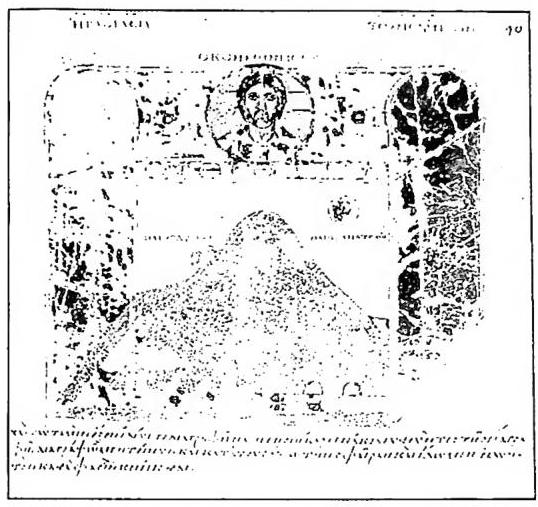
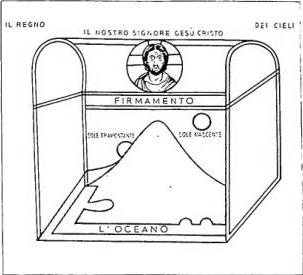
BIBLICAL COSMOGRAPHY - Miniature depicting the cosmos seen from the side, contained in the Topographia Christiana by Cosmas Indicopleustes: Cod. Vat. gr. 699, f. 43r (9th century) - Vatican Library. Graphic reconstruction of the same miniature.
the earth, round, surrounded by the sea. On the shores of the sea, the three gods find two trees and from them create the first humans, Ask and Embla.
From the very scant and dubious information regarding the religion of the Balto-Slavic peoples, it does not seem possible to derive the outlines of a cosmogonic belief (v. CREAZIONE; ESAMERONE).