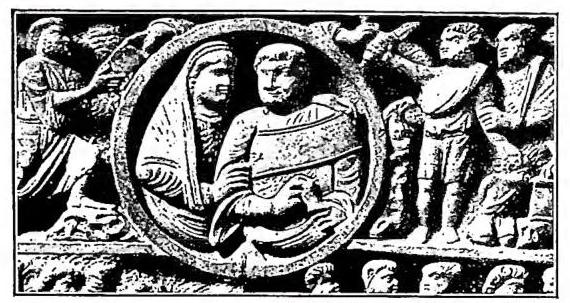
GOD. - According to common understanding, God is the supreme Being, infinite, eternal, absolute, the intelligent and free cause of all reality.
CONTENTS:
I. In dogmatic and moral theology
II. God in the Bible
III. God among primitive peoples
IV. God among civilized peoples
V. God in the history of Western philosophy
VI. Iconography.#### I. GOD IN DOGMATIC AND MORAL THEOLOGY.
The problem of God lies at the heart of all questions concerning the world and human life. Its resolution is a demand of the spirit not only from an ethical-religious perspective but also from a purely philosophical one. Leaving aside what pertains to the idea of God in the history of religions and the history of philosophy, this section is limited to a synthetic "theological" exposition of the problem in the light of Catholic doctrine, which is divine Revelation rationally illustrated and developed. For the sake of order and clarity, the subject may be divided into three points:
knowability, existence, and essence of God. However, it should be immediately noted that these three questions are distinct, not separate, and thus it is difficult to treat one without implicating the others.
CONTENTS:
I. Knowability
II. Existence
III. Essence
IV. In moral theology.I. KNOWABILITY
The Catholic doctrine on the knowability of God is clearly formulated and defined by the Vatican Council (sess. III, can. 2): «The same holy mother Church holds and teaches that God, the principle and end of all things, can be known with certainty through the things that have been created, by the natural light of human reason.» This definition is, first of all, a vindication of the dignity of human reason against every form of agnosticism and skepticism, into which modern philosophy, including rationalism, has fallen. Furthermore, it moderates and corrects the claims of every kind of apriorism, marking the path by which reason can and must arrive at the knowledge of God, that is, the consideration of the world, which evidently presents the characteristics of a finite, conditioned, contingent being, and thus of an effect entirely subordinate to a transcendent cause.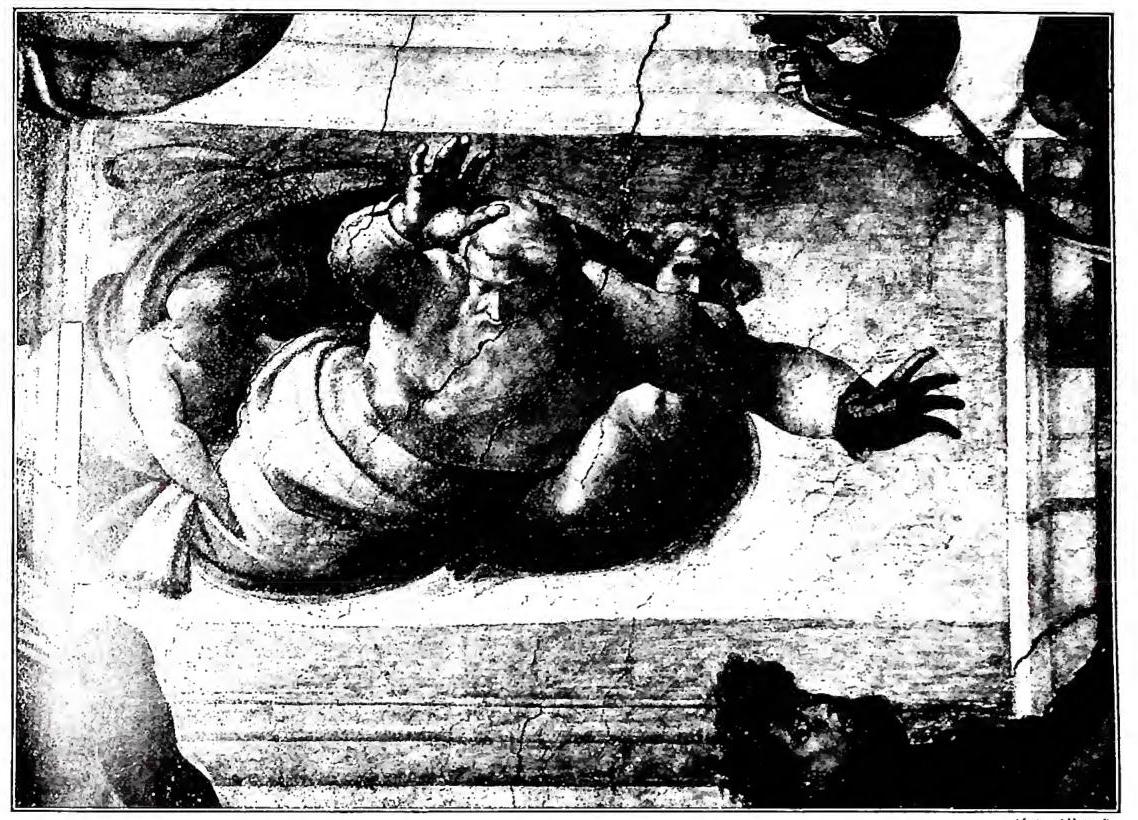
St. Paul, in chapter 1 of the Letter to the Romans, summarizes all these concepts in a drastic form: «What can be known about God is manifest among men, because God himself has manifested it to them. For his invisible attributes, from the creation of the world, are clearly perceived through the things that have been made, by way of reasoning (νοούμενα).»
These texts, illustrated and commented upon by the Fathers of the Church, justify the definition of the Vatican Council and contain in germ the entire doctrinal development of Christian theodicy, as found in the Scholastics and especially in St. Thomas Aquinas, who, based on those texts and with the aid of solid rational principles drawn from the best philosophy, constructs five arguments, now classical, to prove the existence of God and His essential attributes.
(fot. Alinari)
God - God separates the earth from the waters. Fresco by Michelangelo on the ceiling of the Sistine Chapel (1508-12).
II. EXISTENCE
Both in the texts of Sacred Scripture and in the definition of the Vatican Council examined above, one finds not only the affirmation of the natural capacity of human reason to know God, but also the determination of the manner in which one can arrive with certainty at that knowledge.There is no mention of immediate intuition, nor of interior experience, nor even of aprioristic dialecticism, but rather of a cognition acquired through the attentive consideration of created things, in which a relationship with God the Creator is implicit. In other words, it is an ascending process from effects to their proper cause, which philosophers call a posteriori demonstration and which can be schematically expressed in this syllogism: every effect postulates its adequate cause, but the universe is an effect, therefore it postulates its own adequate cause, which is God. The force of this demonstrative process lies entirely in the principle of causality. Assuming the ontological value of this principle as a law of being, the various aspects of cosmic reality are studied, revealing the characteristics of an effect, and one ascends by way of analogy (v. ANALOGIA) to the universal First Cause. St. Thomas, in Sum. Theol., Iª, q. 2, a. 3, in the light of written and oral revelation, adopts these rational criteria for the elaboration of the celebrated "five ways," each of which grasps an aspect of created things. The diagram of the argumentation consists of an empirical observation of fact, which is connected with a general principle of metaphysical character, to conclude with the affirmation of the existence of God.
The 1st way begins with the movement that animates all creation and strikes our attention before any other property. Movement is understood by St. Thomas not only in a physical sense (locomotion), as Aristotle does in this argument (Physics, VIII), but in a metaphysical sense, that is, as the passage from potency to act, a becoming (different from the becoming of modern philosophy). The world, then, is entirely a becoming, πάντα δέ (Heraclitus); now, becoming is the passage from non-being to being: the seed, which is not a tree, becomes a tree by developing. Such passage or development requires the causal influence of a superior being, because no thing can give to itself what it does not have, by virtue of the principle of contradiction. If the world had the fullness of perfection, its becoming would be absurd. Therefore, through the interplay of causal influences among moving beings, since an infinite regress among movers and moved is impossible, one must necessarily arrive at an Unmoved Mover, that is, at a Supreme Being, which is not subject to becoming because it possesses the fullness of being and is the efficient principle of all the world's becoming. Aristotle, remaining on the line of physical motion, does not succeed in establishing a First Mover that transcends moving things; but the consideration of metaphysical motion (the passage from potency to act), according to the mind of St. Thomas, leads to a Transcendental Act.
This fundamental argument reduces to absurdity the claim of all evolutionist philosophy (from Hegel to Bergson), which resolves all reality (God included!) into a perpetual becoming and thus into the inconceivable identification of being with non-being. The definitive conclusion of St. Thomas's 1st way is this: the dynamism of the world reveals its poverty (= potency) and its tendency toward the richness of being (= act); and since every movement requires the causal influence of a being in act upon a being in potency (tome quod movetur ab alio movetur), all that dynamism finds its reason for being only in a Being that moves without being moved, that is, in pure Act without any potentiality.
The 2nd way begins with the observation of the realizing forces of the world, that is, of the various efficient causes subordinate to one another, which, precisely because of their mutual interdependence, do not have in themselves their reason for being, but each is explained by the influence of the other. Since an infinite regress in a series of all subordinate causes is absurd, one must admit a First Cause, which, free from any influence, acts upon the entire series of secondary causes.
The 3rd way proceeds from the observation of the contingency of the world, whereby every created thing is not such that it absolutely requires to exist, that is, it does not have in itself the reason for its existence, but is conditioned by other things. Therefore, there must exist an Unconditioned Being, absolute, which has in itself the reason for its being and for the being of all contingent creatures.
The 4th way rests on the qualitative consideration of the world and thus of the different degrees of perfection of things, in which goodness, truth, beauty, life, etc., are evidently distributed according to the more and the less. If one considers that every perfection is metaphysically reduced to a mode or reason of being, one can say that a thing is more or less perfect (good, true, beautiful, etc.) insofar as it is more or less being. But the more and the less, both in the logical order and in ontological reality, imply a genetic, causal relationship to a maximum: therefore, the things of the world, more or less good, more or less true, more or less beautiful, in a word more or less being, demand a Being that is best, most true, most beautiful, and, in short, infinite richness of being. This argument, which has a Platonic flavor (cf. the dialogue Phaedo and the Symposium), has also recently been the subject of lively discussions. Some have wished to see in it an idealistic-tinged demonstration similar to that of St. Anselm, Descartes, and Leibniz; others find in it a function of exemplary causality, but not efficient, in harmony with Platonism, which explains the relationship between subsistent ideas and the things of the sensible world by way of imitation and formal participation (μίμησις-μέθεξις). But St. Thomas, while admitting this Platonic exemplarism, with due caution, amends and integrates it here, as elsewhere, in the light of Aristotelianism. Indeed, in this 4th way, he recalls Aristotle's principle: "what is maximum in a given genus is the cause of all things that are found in that genus." The reference to the function of efficient causality is evident, as appears also from parallel passages (cf. Summa contra gentiles, II, cap. 15). The basic principle of the 4th way is this: the limitation of the perfection of created things does not depend on their nature, because if a thing were good or beautiful by its own nature, it would be goodness and beauty without limits. Therefore, the limitation depends on an extrinsic cause, which freely and efficiently communicates some degree of its perfection to things. That cause is God, supreme good, supreme truth, supreme beauty, and thus supreme Being, principle and source of all being.
Finally, the 5th way, which is within everyone's reach: it begins with the observation of the order and finality of the world, which reduces to static and dynamic unity the indefinite multiplicity of created things. Now, order and purpose, especially in the irrational world, reveal a transcendent Intelligence and Will, that is, a wise and free Cause, principle and end of the universe. The order and finality of the world cannot be reduced to a subjective idea of the human spirit, as Kant would have it, because the spirit itself feels its own subordination to a purpose, nor can they be attributed to chance or to a blind will (Schopenhauer) or to an unconscious immanent principle (Hartmann), unless one wishes to explain the enigma of the universe with an enigmatic play on words.
BIBL.:
G. MANSER, Das Wesen des Thomismus, 3ª ed., Friburgo 1949; J. MARITAIN, Les degrés du savoir, Parigi 1932; R. GARRIGOU-LAGRANGE, Dieu, son existence et sa nature, Parigi 1920; A. D. SERTILLANGES, Les grandes thèses de la philosophie thomiste, Parigi 1928; E. GILSON, Le Thomisme, Parigi 1942; F. VAN STEENBERGHEN, Ontologie, Lovanio 1946; J. DE FINANCE, Être et agir dans la philosophie de s. Thomas, Roma 1945; A. FOREST, La structure métaphysique du concret selon s. Thomas d'Aquin, Parigi 1931.
A. M.
Concluding, the five ways of St. Thomas, after seven centuries of critique, retain all their solidity and organic coherence for those convinced of the objective value of human cognition and, distinguishing between thought and reality, know how to grasp the harmony between the laws of the one and the other. Synthetically, the five ways philosophically develop the itinerary traced in the Book of Wisdom and the Letter to the Romans. The world has a dynamic and a static aspect. The first, more evident, is movement, which must be considered in its genesis (from potency to act) and in relation to its end (1st and 5th ways). The second, more hidden but more real, is the being and essence of things. Being must be considered in its origin as efficient realization (2nd way) and in its intimate reason as contingent or necessary (3rd way). Essence denotes the qualitative element of things according to a varying gradation (4th way). Both the dynamic and the static aspects reveal themselves empirically through motion, multiplicity, and variety, in which the intellect grasps the metaphysical reason of subordination, limitation, and participation, which in turn leads to a creative Cause, principle and end of all, according to the thought of St. Thomas (Sum. Theol., 1ª, q. 44, a. 1): « Ex hoc quod aliquid est ens per participationem, sequitur quod sit causatum ab alio ».
Within the scope of Catholic doctrine, there are also other proofs of the existence of God, which either reduce to one of St. Thomas’s ways or lack their argumentative force.
a) Ideological argument (dear to St. Augustine): in the human intellect, truths are found with a character of eternity, necessity, and absoluteness. Such a character cannot derive either from the intellect or from the things apprehended by the intellect, because both are contingent. Therefore, a supreme, absolute, eternal, and necessary Truth exists, the source and reason of the truths within us. As Boyer has shown, St. Augustine, with this reasoning—connected to the theory of illumination (v. AGOSTINO)—does not intend to demonstrate either an immediate vision of God or an intuition in the manner of the ontologists; he merely seeks to prove that the immutable truths, which are in our mind and dominate it as an inescapable rule, require a transcendent Truth as a subsistent intelligible Reality. However, this argument, if it is not to fall into ontologism, must pass from the psychological sphere to the ontological order and resolve itself into a relationship of causality between the human intellect, created things, and God, which brings us back to the 4th way of St. Thomas. The human intellect, drawing from the limit of the truth present in things, forms the idea of absolute truth (logical order) and from this ascends to the concept of God as subsistent Truth (ontological order), from whom derives, as from its own cause, the truth that is in things and that formulated in the intellect.
b) Endemonological argument: man has a natural and incoercible tendency toward a supreme good, source of perfect happiness. Such a natural tendency cannot be vain and must therefore exist in its term, that is, a most perfect good (God). This argument, too, proves only insofar as a causal relationship is established between the limited good of creatures (from which arises the concept and desire for a supreme good) and God, infinite goodness.
c) Deontological argument, more compelling than the first two: the human conscience feels the force of a categorical imperative, of a moral law, which transcends man and all evidently contingent cosmic reality. Therefore, a supreme Legislator exists, who has imprinted that law in the human spirit.
d) Moral argument: the universal consensus of the human race in admitting a supreme Principle, object of worship among all peoples. It is impossible to reduce this constant and universal fact to a deception. Atheism (v.), sporadic and debatable in its meaning and value, does not undermine the force of this argument.
Finally, the existence of God is proven by divine Revelation and by other supernatural facts that are part of humanity’s historical patrimony. A particular value is assumed, even in the eyes of modern philosophers (Bergson), by the lived experiences of the great Christian mystics, who attest experimentally and psychologically to the divine presence of the Absolute, not as a vague and indeterminate reality, but as a personal reality that makes dialogue possible.
III. ESSENCE
According to the already cited Vatican Council, reason can know with certainty the existence of God, but it can scarcely grasp His essence. In any case, within the scope of natural faculties, it is absurd to speak of an intuitive or adequate cognition: the mind’s journey toward God is always marked by creatures, which demand His existence and reflect, albeit faintly, the perfections of His transcendent nature. This journey is possible by virtue of the principle of causality, which justifies and validates analogical cognition (v. ANALOGIA), through which the attributes of God are identified by considering the perfections of creation. According to our understanding, these attributes are like the essential properties of God, which, however, are really identical to one another and to the essence, due to the absolute simplicity proper to Pure Act.Consequently, the radical question arises concerning divine essence itself, which must be considered in both a physical and a metaphysical sense. Physical essence corresponds to the complex of elements that specifically constitute a being, as, for example, the soul and the body in man. Metaphysical essence, on the other hand, is the primary element, abstracted from all others, without which a thing cannot even be conceived, e.g., animality and rationality in man. Metaphysical essence, which responds to the quidditative and distinctive definition of a thing, is like the root of all its properties. Christian philosophy unanimously sees the physical essence of God in the sum of all perfections, by which He is the Infinite. This doctrine stands in opposition to every pantheistic monism, whether materialistic (Häckel) or idealistic (Hegel), because it identifies or hybridly mixes the Infinite with the finite, the Absolute with the contingent. Likewise, every limitation of the Infinite is repugnant, even if one attempts to justify it on the grounds of personality, as Renouvier and some others do.
But the question of God’s metaphysical essence is more delicate, on which there are disagreements even within Christian thought. Remaining within the sphere of natural reason, these conclusions are reached:
a) there is no difference between physical essence and metaphysical essence, and thus in both senses the essence of God is the sum of all perfections, that is, actual infinity. This is the thesis of Occam and the nominalists in general, to which the Scotist position closely approximates, which is as follows:
b) the metaphysical essence of God is radical infinity, which implies the exigency of all perfections (Scotus);
c) metaphysically, the divine essence is intellectuality or, more dynamically, actual thought (Giovanni da S. Tommaso, the Salmanticenses, Suárez, Gonet, Billuart, Gardeil, and other Scholastics). This opinion, excluding immanentism, recalls the thinking thought of modern idealism;
d) the divine essence is metaphysically subsistent being itself (s. Tommaso, Capreolo, Molina, Vasquez, Billot, and many modern theologians);
e) the metaphysical essence of God is aseity, that is, the reason of ens a se (= underived being). Thus Buonpensiere with a few others;
f) finally, some place the metaphysical essence of God either in goodness or in freedom.
Now, a thorough evaluation of these theories would require an integral examination of the various systems with which they are connected. Here, it suffices to make a few critical observations, keeping in mind the formal concept of metaphysical essence as defined above. Infinity, preferred by nominalists and Scotists, does not seem to correspond to that concept, because it lacks the characteristic of a primordial element, but rather appears as a reflected notion, if it is true that infinity corresponds to a mode of being. In God, therefore, being is conceived first, and then its infinite mode, which is inferred from pure being (proper to Pure Act).
Nor is the position of those who place the divine essence in actual thought demonstrated to be solid, because thinking is an action, and action, at least logically, follows being, as its presupposition and source.
Aseity, moreover, rather than addressing the question of the essential constitution of God, responds to the question of His origin, affirming His non-derivation from another. An affirmation that does not stand unless one resorts to the concept of the fullness of being, of subsistent being. In short, esse a se is proven by virtue of esse per se; and thus aseity is not first, but perseity.
Finally, goodness is being insofar as it is desirable, and thus, though identical with it, is conceived after II. Freedom is a function of the will, which presupposes intellection and being. Moreover, neither goodness nor thought, and much less freedom, can be conceived as the source of all other perfections.
Thus, the most probable thesis remains the one that asserts, even in this regard, the primacy of being: the metaphysical essence of God lies in the reason of subsistent being, of pure being. Indeed, the principal demonstrative arguments for the existence of God lead to the conclusive concept of God as pure Actuality, Pure Act, free from every shadow of potentiality. Now, actuality is in relation to being: « co magis aliquid est actus quo magis est ens ». God, therefore, is Pure Act insofar as He is pure being, and as such He is distinguished from all creation, which is a synolon of act and potency, that is, of being and essence: « Ipsa autem natura vel essentia divina est eius esse: natura autem vel essentia cuiuslibet rei creatae non est suum esse, sed esse participans ab alio. Et sic in Deo est esse purum, quia ipse Deus est suum esse subsistens » (s. Tommaso, De veritate, q. 21, a. 5). Furthermore, the reason of subsistent being meets the other requirement of metaphysical essence, namely, that it be the source of all perfections, because every perfection is radically reducible to a mode or degree of being: « secundum hoc enim aliqua perfecta sunt quod aliquo modo esse habent » (Sum. Theol., 1°, q. 4, a. 2). Therefore, the infinite perfections of God are like the expression of the unlimited fullness of His pure being: « Deus est ipsum esse per se subsistens, ex quo oportet quod totam perfectionem essendi in se contineat » (ibid.).
Thus, human reason reaches the apex of philosophical speculation concerning the nature of God; the light of Revelation confirms this achievement. In Ex. 3:14-15, God reveals to Moses His proper name, expressed in four fragile letters: Jhwh (= Jahweh), the third-person singular of the imperfect of the verb hwh (= Jait); so that Jahweh = He Is. Modern exegetes (Lagrange, Vaccari, Bea, Ceuppens) justify this interpretation (v. TETRAGRAMMA) and demonstrate the originality of the Mosaic revelation. The Fathers understood the text in the same sense (v. s. Girolamo, In Epist. ad Ephes., II, 3, 14, and s. Agostino, De Genesi ad litt., V, 16). With reason, s. Tommaso writes (Sum. Theol., 1°, q. 13, a. 11): « Hoc nomen qui est (Jahweh)... est maxime proprium nomen Dei... Non enim significat formam aliquam, sed ipsum esse. Unde cum esse Dei sit ipsa eius essentia et hoc nulli alii conveniat... inter alia nomina hoc maxime nominat Deum ».
The Church allows discussion but has not failed to manifest its preferences for the thesis of s. Tommaso, as is evident from the 23rd of the Thomistic Propositions approved by the Sacred Congregation of Studies (1914): « Divina Essentia, per hoc quod exercitae actualitati ipsius esse identificatur, seu per hoc quod est ipsum esse subsistens, in sua veluti metaphysica ratione bene nobis constituta proponitur et per hoc idem rationem nobis exhibet suae infinitatis in perfectione » (AAS, 6 [1914], pp. 383-86).
The existence of God in the face of science and modern thought, 4th ed., Pavia 1924; A. D. Sertillanges, St Thomas d'Aquin, 4th ed., I, Paris 1925, p. 129 ff.; id., Les sources de la croyance en Dieu, ibid. 1928; R. Garrigou-Lagrange, Dieu, son existence et sa nature, 5th ed., ibid. 1928; G. Michelet, Dieu et l'aquaticisme contemporain, 4th ed., ibid. 1929; R. Jolivet, Études sur le problème de Dieu dans la philosophie contemporaine, ibid. 1932; J. Gorlanti, La conoscenza naturale di Dio secondo la Somma Teologica di Alessandro di Hales, Milan 1933; E. Guano, Ricerca di Dio, Rome 1937; M. Daffara, Dio, Turin 1938; F. Ceuppens, Theologia biblica, I, Rome 1938, pp. 22-32; C. Boyer, L'idée de vérité dans la philosophie de St Augustin, Paris 1941; A. Zacchi, Dio, 2 vols., Rome 1944; F. M. Gastani, Dio, ibid. 1944; I. Girolamo, Dio, Florence 1945; M. F. Sciacca, Il problema di Dio e della religione nella filosofia attuale, Brescia 1946; P. Parente, De Deo Uno et Trino, Rome 1946; P. C. Landucci, Esiste Dio?, 1948; J. Dupont, Gnosis, La connaissance religieuse dans les Épîtres de St Paul, Louvain-Paris 1949. Pietro Parente
IV. IN MORAL THEOLOGY
A supernatural morality evidently cannot do without the idea of God, and of a personal God, who has in some way manifested Himself. Philosophy itself demonstrates that a true ethics is impossible without God, and that the only path to be followed is from God to duty, not from duty to God, since duty cannot derive its obligatory value except from the divine will or reason. The absolute dominion of law over all consciences (the absoluteness and universality of law) is indeed inconceivable without a transcendent foundation. Man is a rational being; can such a being, without contradicting his nature, obey a law that does not appear evident to him, and of which he is even forbidden to ask its origin? Duties would then appear as unintelligible and brutal impositions.But the Christian moral system, before being Christian, is reasonable and thus places in God the principle and the end (v. FINE ULTIMO) of our morality, in God who delights in those who love and serve Him.
This God, as He has given an order to the irrational world, animate and inanimate, has also given a law to the world of rational beings, which is the manifestation of His will (v. LEGGE). While leaving individuals free to exercise their energies to the extent and in the direction each prefers, each will be accountable for himself in proportion to the degree of knowledge he has attained of God’s will.
The vision of God and its privation will then be the supreme reward or the supreme punishment: the vision of God, though impossible in the natural order, has been made possible by the supernatural order (v. GRAZIA; PARADISO; REDEVIZIONE; RIVELAZIONE; SACRAMENTI).
The law of God, echo of His will, was first communicated to all through the impression of natural law in hearts; then further through the promulgation of the Decalogue on Sinai; lastly through Jesus Christ, who brought to earth a perfect code of morality.
This complex of norms regulates human activity in relation to all that surrounds us and has connection with us; and first of all, in relation to God Himself.
Once the knowledge of a personal God, endowed with moral attributes, and particularly with power and goodness, is established, a disposition arises spontaneously in the soul, composed of reverence, filial fear, and love. All this is nothing other than the virtue of religion, which embraces all those actions in which the recognition of God as supreme Lord and the submission of the creature to His dominion are expressed (v. ABBRAZIONE; CULTO; DEVOZIONE; GIURAMENTO; ORAZIONE; PREGHIERA; SACRIFICIO; VOTO etc).
This harmonious bond between the creature and his God, capable of such diverse notes and which can reach an indefinite intensity, in Christian morality finds further development in the theological virtues, whose object is no longer the acts that relate to God, but God Himself. In faith, the Christian sees God as his creator; in hope, he considers Him as his ultimate end; through love (v. CARITÀ), he gives himself to unite with Him in a more perfect manner.
All this can be read summarized in the first precept of the Decalogue: «Io sono il Signore Dio tuo... Non avrai dèi stranieri dinanzi a me» (Ex. 20, 2-6; Deut. 5, 6-10), reconfirmed in the Gospel: «Il primo di tutti è: Ascolta, Israele: il Signore Dio nostro è l'unico Signore; ama dunque il Signore tuo Dio con tutto il tuo cuore, con tutta la tua anima, con tutta la tua mente e con tutta la tua forza. Questo è il primo comandamento» (Mc. 12, 28-31).
Pietro Palazzini
II. GOD IN THE BIBLE.
In Scripture, God is not presented in philosophical terms. God is the center and soul of the Bible, not as an object of inquiry, but as the Creator and Lord of the world and as the loving Father of His chosen ones.
The Old Testament has a very elevated concept of God. This is already evident in the various names, among which the principal ones are: 'El, 'Elōhim, Jahweh; quite frequent is also the form 'Elōah (cf. Is. 44, 8; Ps. 17, 32; Dan. 11, 17 etc.), which designates divinity in general or is the proper name of the true God (cf. Deut. 32, 15; Heb. 3, 3 and often in Job). In composition with 'El ('Elōhim) or with Jahweh appear especially the terms 'elōh = 'Altissimo' (Gen. 14, 18-20, 22; Ps. 46, 3; 77, 56) and Saadaj (Gen. 17, 1; 28, 3; 35, 11; etc.), usually translated as 'Onnipotente' ('Almighty'), though its etymological meaning is much debated. Other denominations are Qēdhā Jīšrā'ēl 'Santo d'Israele', an expression frequent in Isaiah, and 'Elōhē haš-šāmajim 'Dio del cielo', which is found in less ancient texts (Jon. 1, 9; Ps. 135, 26; Esd. 1, 2; Neh. 1, 4, 5 etc.). Finally, it should be noted that God is also called with the generic term Be'al «master», «Lord», which is ordinarily reserved for false divinities, and mēlekh «king». The first of these names is rarely applied to the true God (cf. Judg. 6, 25), but appears in many theophoric proper names, such as 'Elba'al, Be'eljādhā', Be'aljāh etc.; the second is found in Deut. 35, 5; Is. 6, 5; 33, 22; 43, 15; Jer. 48, 15; Ps. 5, 3, etc.; sometimes it is specified with reference to the chosen people («king of Jacob», «king of Israel»), or with adjectives that determine majesty («great king», «eternal», «of glory», etc.). In the Septuagint, the term Κύριος «Lord» is widely used, which in the New Testament will usually be reserved for the Son of God.
In the Bible, besides the various divine attributes, the purest monotheism is attested. In the New Testament, it is maintained in absolute form, despite the clear testimony concerning the Trinity of persons. It stands out even more in the Old Testament, where the Trinitarian mystery is only vaguely adumbrated, while polemics against pagan idolatry are frequent, especially in the more recent books (Wis. 14, 13 ff.), but also in older texts, particularly in the Letter of Jeremiah and in the strong assertions of the great prophets (Is. 40, 19, 20; 44, 13-19; Jer. 10, 3 ff.; Ez. 6, 4, 5; 14, 6 ff.; Dan. 3, 12 ff.). In the minor prophets, even the most ancient (Am. 2, 4; 4, 13; 5, 8 ff.; 9, 2, 5 ff.; Hos. 4, 12; 9, 10; 13, 4), the same faith is found.
Moreover, even those who point to other religious forms for the origins of the Hebrew people (animism, totemism, demonism, etc.) admit prophetic monotheism. Against them, it can be observed that certain idolatrous deviations or cultic deformations should be judged as such, even in the oldest texts, and not as indices of a presumed religious evolution. Furthermore, monotheism is already found in the patriarchal times in a very clear manner (Gen. 18, 25; 24, 3; Deut. 4, 35; 39; 6, 4). Today, less emphasis is placed on the various local denominations (such as «God of Bethel» in Gen. 31, 13 etc.), exploited as signs of an alleged polytheism; they are merely the memory of ancient sanctuaries or of particular miraculous events. Even non-Catholic authors (W. Eichrodt) recognize that the different theophanies or angelophanies do not contradict the monotheistic idea at all. The expressions «angel of Jahweh», «face of God», «name» or «glory of Jahweh», etc., indicate nothing other than the direct manifestation of God or, very rarely, the indirect one through an angelic messenger.
At times, the Bible approaches the problem of God's existence in a practical manner and resolves it through the principle of causality (Hebr. 11:3; Rom. 1:20; Sap. 13:1-15, 19; Ps. 18:2; Iob. 12:7 ff.; Jer. 10:11; Is. 37:16; 40:7). The demonstration is usually based on the cosmological argument. The most developed or emphasized theological concept in the Old Testament is that of God as Creator (v. CREAZIONE) and of Providence, particularly in relation to the chosen people. Despite the many anthropomorphisms (v.), there are texts that describe the spirituality and divine essence in a striking manner. The most famous is Ex. 3:14, where the profound interpretation of the name Yahweh is given, describing God as "He who is by essence" (v. ASEITÀ).
Angelo Penna
III. GOD AMONG PRIMITIVE PEOPLES.
In religious ethnology, the term Supreme Being (Höchstes Wesen, Supreme Being, Être Suprême, etc.) commonly refers to the supernatural being who, in the beliefs of individual contemporary primitive peoples, traditionally holds—or has acquired—ontological preeminence over other entities or figures (mythological, animistic, manistic, etc.) within their respective religions, embodying distinctive characteristics such as great antiquity, omnipresence, omniscience, omnipotence, and creativity. These faculties and attributes are typically absent, either individually or collectively, in the remaining figures of primitive religions, and their convergence in the Supreme Being often sharply distinguishes him from those figures, granting him a preeminent place in animological conceptions and, thus, the dignity of a supreme deity.
The reality of such a belief as an original and autonomous element of primitive cultures—outside any ancient or recent derivation from the monotheistic religions of highly civilized peoples, and particularly from the influence of Christian missionaries—was long misunderstood. This was due in part to the persistent lack of accurate and reliable information about so-called "natural peoples," and in part to the a priori skepticism within educated circles regarding the intellectual capacity of such peoples to spontaneously arrive at such elevated animological concepts, which were presumed necessary for the recognition of a supreme god. This attitude among historians and psychologists of religion, which prevailed throughout the second half of the last century and beyond, was based, among other things, on the unquestioned axiom that crude and rough forms of material and social culture in early humanity must necessarily be associated with equally rough forms of spiritual life. This axiom was not logically flawed but rather in the arbitrary definition of the "primitiveness" of beliefs, as conceptions that were not truly primitive were presented and illustrated as such in the progressive search for a primum spirituale subjectively, and thus fallaciously, understood ("psychologism"). The reporting, already in the 19th century, of primitive beliefs in a personal Being with traits typical of a true supreme deity—first among some tribes of the Andaman Islands and southern Australia (Man 1878-85, Howitt 1884), and later among uncivilized peoples in various parts of the globe—was met with distrust or went unnoticed, despite the courageous, isolated stance of Andrew Lang (The Making of Religion, 1898). It was primarily thanks to the work of the Vienna ethnological school, and in particular its leader, Fr. W. Schmidt, that these observations were systematically gathered and later expanded through a broad, organic plan of direct research. Drawing on extensive documentation, in a work that is also the first vast attempt to historically determine a prius and a posterius in the succession of religious beliefs among primitive humanity, Schmidt opposes previous theories—which posited various types of animological conceptions (fetishism, manism, animism, etc.) as the origin of religion—with a new theory asserting the chronological priority of belief in a Supreme Being. Schmidt's synthetic work currently concerns the cultures he classified (and which are generally, if with some reservations, recognized) as the most ancient accessible to us (Urkulturen, or "original cultures"), as well as part of the later pastoral cultures classified by Schmidt as "primary" (v. ETNOLOGIA); and it arrives at the affirmation of a universal primordial monotheism, preceding the dispersion of today's sparse "original" populations into marginal or otherwise inaccessible regions of all the world's continents. The fundamental characteristics of this monotheism would be as follows:
I. UNITY
The Supreme Being is "one." The supernatural figures sometimes found alongside Him, even in the beliefs of the most archaic peoples, are interpretable as contributions from more recent religions. As such, the figures of mothers, wives, and children of the Supreme Being should be explained, deriving especially from the lunar mythology of patriarchal peoples. To an internal evolution of the Urkulturen (primordial cultures), Schmidt instead attributes other deviations, such as the elevation to divinity of the tribal ancestor, who rivals the Supreme Being and may obscure His figure (Andamanese, some Central-Northern Californians, Yuin of Southern Australia, etc.); the personifications of certain particular aspects and functions of the Supreme Being, which rise to the status of independent beings (Arctic cultures, some Algonquins); and finally, the emergence of an antagonist, the Evil Being (Arctic peoples, many among the Algonquins, eastern tribes of the Paleo-Californians), a phenomenon that is ancient and deeply rooted among the herders of Central Asia.II. NAMES
The most frequent and widespread are "father," "lord," "the elder," also "our father," "father in heaven," "father of all," "our great father," "father of life"; secondly come names referring to his activity as "creator" or "maker," "owner" (Lenape), "lord of life," "lord of death" (Western Cree), "giver of food" (Montagnais), "lord of boars" (Negritos), "ruler of the world" (Maidu), "lord of heaven and earth" (Negritos), "ruler of the world" (Maidu), "lord of heaven and earth" (Cheyenne). Rarer are names pertaining to his celestial abode and activity, such as "sky," "thunderer."III. FIGURE
Schmidt opines that the Supreme Being is attributed a form of spirituality, which primitives are mostly unable to define explicitly: expressions such as "he is like the wind" would be attempts to convey such concepts. However, far more often, primitives form an anthropomorphic image of him, as a being with a bright, radiant, or even fiery face, of tall or gigantic stature, etc.IV. SEAT
It is generally believed that He currently resides in heaven, but in some of the most archaic cultures, the motif frequently recurs that the Supreme Being, after creation, dwelt for a certain period on earth, in confident and benevolent communion with men, instructing them in their needs, instituting their sacred ceremonies, and, among some tribes, celebrating them Himself together with His creatures.V. DURATION OF EXISTENCE
The eternity of the Supreme Being is explicitly affirmed among one of the primitive peoples of Australia: the Baiame of the Wiradvuri bears, among others, the name of Burrambian, from burrambian "eternal"; but more often, his great antiquity is implied by the statement that he was "alone" at the beginning, before other beings. In some primitive cultures (Arctic, Paleo-Californian, Algonquian), the representative of evil is considered coeval with the Supreme Being. A recurring motif in the religions of gathering peoples is the unsuccessful attempt by the Supreme Being—immortal himself—to grant humans a share in the same immortality. Although the most primitive languages almost always lack a term as abstract as that denoting eternity, the latter is expressed by affirming that the Supreme Being is uncreated: an attribute that even the tribal ancestor (or cultural hero) seeks to claim when rivaling the deity. In other cases, the Supreme Being appears when the cosmos still contains nothing but the original chaos, ocean, and mists.VI. OMNIPRESENCE AND OMNISCIENCE
Omnipresence is not explicitly affirmed and seems to have interested primitive mentality little; it is rather a collateral, integral attribute of omniscience. In general, there is a lack of speculative interest in the abstract properties of the divinity, so that the affirmations of primitives in this regard have predominantly practical—that is, ethical—value. Only in the younger primordial cultures is the Supreme Being no longer conceived as having immediate and direct knowledge of what occurs in the world, but obtains it through his messengers or subordinate entities; his omniscience is thus only mediated, for example, in the sense that the sun and moon are the eyes with which the Supreme Being sees the earth and what happens upon it (Samoyeds, Semang); the stars are the ears that allow him to hear at night, compensating for the faint lunar light (Samoyeds), or the innumerable eyes with which he gazes upon the dark earth, unnecessary by day due to the brilliant light of the sun (Alakaluf); while the Andamanese believe the Supreme Being to be omniscient only by day. Among other primitives, by contrast (African and Asian Pygmies and Pygmoids, Fuegians, etc.), he is conceived as capable of penetrating even the most secret recesses of the human soul.VII. OMNIPOTENCE
The affirmation, explicit or implicit, of this attribute is nearly universal in primordial cultures: no force can successfully oppose the Supreme Being, not even that of the most powerful sorcerers. This conviction is expressed in mythical form in the oral literature of certain American and Asian tribes (some Algonquins, Samoyeds, Western Paleo-Californians), where the motif of contests between the Supreme Being and the cultural hero or tribal ancestor recurs, in which (or in the last and most difficult of which) the former emerges victorious. His power over the health and life of men is unlimited.VIII. OTHER ATTRIBUTES AND FUNCTIONS
The Supreme Being is almost always the creator of the cosmos and of man (v. CREAZIONE) and the guardian and enforcer of the ethical order that emanates from him. All good, and only good, enjoyed by humanity comes from him: not only objectively, but also subjectively, insofar as many primitive peoples recognize his "affective goodness" toward man, his care and concern for the latter's well-being and destiny. The various manifestations of immorality that characterize the gods of later cultures are not found in him; and the accusations of "murderer" and "evil" sometimes leveled against him are to be interpreted as references to his aspect as a severe punisher, through disease and death, of violations of the moral precepts he has imposed on humanity.Father Schmidt's theory has been criticized from various quarters (in Italy particularly by R. Pettazzoni); nevertheless, and despite the fact that such beliefs are not found among all "primordial" peoples (they are absent, for example, among the Vedda of Ceylon and the Northern Andamanese, were doubtful among the now-extinct Tasmanians, and are partly now called into question regarding the original culture of the African Pygmies), the ethnological antiquity of the belief in a Supreme Being is now positively established, and must be recognized as a patrimony proper to many of the most primitive peoples across the continents. No less important is the observation that such belief is found, albeit mingled with other religious elements, among many peoples with later and more evolved cultures ("primary" and "secondary") in every part of the globe.
The Aranda, totemists of central Australia, possess the notion of a being (Altjira) uncreated and eternal, whose dwelling is in the sky, and whose campfires are the stars; he is conceived as an immense man, red-skinned, with light hair falling over his shoulders, feet like those of the emu, while his wives have dog-like feet. He is good, but indifferent to worldly affairs; lord of the sky, he did not create man and does not care for him; no cult is directed to him. Here and there in Indonesia (e.g., among the Batak of Sumatra), in Melanesia (in some southern islands of the Solomon group), and even more in Africa (Nilotics, some Sudanese and Bantu peoples), the belief in an ancient Supreme Being coexists alongside forms of totemism; but it generally appears to be an independent belief, assignable to different cultural strata superimposed over time, and it must be recognized that the totemistic mentality favors the development of magic rather than that of theistic conceptions. This is clearly observed, for example, among the indigenous peoples of California, where totemistic tribes completely ignore the figure of a Supreme Being (Kroeber). The situation is more complex in South America, where totemic culture, scarcely distinguishable from the neo-matriarchal, has also influenced the most primitive peoples and groups. In any case, even apart from the three small Fuegian groups, the concept of a high deity is found on this continent already among the peoples who best represent the stage of gatherers and hunters. The Chamacoco, in the Chaco region, are those who possess the mythological figure closest to a supreme god, the Escetevuarha (of female sex), mother of infinite spirits, who dominates all things, prevents the sun from burning the earth, and provides water to humanity; she demands that men sing in her honor every night, and punishes them if they neglect this duty. The "Botocudo" (Ge) of eastern Brazil believe in a "White-Headed Father" who lives in the sky, apart from other celestial spirits: a gigantic chief of spirits, he sends rain and storms, kills enemies with invisible arrows, and causes the lunar phases. The Uitoto, totemistic gatherers and hunters of the upper Japurá, also have a great creator and beneficent god, whom they call "father," though doubts remain regarding the originality of such belief. Even when moving to the relatively superior agricultural cultures of the upper and middle Amazon, similar conceptions are found here and there. The Cashinahua of the upper Juruá speak of an "Old Father" living in the sky with his wife, the "Great Mother"; his principal function is to lead the souls of the dead to heaven and provide them with every good there; he has been identified with Poka "the Good," who sought to make men immortal, and is the father of the cultural hero; during storms, it is believed that he weeps and sobs, remembering his lost children. The Tupinambá of the Atlantic coast knew a thunder god endowed with sufficiently elevated traits that missionaries deemed it appropriate to adopt his name (Tupan, Topana) for Christian preaching. The Apapocuva (also of the great Tupi-Guarani group) recognize a creator, "our great father," who generated the cultural heroes. But it is precisely the importance of these cultural heroes, together with the development of astral mythology—especially the personifications of the sun and moon—that among the majority of Amazonian peoples relegates the figure of the Supreme Beings to the background, practically nullifying their cult.
That the solar character of the Supreme Being may be secondary is demonstrated by the conceptions of numerous primitive tribes of northeastern India. The supreme deity of these bears the name of Sing Bonga, "spirit of the sun" among the Santal, Munda, Ho, Birhor, and other Kolarian peoples; the same deity is found among the Munda of Chota-Nagpur. He is a benevolent being, creator and preserver of life, eminent among all the gods; yet his solar nature appears to be acquired, likely borrowed from the younger Dravidian populations among whom traces of similar conceptions (linked to totemism?) still exist, and only later Hinduized. Thus, among the Oraon and Maler (Dravidian), the Supreme Being originally bore, and in some cases still retains, the name of "solar king"; the Oraon later adopted for him the Hindu names of Dharmi or Dharmesh "the Holy One," who manifests himself in the sun, or of Bhagwan (Bhagavat), common to the Bhil of central India. Yet not infrequently, a splitting of the two concepts has occurred, distinguishing the Supreme Being (Dharmesh, Bhagwan) from a particular solar god, who has retained ancient names. The same happens among the Gond scattered throughout central India: their "great god" or "old god" seems to be only a primus inter pares among the minor deities, distinct from the invisible creator and preserver of the world, of whom they have another concept. Traits harking back, at least in part, to even greater antiquity seem to be offered by the conceptions of the Chenchu of southern India: alongside their Supreme Being, Bhagavantaru, living in heaven, creator of human souls, manifesting himself in thunder and rain, stands a female figure, Garelamaisana, mistress of the jungle and its products. In general, it can be observed that figures of celestial deities were already present and alive in pre-Aryan India, even in the most archaic ethnic strata: pervasive Hindu pantheism certainly influenced them, lending them new names, but did not erase their ancient traces. A not dissimilar process occurred in Indonesia, where the religious conceptions of the most primitive peoples often shine through beneath the veneer of more advanced and recent civilizations, first Hinduism and then Islam. Such is the case with the ancient Supreme Being of the Batak of Sumatra, Mula Giadi, overshadowed by the advent and affirmation of another deity (Hindu), Batara Guru (Shiva). The Ngadha of Flores preserve the belief in a Supreme Being, existing from the beginning of time, dwelling in the firmament, unique and double at the same time: Deva above (conceived as male) and Nitu below (conceived as female). He is said to be invisible except in dreams, but is conceived as white in appearance, with a flowing beard, and his garments are described as wondrous—the fine mantle, the splendid belt, the leather bag of horse or goat hide, the bracelets large as plates. Deva is the creator and master of all, even of men, he who sees and knows all, the powerful one, he who takes life; he is believed to be benevolent, but is feared for his justice, which manifests itself in the illnesses and harm inflicted upon wrongdoers.
The figures of high feminine deities, such as those mentioned above, almost always betray the corresponding presence, in the sociological sphere, of agricultural matriarchy, which as a rule fosters the development of animism and lunar mythology. Feminine traits are found in the figure of Hintubuhet, deity of New Ireland, uncreated, existing from the beginning of time, creator of heaven, earth, and men, but now indifferent and idle, and as such receiving no cult except in exceptional cases; and a feminine creator deity is reported, for example, from the island of Viva (Fiji). Yet even in matriarchal skies, the femininity of the Supreme Being is a sporadic aspect, which, for instance, among the matriarchal Bantu of west-central Africa is revealed only in traces: here (as among the OvAmbo and OviMbundo of Angola) the Supreme Being Kalunga is a manistic deity, connected with the earth and with the dead who dwell in it, or even identified with the chthonic, subterranean conception of the afterlife; but he is a masculine being, as is the other divine figure, also of great antiquity among the Bantu, of Nzambi, a celestial creator being who reigns in heaven.
In manistic religions, which predominate in Black Africa, among both patriarchal and matriarchal peoples, the cult of ancestors overshadows or replaces that of the Supreme Being, but does not obliterate his figure, which remains eminent though distant. The AmaZulu believe in a celestial god, Inkosi Pezulu "the Chief in heaven," who manifests himself in meteorological phenomena and strikes down transgressors of tribal laws; the AmaXosa see in the figure of uDali the creator of all things, who controls and governs everything, rewards good and punishes evil: yet to these and other Supreme Beings no cult is offered directly, but rather through the ancestors, who in the invisible world are closer to the deity, possess greater wisdom than men on earth, and are thus the preeminent mediators "at the court of the unapproachable Chief."
The figure (and cult) of a Supreme Being assumes even greater prominence among pastoral peoples, the most typical and pure representatives of which, in Africa, are the Galla. In their celestial god, Waq or Waqa, are summarized almost all the attributes and faculties that Schmidt recognized in the Supreme Beings of primordial peoples, and the intimate and direct cultic and ethical relationship between man and God is felt more profoundly than it generally is among Africans. Schmidt's recent merit lies in having highlighted the hitherto neglected monotheistic substratum in certain religions of the pastoral peoples of Asia: among the Tatars of the Abakan, for example, there emerges above a plurality of minor gods, celestial and infernal, an originally unique figure of a celestial Being, Kudai, whose unity has nevertheless become confused in the identification with multiple gods, the Seven (or Nine) Kudai: this is also a creator and benevolent god dwelling in heaven, also called "the White," "the Golden," exceptionally "Father," dispenser of life and fertility, source of authority and order, moral legislator.
It should finally be noted that even in religions considered most typically polytheistic, such as the Polynesian, the conception of a true Supreme Being is not always unknown, though it presents particular aspects. Thus, for example, on the island of Rennell (at the southern extremity of the Solomon group, but colonized by Polynesians and remaining immune from subsequent cultural contacts) the highest place in beliefs is occupied by Angiki and Ha "the Chief on high," the gigantic head of the divine family, who manifests his wrath with thunder and lightning: if he is assigned a wife and children, this is in a supernatural, symbolic form, being "too sacred" to beget children from a woman. His sacred character is also revealed in the prohibition against pronouncing, except in a whisper, his personal name, Te Tonusanga (as, for example, with the name of Daramulun among the Yuin of Australia); and to his lofty and feared figure is contrasted that of Tangangoa—the well-known supreme god of the Polynesian pantheon—of whom no respect is had and who is mocked, considered unworthy of the name of God.
For the cult of the Supreme Being, V. PREGHIERA; SACRIFICIO.
IV. DIO PRESSO I POPOLI DI CULTURA SUPERIORE.
Come presso i primitivi così anche presso i popoli che hanno raggiunto un grado superiore di cultura e il cui aggrappamento dallo stato tribale è passato a quello cittadino e nazionale, l'idea di Dio sta al centro della loro ideazione religiosa.
I. NATIONAL RELIGIONS
Mexico and Peru. — Pre-Columbian Mexico and Peru should be examined first because, from a cultural standpoint, they form the connecting link between primitive populations and those that have reached a higher level of civilization. The Franciscan missionary Bernardino de Sahagún, who first came into contact with the Aztecs of Mexico after the Spanish conquest, learned their language and thoroughly understood their customs and traditions, affirms that they believed «in one God, pure spirit, omnipotent and creator of all things, to whom they attributed all wisdom, beauty, and bliss». His name is Tezcatlipoca, considered the god of justice, and thus represented with a golden mirror with which he scrutinizes the actions of men. In Peru, the Supreme Being is called Pachacamak, indefinable, to be named only in a low voice, creator and legislator.China. — Apart from Christianity, three religions exist in this vast country: the ancient natural religion systematized by Confucius, who left intact its ancient heritage of beliefs and rites; Taoism, from tao (way), a philosophical vision of the universe with a pantheistic orientation; and Buddhism, which penetrated China from the south in the form of the «Great Vehicle».
The indigenous religion of China is the religion of Heaven (T'ien), to which the title of «Supreme Lord» (Shang-ti) is given. The concept of Heaven as the sole Lord is developed more from an ethical than a doctrinal standpoint, in accordance with the more practical than metaphysical mentality of the Chinese. The emperor holds the mandate to execute the will of Heaven for the benefit of his people; his negligence provokes, on the part of the Supreme Lord, natural calamities and the people’s discontent.
Japan. — The national religion of Japan is a transparent naturalistic paganism, despite the systematization of mythology undertaken in the 18th century by Mabuchi (d. 1769), Motoori (d. 1801), and Hirato (d. 1841). It is called Kami-no-michi, the "way of the Kami," that is, of the gods, or shin-to with the same meaning. Kami are "superior" beings; that is, the great divinities of nature, especially the sun, conceived as feminine and named Amateram (v.), progenitor of the imperial dynasty, regulator of the heavens, who eventually absorbed the uranic element that recognized the existence of a "lord of the middle of the sky" from whom the generations of the gods would descend.
Egypt. — From the oldest elements of Egyptian religion, it emerges that it was a deification of the sky and the sun that traverses its spaces. The concept of divinity is expressed with the word muter, adopted also by Coptic Christians to signify God. The various deities of Egypt were arranged by priestly speculation into enneads or groups of nine, tending to place in the foreground the god of the politically dominant city: Atum at Heliopolis, Thot at Hermopolis, Ptah at Memphis, Amôn at Thebes. The theology of Amôn attained speculative value: he produced the gods with his word, ordered the world by separating the sky from the earth, and created things, animals, and men.
The political power of the priesthood of Amôn provoked the reaction of Pharaoh Amenophis IV (d. 1358 B.C.), who moved the capital from Thebes to the site of present-day al-Amarna, establishing there the monotheistic-solar cult of the sun’s disk, Aten, exalted in a beautiful hymn as the creator of all things, from the Nile to the little bird that chirps in its nest.
Semites. — Among the Eastern Semites (Babylonians and Assyrians); Western Semites (Canaanites, Arameans, Hebrews); and Southern Semites (Arabs, Ethiopians), the concept of God is expressed with the name el (ilu, ilâh), from a root meaning dominion, lordship, and is always tied to a person rather than a locality.
Among the Babylonians, the Supreme Being is called Anu (= Sky), and his ideogram is a star. He presides over the celestial regions and regulates the course of the stars. Opposite him stands Adad, who represents the meteorological sky and is the lord of the storm and lightning.
Indo-Europeans. — This great family of peoples, united by linguistic criteria, includes in Asia the Indians, Iranians, and Armenians, and in Europe the Slavs, Germans, Celts, Illyrians, Thracians, Greeks, and Italics. Before separating from their original homeland, these peoples already shared a common heritage of vocabulary related to domestic life, agriculture, and the patriarchal organization of the family; and from a religious standpoint, they had already established the concept of the Supreme Being with a word whose root is die, meaning "to shine," referring to the astronomical sky understood as father. This Supreme Being is called Dyaus in India, Zeus (Dieus) in Greece, Deus among the Latins, Ziu among the Germans, and Dievas among the Lithuanians.
India. — In Vedic India, the meteorological manifestations of the sky have taken precedence over the astronomical ones under the figure and name of Indra, while those of the sky as seer and guardian of the moral law go by the name of Vāruṣa, which properly signifies the nocturnal sky. Brahmanism, which succeeds Vedism and is its religious-philosophical development, culminates in a pantheistic vision of the universe insofar as it tends to dissolve—that is, to annul—the individual soul (ātman) into the world soul (brahma), following the path of knowledge rather than that of ritual sacrifice: a pantheistic and essentially atheistic conclusion, for without the recognition of a transcendent Being, there is no religion. This perspective remains that of the current religion of India (Neo-Brahmanism or Hinduism), contaminated by elements drawn from popular religion and complacently tolerated by the Brahmins, who, after the Buddhist interlude, returned as the dominators of the country’s religion. In the context of cultic religion, while maintaining the monistic vision of the identity of the individual self (ātman) with the universal (brahman), the action of brahman is specified through the three aspects of creator, preserver, and destroyer, identified with the three Vedic and Brahmanic deities Brahma, Viṣṇu, and Śiva, the so-called Indian trinity (trimurti). Among these, Viṣṇu in particular is the object of invocations and prayers that regard him as personal and transcendent.
Greece. — Setting aside the religion of the Aegean era, whose archaeological findings remain silent for us, one must turn to Homer to find both an echo of pre-Homeric religiosity and a sufficiently rich profile of the divine world of the Greeks. In the Homeric poems, Zeus, personification of the sky, is the father of gods and men, lord of atmospheric phenomena, and ruler of the other gods, whom he gathers around himself on Olympus. The fact that he, master of all, cannot dominate fate, while appearing as a limitation of his power, ultimately becomes an homage to the idea of God, insofar as fate opposes the caprice of the gods and is the expression of the physical and moral laws that maintain the equilibrium of the cosmos. Mythology has partly spoiled this grand profile of Zeus, so clearly oriented toward a monotheistic conception. Hesiod’s Theogony coordinates the data of mythical tradition and shows how from the formless and dark chaos, dominated by rebellious forces, the cosmos—that is, the ordered world—emerged, moving toward light and beauty, represented by Zeus. After Homer and Hesiod, during the 8th–6th centuries, a period of great religious and social upheaval, the longing of the Greek conscience for a God who bestows good and punishes evil matured. The Persian Wars brought to fruition the elements that would characterize classical Greece, on whose threshold stand the great figures of Pindar and the two tragedians Aeschylus and Sophocles: Euripides, a contemporary of Sophocles, already belongs to the critical and enlightened currents of the new era. Pindar (d. 448) exalts Zeus as the personification of the moral order of the world, creator of right and law; he exalts moral abstractions: Truth, Infallibility, Law, as manifestations of his unifying action, in which the individual features of the gods merge. Aeschylus (d. 456) magnifies the omnipotence of Zeus, who encompasses within himself the universe and what lies beyond it, and whose figure represents the unity of "the divine" (τὸ θεῖον); he is the avenger of the sins of fathers, for which their children must accept expiation until the deity absolves them, as happened to the matricide Orestes, who killed to obey the familial duty of blood vengeance and was finally acquitted by the Areopagus. Sophocles (d. 406) venerates the gods, respects oracles, and senses the power of fate as the manifestation of a superior will, sanctioned only by Zeus, which does not act as external constraint but operates and is fulfilled within the psyche. A clear example is Oedipus, who submits to his most sorrowful fate yet does not lose the nobility of his conscience and merits ending his days, re-blessed, in the sacred grove of the Eumenides.
The religiosity of the mysteries, which arose in the 6th century, a period of political and social upheaval, by placing in the foreground the concern of souls for their individual fate in the afterlife, contributed in Greece—and later in the Hellenistic world—to ennobling the moral vision of life, inviting men to look to the heavens as their homeland of origin, to which they must return after freeing themselves from the evil in which the soul is enmeshed, like a ray of light within the dark prison of matter.
BIBL.:
For Japan: G. B. Sansoni, La religione dello Shinto (Florence 1933); A. Lloyd, The Creed of Half Japan (London 1911).
For Egypt: A. Moret, Le rituel du culte divin journalier en Égypte (Paris 1902); J. H. Breasted, Development of Religion and Thought in Ancient Egypt (New York 1912).
For the Semites: R. Dussaud, Les religions des Hittites et des Hourrites, des Phéniciens et des Syriens (Paris 1945); S. Moscati, Il mondo dei Fenici (Milan 1966).
For the Indo-Europeans: G. Dumézil, L’idéologie tripartie des Indo-Européens (Brussels 1958); H. Güntert, Der arische Weltkönig und Heiland (Halle 1923).
For India: L. Renou, Religions of Ancient India (London 1953); A. B. Keith, The Religion and Philosophy of the Veda and Upanishads (Cambridge, Mass. 1925).
For Greece: M. P. Nilsson, Geschichte der griechischen Religion (Munich 1941-1950); W. F. Otto, Die Götter Griechenlands (Bonn 1929).
— G. Rinaldi
The process of religious unification that began during the Hellenistic era was furthered by the development of Platonism, which identified the idea of the good with God and posited the world of ideas as the archetype upon which God created the universe, thus providing the foundations for the theodicy of the Hellenistic period.
Rome. — Roman religiosity is characterized by a reverence for the divine world, not curiously scrutinized from an intellectual standpoint but deeply felt from the perspective of practical action. Jupiter has possessed the attributes of the supreme deity since pre-Capitoline times. Like other Indo-European supreme beings, he is a deity of both the astronomical and meteorological sky: his cult is celebrated on heights such as the Capitoline Hill and Mount Alban; with lightning, he manifests and sanctions his commands. Toward the end of the Republic, a monotheistic conception of the divinity began to take shape in philosophical circles, recognizing in Jupiter the "numen praestantissimum."
Celts, Germans, Slavs. — Determining the profile of the Supreme Being among these peoples is more difficult due to the scarcity and fragmentary nature of the sources, as well as the superficiality of the "Roman interpretation" of the deities of the peoples with whom the Romans came into contact. For the Celts, Caesar identifies Mercury as the principal deity, the most frequently mentioned in inscriptions and depicted on roadside cippi. Of the triad named by Lucan (I, 446), Taranis most closely recalls the figure of Jupiter the thunderer. Tacitus interprets the supreme God of the Germans as Mercury, under which name the indigenous deity Watan (Odin) is to be understood, conceived as the universal father and "regnator omnium Deus," worshipped according to Germanic custom in the depths of a sacred forest.
The religion of the Slavs is known through the accounts of Latin missionaries in the West and Byzantine writers in the East. Under various names—Peru for the Russians, Svarog (Zuarniš), Triglav, Svantevit for the Baltic Slavs—their Supreme Beings are regarded as tribal chiefs, endowed with divinatory powers, and represented as polycephalic (with three, four, or even more heads), a naive way of affirming their omniscience, a characteristic of sky deities.
II. SUPRANATIONAL RELIGIONS
For Judaism and Christianity, V. the respective entries.Buddhism. — From an intellectual standpoint, Buddhism represents the final outcome of Brahmanic speculation, culminating in a pancosmism that identifies the universal self with the individual self. From a religious perspective, the Buddhism preached by the Buddha is atheistic because it excludes an ordering mind from the governance of the world; it does not abolish the gods but subjects them to the mechanical law that regulates the entire universe and denies the existence of the soul. From this original agnostic orientation, known as the "small vehicle" (hināyāna), that is, the small raft that carries one to the shore of salvation (nirvana) across the current of transmigration, a broader vehicle developed (mahāyāna = great vehicle), designed for the masses rather than the few, more capable of satisfying spirits desiring a more intimate and personal religious piety. Mahāyāna Buddhism introduces the concept of a transcendent and permanent God, in the figure of the cosmic Buddha (Adi Buddha), who revealed himself one day in the historical Buddha. Every individual, by following the path of piety (bhakti), can become a bodhisattva, that is, place themselves in a position to attain the rank of Buddha, and can facilitate this ascent by renouncing the achievement of final liberation to allow their sacrifice to benefit others. To attain this state, trust in the Buddha is helpful, manifested through acts of worship: hence temples, statues, ceremonies, and prayer formulas unknown to primitive Buddhism.
Mazdeism. — In contrast to the naturalistic polytheism of the Persians, a reformer, Zarathustra (Zoroaster), born perhaps in Media between the 7th and 6th centuries B.C., preached a religion of monotheistic content. Initially opposed by the dominant priestly class of the Magi, it was eventually accepted in the Iranian region, with adaptations to ancient naturism, and established itself as the national religion of Persia during the Sassanid period (226-651 A.D.). Ahuramazdā, the "Wise Lord," is the sole God preached by Zarathustra, whose teaching is preserved in the sacred book called the Avesta (from the Pahlavi Apatāth, "fundamental text"), which survives not in its entirety but in fragments. Ahuramazdā (v.) is the champion of truth against error, the creator of the universe through his omnipotent word, and its provident preserver. His throne is surrounded by six "Holy Immortals" (Ameša Spenta, v.): Good Thought, Justice, Sovereignty, Piety, Integrity, and Immortality, which express God's providence in the governance of the world.
Islam. — Even during pre-Islamic paganism, the figure of Allāh was dominant over the other gods of Arab polytheism. Muhammad, whose religious formation was influenced by Christians and Jews settled on the northern borders of the Arabian Peninsula, raised the banner of the one God against that polytheism—omnipotent, omniscient, and just in rewarding the actions of men,
who reveals himself not through the chatter of soothsayers or in the objects of nature, but through prophets, among whom the principal ones are Abraham, Moses, Jesus, and, lastly, Muhammad himself, the supreme messenger (rasūl Allāh). His monotheism is of Jewish origin insofar as it excludes the two mysteries of the Christian faith: the Trinity and the Incarnation of the Word: "God is one, God the eternal; (He) has not begotten nor was He begotten. And there is none like unto Him" (Qur'an, 1:2). For the development of Muslim theology and mysticism, V. ISLĀM. V. also: ANIMISM; HENOTHEISM; MONOTHEISM; POLYTHEISM.
V. PHILOSOPHY.
Philosophy, as a rational inquiry into the absolute—that is, the pursuit of knowledge whose ultimate conclusions validate its premises—has always been directed toward the treatment of the problem of God, namely, the determination of a resolutive concept in which the ideal and real order of being finds its foundation and justification. Even the particular disciplines into which philosophical knowledge is articulated (e.g., cosmology, ontology, logic, ethics, aesthetics, etc.) presuppose a reference to the supreme concepts in which the meaning of reality is concluded, and thus implicitly contain the outlines of a natural theology. This is true even in atheistic systems, which, despite their negation of traditional concepts, involve the application of a new sense of the whole, of the absolute—in short, of what, in a very broad sense, may still be termed the divine. Therefore, the perspective to be adopted in considering the problem of God in the history of Western philosophy should be elevated enough to permit a synthesis of what is essential in the contribution of human thought to the resolution of the problem of being.
In the problem of God, three sub-problems may be distinguished: a) that of His nature, b) that of His relations with the
The problem of God can be distinguished into three sub-problems: a) that of His nature, b) of His relations with the world, and c) of His knowability. In ancient philosophy, the first two problems take precedence and subordinate the one concerning knowability; in Christian philosophy, the latter gains autonomous consistency alongside the other two; in modern philosophy, the problem of God's knowability prevails over the other two, almost to the point of resolving them within itself.
a) Regarding the nature of God, solutions oscillate between ontological conceptions (God as being), logical conceptions (God as idea or thought or regulating principle of the mind, etc.), axiological conceptions (God as value), and spiritualistic and personal conceptions (God as the presence of immaterial being to itself, in the fullness of the act that is thought, will, love). From a very general historical perspective, without any particular details, it can be said that in the highest theological investigations of classical antiquity, the ontological and logical conceptions prevail; in modern philosophy, the logical and axiological conceptions prevail; while Christian philosophy synthesizes the ontological, logical, and axiological determinations in the spiritualistic and personal conception of God.
b) The problem of the relations between God and the world gives rise to two extreme solutions: monistic (unity of God and world) and dualistic (duality of God and the material principle that is the support of the world of becoming). The monistic solution takes two forms, characteristic of classical thought and modern thought respectively, depending on whether the divine remains immanent in the empirical order of phenomena (naturalistic pantheism) or in the ideal order of human mentality (idealistic pantheism). The creationist principle, proper to Christian philosophy, can, in a certain sense, be called both monistic and dualistic: monistic, insofar as the world (universe of things and universe of souls) belongs entirely to the power of the creator; dualistic, insofar as the created, contained in the free act that gives it existence and consistency, remains constituted in its own nature and is distinctly separated, by its ontological positivity, from the substance and being of the creator.
c) Finally, the problem of God's knowability historically admits two extreme theses: ontological-intellectualistic (God as the object of an immediate apprehension of the intellect) and agnostic (unknowability of God), between which moves the intermediate solution, supported by ecclesiastical magisterium, of God's demonstrability (God not intuited, but knowable through a rational process of inference from created things: a process that culminates in the qualification of the divine being with positive attributes, valid for knowledge, but inadequate to resolve the divine being within human comprehension). From the agnostic thesis derive the fideistic, pragmatistic, and sentimental currents, which seek to compensate for the lack of speculative means in penetrating the divine, respectively, with the aids of Grace and Revelation, or with the postulates of praxis, or with the indefinite revelations of the heart. For intellectualistic and rationalistic currents, the relations between man and God are resolved without residue in the sphere of natural knowability, with the consequent reduction of religion to philosophy; for fideistic currents, they are established only on the basis of a supernatural intervention, with the consequent reduction of philosophy to religion; for an intermediate current, which moves in the furrow of Catholic orthodoxy, the metaphysical idea of God, emerging from the natural and rational order, constitutes indeed a necessary preamble to faith, but does not exhaust the meaning of human relations with God, so that philosophy and religion are distinguished in conditions of continuity and complementarity.
SUMMARY:
I. In classical antiquity
II. In patristics and scholasticism
III. In modern and contemporary philosophy.I. IN CLASSICAL ANTIQUITY
To supplement the preceding outline with some references to the historical development of these problems, it is first noted that, regarding the nature of God, classical philosophy struggled to free itself—through the work of Plato and Aristotle, and even then not stably—from the naturalistic terrain in which the mythology of the poets had originated.The poetic image is the undifferentiated space of the sensible and the ideal, the corporeal and the spiritual, the finite and the infinite: and within this lived space, the gods of Olympus, the fruit of the imagination that objectifies in physical forms every human sense of power and ideality, animate nature with conscious and available forces. Just as intuitive moments follow one another, each with its own absoluteness, so the divine mythical apparitions were juxtaposed, populating Olympus with a multiplicity of deities, among which the theological instinct of the Greeks sought to compose a certain order, arranging them hierarchically under the empire of Zeus, the supreme God. The divine monarchy was an insufficient corrective to classical polytheism; thus, when alongside the "theologians" arose the "physiologists," that is, the first naturalist philosophers of Greece, they sought to unify in a physical element the "principle" of reality, and divine was the "water" of Thales, divine the "ἄπειρον" of Anaximander, divine the "fire" of Heraclitus. A vigorous push toward unity was given by Xenophanes, with his protest against the polymorphous and basely anthropomorphic representation of the gods; but his God, as "One-All," does not exceed the limits of the naturalistic pantheism of the Greeks: and within these limits remains the "being" one, immutable, motionless, which Parmenides likens to a sphere, well-defined and enclosed in its perfect roundness. Whether with Empedocles the cosmic dynamism is seen as the result of the action of an active principle of love and strife upon the passive elements that constitute the "roots" of the world, or whether with Democritus every motion proceeds from the nature of the material elements, called atoms, from which the soul and intellect also result; whether with Epicurus some element of freedom is introduced into cosmic determinism, and the gods, composed themselves of the finest atoms, live blissfully in the spaces between world and world, indifferent to human affairs; or whether, finally, with the Stoics God is conceived as the universal reason (λόγος) that, intrinsic to matter and itself material, constitutes its propulsive and hegemonic element: in every case, speculation offers nothing more than a refined image of that naturalistic pantheism in which the theogonic imagination of the first poets of Greece had sculpted the powerful semblances of the gods of Olympus. Ultimately, the astral divinity that the Demiurge of Plato’s Timaeus composes with a measured mixture of ideal substances does not escape this framework; nor do the various unmoved movers, divine intelligences, that preside over the harmonious movements of the spheres in the single heaven of Aristotelian astronomy (Met., 1073 a 14 ff.).
A luminous opening toward a different conception of God is offered by Plato’s "essences": the immutable, eternal, immaterial forms of every earthly appearance, perceptible not with the eyes of the body, but with the gaze of the soul. The same aesthetic exigency that moved the Greeks toward the finite, the complete, the clearly defined, drove Plato beyond the chiaroscuro vision of the senses, in which being is always mixed with non-being, toward the pure intelligible that "has the most of being that can be had" (Phaed., 92 d). The ideas are, in fact, "what precisely each thing is," its "being without qualification" (αὐτὸ δ' ἕστι: op. cit., 75 d). And since being, which binds every idea to its specific nature, is also that which circulates among all ideas, "embracing" and "binding" them all, there emerges above all ideas that which might be called the idea of ideas, that is, the being that "fully is," toward which things and ideas tend as to their Good. The Good is therefore constitutive of the being and essence of all things, as it is the cause of their intelligibility (Rep., VI, 508 e, 509 a). The true cause, both of each individual thing and of things as a whole, is their best way of being, that is, their being as they are (Phaed., 98 a). No Atlas has the strength to embrace and sustain the world, except the Good (op. cit., 99 c).
Critics have often discerned in the Good of the Phaedo and the Republic the traits of the Christian God, who is precisely Being and Good. But comparisons and anticipations must not obscure the exact measure of the profound differences. The Being-Good of the Phaedo and the Republic is object, not subject; it is intelligible and principle of intelligibility, not intelligence; it is efficient cause insofar as it is final cause, not final cause insofar as it is efficient cause. The world stretches toward the fullness of being, which is its Good, and in this sense the Good is the cause of intelligibility and existence; but this ascensional motion is not, as for the Christian God, the response to the act of love of the Creator toward the creature. Here the traits of the Aristotelian God are recognized. Aristotle, who was a student of Plato, repudiated the Demiurge and the imaginistic conception of the master’s later dialogues, but made his own the theology of the Phaedo and the Republic, and developed it in the broad expanse of the Physics and the Metaphysics. The true Platonism of Aristotle, more than in what critics glean from the few fragments of the Stagirite’s early dialogues, lies in the unmoved mover that, like the Good of the Phaedo and the Republic, moves not as subject but as "object of love" (Met., 1072b3): efficient cause, likewise, insofar as it is final cause, not vice versa. Here too, all nature moves toward it as toward pure actuality and ideality in which it would realize itself: but the pure act, devoid of every potential and material element, does not turn with its ideative and effective power toward the cosmos, but rather consumes itself in a solitary thought that is ideality circulating upon itself, intelligence as intelligence of intelligence (νόησις νόησις). We would perhaps not be far from Aristotle’s thought in saying that his God is the limit concept of the ideality immanent in the world: the celebration of the naturalistic pantheism of the Greeks at the summit of their speculative effort. Indeed, Aristotle himself poses the problem of whether the good and the best, in which the nature of the universe participates, is something separate from nature and existing in itself, or whether it is nothing other than the order of the whole, or whether it is in both ways, as in an army, where it is true both that its good consists in its order and that its leader is its good, because the order depends on the leader (Met., 1075 a 11-15). The question remains unanswered, because the answer would have been beyond the limits of the Aristotelian conception.
In passing from the nature of God to His knowability, it is clear that for classical philosophy, since God, the intelligible, is the object of pure thought as such, wherever there is pure thought, there cannot but be—more than an intelligence of God—God Himself in His actuality. The dogma of classical intellectualism, already sanctioned by Parmenide with the assertion that thought is not different from being, because it is only thought of what is (frg. 34), and developed by Plato with the aphorism in the Republic «what fully is, is fully knowable» (παντελῶς ὃν παντελῶς γνωστὸν; V, 477 a), finds application in the mentality of the ancient sage who, when he reaches the summit of contemplative life, identifies himself with the activity of pure thought that thinks itself, that is, with God. Christian contemplation will always maintain substance before substance, the soul before God (facie ad faciem); Aristotelian contemplation sweeps the sage into the vortex of pure intelligence, which does not belong to his humanity or his individuality, because it is the proper condition of the divine.
It is necessary to return briefly to Plato, so that it is not believed that the line of his theology unfolds solely in the direction marked by the Phaedo and the Republic, which leads to Aristotle. There is another line that, starting from the later dialogues and without touching Aristotle, extends historically into Neoplatonism. The direction of this line is marked by the need to reintegrate into the principle of being the elements of subjectivity, vitality, productivity, and providence, which escaped the pure ideality of essence.
The Sophist is an attempt to introduce life and movement into the world of ideas: but the movement achieved there still remains within the limits of pure logic. A more valid result seems to be achieved by splitting the order of principles. The God of Plato cannot be at once ideality and subjectivity, and must divide Himself, as the gods of the Phaedrus, principle of life and movement, are divided from the purest essences that they manage to contemplate at the summit of their celestial ride. The Demiurge of the Timaeus, finally, realizes the concept that only in the soul is there intellect and only the intellect can bring to completion upon things the idea of the better (46 c-d): he is therefore god, invisible, intelligent, good and without envy, father, orderer, provident. But the intelligible remains outside this operative and provident intellect, which in its action is doubly limited: above by the ideas that it mirrors as a model for its shaping activity, below by the spurious «matrix» of becoming, upon which it imprints the mark of its ordering activity. The universe, which emerges from the industrious hands of the Demiurge, reproduces with a degrading level of perfection the eternal exemplar to which it conforms: and it happens, therefore, that even man, recognizing himself as an image very distant from the fullness of the ideal being, cannot claim to express in his thought more than an imitation very disproportionate to his inaccessible object (λόγοις εὖ μιμεῖσθαι; Tim. 10 e). Pure intelligence, which identified the sage with God, gives way to an anxious search, nourished by humility and sometimes by discouragement.
This is the voice of Plato that reaches Plotinus, resounding in the hypostases that overflow from the absolute Unity, which is the Good and God, giving rise to the intelligible world, the universal Soul, and nature. Here too, the relationship established between the various degrees of being emanating from God is one of imitation, so that the inverse process by which man, through sensibility and intellect, returns to his origin is mimetic. But to remain in the field of thought is still to remain in the atrium of the temple, where there are the statues of the gods, that is, their images, not what the images represent. It is necessary to go beyond the atrium, annihilating in ourselves sensibility, thought, being, to obtain a «conjunction of the soul with God, and a perception of the like with the like» in the supreme state of ecstasy. In Neoplatonic ecstasy, which surpasses the intellect, classical intellectualism is also surpassed: so that this last voice of ancient philosophy, not immune from Jewish and Christian influences, is destined in turn to evoke immediate echoes in the philosophy of Christianity.
II. IN PATRISTICS AND SCHOLASTICISM
When Christianity enters the world, it continues the philosophical discourse with a certain coherence. The ideas of Plato remain in St. Augustine; the One of Plotinus remains in Pseudo-Dionysius the Areopagite; the unmoved mover of Aristotle remains in St. Thomas. Yet, while there is a literal fidelity, it corresponds to anything but a substantial fidelity—rather, to an innovative spirit that some have deemed truly revolutionary. In relation to the tripartite schema adopted, the three essential contributions made by Christian philosophy are: a) the concept of the spirituality and personality of God, concerning His nature; b) the concept of creation, concerning the relationship between God and the world; c) the concept of analogy, concerning the problem of God's knowability.Christianity is a religion before being a philosophy: it is a new relationship between God and man, established on the basis of Revelation and divine Incarnation. The first rational inquiries into the God of Christianity could not but be conditioned by what God had said of Himself, and thus the first speculative contribution of the Fathers merges and blends with the laborious process of dogmatic definition. Yet this contribution itself easily emerges when one considers that, faced with a God who lives, speaks, understands, and bends, providentially, not only toward man but also toward the grasses and flowers of the field, the conception of a God consumed in pure intelligence, whose object is Himself, can no longer hold. The new God of the philosophers, in addition to being an object, must be a subject; in addition to being thought and thought, He must be a thinker, and only secondarily thought and thought insofar as He is primarily a thinker. As "no one has ascended to heaven except the one who descended from it," so the movement of love of things must be the response to the inverse initial movement: thus God appears as the object of love insofar as He primarily manifests Himself as the subject of love, the object of the will and the end marked for creatures insofar as He is Will that wills Himself and absolute Goodness. It suffices to read St. Augustine's De Trinitate to understand how from a dogmatic theology, grounded in the mysteries of Revelation, a new natural theology arises that adumbrates the depths of the personal and spiritual God through the penetration of the human spirit, one in the multiplicity of its functions, present to itself in its interior word and in the intrinsic power of willing and loving. Now the Platonic duality of the ideal principle and the spiritual principle, of the intelligible and the intellect, can no longer subsist, and the Platonic ideas live and are unified in the fullness of divine life as the internal generation of the Father in the Son, who is His Wisdom and His eternal Word.
The ontological conception of God is not, as is often repeated, the original contribution of Christian philosophy. Ontology is a legacy of pagan antiquity: it suffices to recall the Phaedo and the Republic. The ontology of the classical philosophers well accords with biblical ontology when the Fathers and Doctors place at the forefront of their discourses on God the divine self-definition of Ex. 3:14: Ego sum qui sum. Ait: sic dicet filiis Israel: qui est misit me ad vos. But what is original to Christian philosophy is all that by which esse becomes a sum. Whoever repeats the biblical verse places the accent on the Ego, as if to highlight the process by which esse, in its fullness, becomes a living and personal reality. St. Bonaventure speaks with the voice of all when he exclaims: «Ecce personalis distinctio: Exodi tertio, ego sum qui sum» (Com. in Io., VIII, 38). The ontology of the classics was the resolution of the existence of things into their ideality, so much so that at the summit of being they found nothing more than Aristotle's "thought thinking itself," so much so that Plato needed to juxtapose to the principle of pure ideality the counterpart of the animated and intelligent principle; the ontology of Christians is the integration of ideality with the fullness of existence. Classical ontology is existence volatilized into essence; Christian ontology is essence consolidated into existence. The highest concept of God reached by Christian philosophy revolves entirely around the identification of essence with existence (in Deo idem est esse et essentia: C. Gent., I, 22). It is thus understandable that St. Thomas can continue to define God as pure act: but the word now resounds with a special timbre that it did not have in Aristotle, because in the Greek philosopher pure act was mere intelligibility, purified of every potential element, whereas in St. Thomas it is the absolute positivity of the act by which being belongs to itself, with the exclusion of non-being and every defective form of existence: ens dicitur ab actu essendi. From this aseity, or perfect independence of the circle by which God possesses Himself in His own act, all other attributes of the divine being are deduced: infinity, perfection, eternity, omniscience, supreme goodness, holiness, etc.
It is also an attribute of Being, in such overflowing richness of positivity, the note of diffusiveness and communicability: Bonum est diffusivum sui. From this
from the one divine act of being, yet diverse in the multiplicity of its created forms. This unity-in-diversity reflects the infinite richness of the divine essence, which, while remaining absolutely simple and undivided, communicates itself in a plurality of participations. The contingency of the created world, with its becoming and mutability, does not imply a defect in the creative act but rather reveals the gratuity of God’s love, which freely wills the existence of finite beings without any necessity other than that of His own goodness. The Bonum est diffusivum sui thus finds its highest expression in creation: not as an emanation that would diminish the divine plenitude, but as a free and sovereign act by which God, without any alteration of His essence, brings into existence beings distinct from Himself, yet wholly dependent on Him for their subsistence.
This dependence, however, does not reduce creatures to mere illusions or ephemeral shadows. On the contrary, the Christian doctrine of creation affirms the real and positive consistency of finite beings, each of which possesses its own nature, its own operations, and its own finality. The Aristotelian-Thomistic principle omne agens agit sibi simile (every agent produces something like itself) ensures that the divine causality does not exhaust itself in inert effects but rather establishes creatures as secondary causes, capable of acting in their own right and contributing to the unfolding of the cosmic order. As St. Thomas writes: "If, therefore, God communicated to other beings His likeness in being, inasmuch as things are produced into being, it follows that He communicated to them His likeness in acting, so that created things might also have their own actions... To detract from the perfection of creatures is to detract from the perfection of the divine power" (Contra Gentiles, III, 69). Thus, the more a being actualizes its own nature and attains its proper perfection, the more it reflects the divine likeness: "Unumquodque tendens in suam perfectionem, tendit in divinam similitudinem" (ibid., III, 21).
For the Christian thinker, as for the believer, the universe thus appears as a harmonious whole, ordered toward God as its first principle and ultimate end. The contingency of creatures does not signify their insignificance but rather their radical dependence on the Being who alone is self-sufficient. This dependence, far from negating the reality of the created world, grounds it in the most profound way: for it is precisely because creatures are not God that they are at all. The doctrine of creation, therefore, not only safeguards the transcendence of God but also affirms the intrinsic value of the finite, the goodness of the material, and the dignity of every being called to participate, in its own measure, in the divine perfection. In this light, the cosmos is neither an illusion to be transcended nor a prison from which to escape, but a sacred theater in which the glory of the Creator is manifested and the drama of salvation unfolds.
divine, while multiplying in the endless variety of beings, among which there runs not a univocity that sacrifices one to another, nor an equivocity that renders them solitary and hostile, analogy (v.) that is the bond of their individuality and the conductor of their affinity. To the analogia entis (v. ESSERE) then follows the analogia mentis. The law of unity and difference that animates Christian cosmology, rationally justified by the creative principle, is also fruitful in the gnoseological order to determine, in the greatest representatives of medieval thought, the solution to the problem of the knowability of God. Here, the prevailing doctrine finds itself under the continuous solicitation of two opposing and extreme tendencies, one of which would lead to God as known in Himself, the other to God as unknown and unknowable: a) the first tendency, in which the thrust of classical intellectualism is only slightly muted, seeks an evident intellection of God that precedes all investigation and is the starting point of all investigation. It seems that, by declaring His name Esse, God has enclosed His essence within it, and that man can grasp in the notion of Esse or in another name that God has attributed to Himself, the very essence of God. The doctrine of illumination of St. Augustine, deriving human apprehension of truth from the source of Truth, which is God Himself, may insinuate the suspicion of an exhaustive penetration of the divine Being by human knowledge. On the convertibility of existence and essence in God is founded the famous ontological argument of St. Anselm, which sees the notion of the Most Perfect Being convert into the sure affirmation of His existence, because the Most Perfect Being cannot lack the perfection of existence. b) The opposite tendency, heavy with all the echoes of the supra-essential and supra-intelligible One of Neoplatonism, is a deduction, to a certain extent legitimate, of the Augustinian-Scholastic adage: Quidquid scientia comprehenditur, scientia comprehensione finitur (De civ. Dei, XII, 18). If the notion of God is contained in the finite mind of the creature, which thinks only by referring to the sensible phantasm, it seems that the notion itself cannot but contaminate the divine essence, mentally inaccessible, with improper attributions. From this consideration, which is the germ of the critical doubt of modern philosophy, originates negative theology (Deus qui scitur melius nesciendo: St. Augustine, De ordine, II), which admits that it is possible to refer to God rather by denying than by affirming any determination intrinsic to the human mentality. From this negation, the mystic departs to achieve an affective and supernatural contact with the divine, beyond the darkness in which all rational investigation is lost. c) The prevailing doctrine (which may be called median, not because it is a compromise between the two opposing tendencies, but because it expresses in its synthesis the partial truth that solicits them) refers to the biblical text: Invisibilia enim ipsius, a creatura mundi, per ea quae facta sunt, intellecta, conspicuntur (Rom. 1, 20). God is not seen, not intuited, but demonstrated by causal inference from the existence of creatures, especially rational creatures, in which He manifests Himself. Already St. Basil, in polemic against Eunomius, declared that no divine name suffices for man to exhaust the depth of the divine essence, but that divine names, though rooted in the concepts of the human mind (κατ' ἐπίνοιαν), have a positive validity of metaphysical signification, and are not arbitrary fantastic constructions. To remove from Augustine’s doctrine of illumination any intuitionistic and immanentistic meaning, St. Thomas interprets it in the sense that the eternal truth of God is the source of human knowledge non obiective, sed causaliter, that is, not as the object of an immediate apprehension, but as the cause of the intellectual capacity, incorporated with the human intellect (Sum. Theol., 1°, q. 84, a. 6). The same St. Thomas opposes the God known in Himself of St. Anselm, but the argument of St. Anselm retains its value in a large part of the Scholastic tradition, not insofar as it presumes a direct intuition of the divine essence, but insofar as, in the demonstrative and causal order, from the existence in us of the idea of the ipsum Esse, which governs the whole order of our mentality and experience, the real and objective existence of Being itself is inferred. Alongside negative theology stands a positive theology, which predicates of God the qualifications that the mind derives via eminentiae from the perfections of the real; and the same negative procedure is declared fruitful of positive meanings, according to the consideration of L. Thomassin, based on the texts of Pseudo-Dionysius, quod omnes negationes positionem aliquam implicat. It is specified that God can be known, though He cannot be comprehended, understanding by comprehension a compenetration with the divine essence that would identify us with God Himself. It is also specified that of God one can know quia est, though one cannot exhaust in our concept the quid sit; but since, according to a consideration that will become explicit in Suárez, the affirmation of existence always implies a certain qualification of essence (Nos non possumus demonstrare Deum esse, nisi demonstrando aliquo modo quid sit: Disput. metaph., XXIV, sez. II, 41), it is also possible for us to predicate valid, though inadequate, attributes of the essence.
Significant validity of human concepts, rationally expressed, and their inadequacy for an exhaustive expression; positivity of verbal terms and their disproportion with respect to the object to which they allude; vision not in sole, but per solem, that is, through that intellectual light which belongs to us, though it is a participata similitudo of the uncreated light; cosmic elevation, by which all created things, and above all the human soul, possunt considerari ut res vel ut signa, as St. Bonaventure says (In I Sent. 3, 3, ad 2), that is, the more they are in their perfection, the more they refer to the perfection of the Creator; bond and incommensurability structural; this is the meaning of analogism that reverberates from the ontological order to the cognitive and moral order and, outside of philosophy, spreads into every manifestation of art, poetry, and ritual, enveloping all the manifestations of the medieval soul in the atmosphere of a universal liturgism.
III. IN MODERN AND CONTEMPORARY PHILOSOPHY
A gradual elimination of the concept and sense of analogy is, perhaps, the most comprehensive characteristic of modern and contemporary philosophy in relation to the theological problem: one might even say, of modern and contemporary philosophy as such. The elimination of that concept gives rise to a twofold consequence: a) either human conception closes within its internal rhythms and resolves the absolute within them, with a monistic and immanentistic result that reproduces, in a subjectivist context, the same outcome achieved, in an objectivist context, by classical intellectualism (this is the current that, from Cartesian mathematicism, through Malebranche’s ontologism, Spinoza’s and Leibniz’s panlogism, the natural religion of the Enlightenment thinkers, extends to the absolute Subject of post-Kantian idealism, and continues in the more recent forms of humanism, humanitarianism, aestheticism, and atheism); b) or human conception recognizes itself as incapable of signifying the absolute, so that the relationship with the latter is established on irrational, sentimental, fideistic grounds, or by reason of shock and collision (this is the current that, starting from Occam’s terminism, through German theology, Lutheranism, and the various empiricist doctrines of "belief," reaches Kant’s theological postulate of practical reason, and then continues in Schleiermacher’s sentimentalism, the doctrine of values, E. Hartmann’s irrationalism, and so on up to the present in those forms of theistic existentialism that, rooted in Kierkegaard’s Lutheran terrain, establish the human relationship with God on the basis of contradiction and absurdity). In both cases, what is excluded is the transparency of the mental term over transcendent values, which are either resolved into pure mentality or persist in their transcendence and announce themselves by other means, outside of mentality or in contradiction with II. Below, it is not possible to account, in two distinct sections, for these two currents, so frequent are the connections and interferences: but the initial schema, which would require much fuller development, must be kept in mind to find a guiding thread through the enormous complexity of contributions and systems.The Renaissance is the deepening and exaltation of the perfections of Man-as-image and Cosmos-as-vestige: that to which the image and vestige allude gradually fades, though surviving at first in some mystical transparency, which is still noted, for example, in M. Ficino and Pico della Mirandola. The passage from Nicholas of Cusa to G. Bruno and J. Böhme gives the exact sense of the progressive enclosure of the cosmic monad and the mental image within their internal rhythms, to the point of rendering intrinsic to the divine even the frictions and contradictions that tear apart the real. In Cusanus, despite some perplexity, the coincidence of opposites is the limit to which human mentality arrives in its extreme effort, adumbrating the inaccessible divine in which opposition ceases; in Bruno, sometimes the universe is deified in its infinity, sometimes it is deluded in its unitary totality to signify the infinity of the Deity of which it is "the great simulacrum and the great image"; in Böhme, the contradiction of yes and no, of good and evil, becomes intrinsic to God, the totality of being, from which both the positive forces of construction and the destructive forces of hatred and wrath spring forth. Böhme was not without the influence of German mysticism, the same that had paved the way for Lutheranism. Already in the medieval world, the consumption of universals in Occam’s nominalism had limited the demonstrative capacity of reason in relation to divine truths. In the currents descending from Occam, the ideas of the human mind, mere names or flatus vocis, become insignificant regarding the divine, just as in Luther the works of man become ineffective with respect to Grace. In those currents, revelation of the supreme truths is expected only from faith, just as in Luther salvation is expected only from Grace and predestination. To the medieval openness of reason to the transcendent succeeds the fracture between the two domains: and all modern thought either maintains the fracture or repairs it in such a way that reason occupies the entire domain of faith. Meanwhile, Descartes prepares the advent of panlogism, which in turn prepares the advent of the absolute mentality of the post-Kantians. Descartes’ clear and distinct ideas do indeed come from God, but they are too clear and distinct, and serve the philosopher and the physicist too well to ensnare the entire world in a mathematical web or imprison it in a mechanical device, so that the mind possessing those ideas must soon lose in them the sense of mystery, deeming superfluous the God who bestows them upon man. Pascal is the drama of the believer’s heart that seeks to rediscover the God of Abraham, Isaac, and Jacob beyond the iron fence of mathematical reason. But before yielding the fruits of the absolute Subject of idealist philosophy, Cartesianism bears fruit, in the ontologism and occasionalism of A. Geulincx and F. Malebranche, in an absorbing transcendentalism, with a strong mystical accent, where all that thinks in the world thinks in God, all that acts in the world acts by the work of God. Ontologism is the lost initiative of the human mind, just as occasionalism is the lost spontaneity of physical causes: both negate secondary causes. In Scholasticism, substance was defined as "res cuius naturae debetur esse non in alio" (s. Tommaso, Quodl., IX, q. 3, a. 5, ad 2), that is, a being that is not constituted as a mode or accident of another being, and thus it was permitted to attribute substantiality both to the Creator and to creatures, reaffirming the consistency of the latter in their own being. Instead, Descartes’ substance ("res quae ita exsistit, ut nulla alia re indigeat ad exsistendum") does not permit attributing substantiality except to God, extending it to creatures in a manner that the philosopher himself declares "equivocal." Beyond what might be called the Cartesian equivocation, there is
The critical doubt of Kant arises, even more than from the phenomenalism of Hume, from the closure of Leibniz’s monads. Kant’s subjects do indeed communicate among themselves through the forms of understanding, which, common to all men, guarantee the universality and objectivity of scientific knowledge; but they do not intellectually communicate with God, because those very forms, unable to apply to empirical experience in the intuition of God, are not valid in their transcendent use. God is conceived, but He is not known within the limits of pure reason, for the idea we have of Him cannot be converted into an intuition of reality. The idea of God, subject to the antinomies in which reason struggles in attempting to demonstrate His existence, remains as a «regulative» principle of a process of unifying experience that our mentality cannot bring to completion. Post-Kantian idealist philosophy, however, completes the process, arriving at Fichte’s transcendental Ego, which produces and resolves within itself the empirical individualities of men; at Schelling’s Absolute, which, with a strong Brunian and Spinozian emphasis, constitutes the moment of identity and indistinction between subject and object, spirit and nature; and especially at Hegel’s Absolute Spirit, which, through the broadest dialectical development—encompassing the moments of eternal ideal history in its conscious determinations and its natural externalizations—reduces all reality to the rational in the luminous self-possession of intellectual life.
Within this process are included the imaginative representations of the divine with which religion prepares the advent of pure philosophical conception: the dogmas and mysteries of Christianity are assumed, outside their historical and positive meaning, as symbols of the creative process of the infinite that determines itself in the finite and incarnates in the sensible, to redeem itself finally in pure rational spirituality. This idealist symbolism (which reproduces the relationship by which the ancient Stoics assumed the mythical representations of the gods as allegories, proportionate to popular understanding, of the God of the philosophers) is the inversion of medieval analogism: in the latter, rational truths are open to the mysteries of faith, adumbrating them in an effective yet inadequate manner, whereas in idealist symbolism, the mysteries of faith are open to rational truths, as their imaginative foreshadowing.
While the immanentist design of the post-Kantians extends into various idealist or positivist forms of humanism, humanitarianism, or explicit atheism that reach us today (Feuerbach: God as the self-alienation of man who substantiates in Him his needs and aspirations; Nietzsche: God as a product of human weakness that arrests in Him the vital impulse toward indefinite surpassing; Comte: God as the Great Being of humanity, in its historical continuity and solidarity; Durkheim: God as the self-adoration of social consciousness; Hamelin: God as the consciousness of the totality of human facts and relations; G. Gentile: God as the objective moment that circulates dialectically, together with the subjective moment of art, in the absolute actuality of philosophical self-consciousness)—and while the metaphysical residue of Kant’s Critique of Pure Reason is reborn, in positivist terms, with Spencer’s «unknowable» (the Absolute as that impenetrable yet positive ground to which the forms and relations within which our clear consciousness moves are applied)—another strand of fundamental importance for the lay theology of modernity branches off from Kant’s Critique of Practical Reason. What is forbidden to pure reason (that is, to rise from the immanent legality of facts to the demonstration of the transcendent intellect that establishes that legality) is granted to practical reason, which, observing that the moral will is indeed autonomous—that is, obedient to a categorical imperative that has no justification outside itself—but that the perfectly moral intention remains a pure form that does not take hold of empirical reality, which sometimes dramatically contradicts the good intentions of the virtuous man, is led to postulate a supreme Will that simultaneously dominates the order of facts and the order of laws and, establishing harmony between nature and spirit, also equates virtue and happiness. From this perspective, moral laws appear as divine commands, and God re-emerges as a postulate of moral consciousness.
(From Wilpert, Sarcofagi, inv. III)
Dio - The Manus Dei crowning the two spouses Catervius and Severina, Sarcophagus of Tolentino (4th century).
Subsequent philosophy atones in a thousand ways for the dualism of Kant’s two Critiques, whether by exacerbating it or seeking to heal it by re-establishing unity among spiritual functions under the primacy of practical reason. Schleiermacher moves toward unity by making feeling the principle of religious life, achieving through feeling that penetration of the divine which places us above the dualism of subject-object, spirit-nature, sensibility-intellect. Conversely, the dualism is exacerbated in Ritschl’s theory of values, which sharply distinguishes religious knowledge from theoretical knowledge, value judgments from scientific judgments, so that the personal relationship with God is established outside any philosophical question about His existence and the truth-content of Christian beliefs, seeking in God and these truths only what satisfies our sentimental and moral needs.
For Spinoza: J. Freudenthal, Spinoza, sein Leben und seine Lehre, Stuttgart 1904; L. Brunschvicg, Spinoza et ses contemporains, Paris 1923; G. Gentile, Il modernismo e i rapporti tra religione e filosofia, Bari 1909; V. SPINOZA.
For Leibniz: L. Couturat, La logique de Leibniz, Paris 1901; B. Russell, A Critical Exposition of the Philosophy of Leibniz, Cambridge 1900; E. Cassirer, Leibniz’ System in seinen wissenschaftlichen Grundlagen, Marburg 1902; V. LEIBNIZ.
For Kant: H. Cohen, Kants Theorie der Erfahrung, Berlin 1885; P. Natorp, Kant und die Marburger Schule, Berlin 1912; E. Cassirer, Kants Leben und Lehre, Berlin 1918; V. KANT.
For the post-Kantians: R. Kroner, Von Kant bis Hegel, Tübingen 1921-24; B. Croce, Saggio sullo Hegel, Bari 1913; G. Gentile, La riforma della dialettica hegeliana, Messina 1913; V. IDEALISMO.
For Schleiermacher and Ritschl: O. Ritschl, Schleiermachers Reden über die Religion und ihre Nachwirkungen auf die evangelische Kirche Deutschlands, Bonn 1874; W. Herrmann, Die Religion im Verhältnis zum Welterkennen und zur Sittlichkeit, Halle 1879; A. Ritschl, Die christliche Lehre von der Rechtfertigung und Versöhnung, Bonn 1870-74; V. SCHLEIERMACHER; V. RITSCHL.
A. MASNOVO
The «belief» that intervened to fill the metaphysical void left by pre-Kantian English empiricism also emerges after Kant in the philosophy of Hamilton and Mansel, providing sound reasons for the psychological experience and moral will that seek to rise to God, while God remains not only unknowable but unthinkable, insofar as God must by definition be the Unconditioned (the unconditionally unlimited, that is, the infinite, and the unconditionally limited, that is, the absolute), whereas thought is by its nature a relation between terms and their reciprocal conditioning, so that to think God would be to determine and limit Him within the conditions of our intellect (without any theistic intent, Stuart Mill rightly objected to Hamilton that «determination» is not synonymous with «limitation», and that qualifying God with certain attributes does not mean imprisoning Him in the limited quantity of those attributes). Mansel also suggested the inconceivability of God due to the impossibility of reconciling infinity with personality, and this motif reverberates in nineteenth-century French philosophy, for example in Vacherot and Renouvier (whereas in Italy, Gioberti considered infinity and personality so far from incompatible that infinity constitutes the perfection of the person, as the perfect self-possession of being that returns to itself from its own act, without any external intervention). To illustrate how much the Kantian legacy still bears fruit in French philosophy, it suffices to recall the neo-criticism of Renouvier, who smooths over the conflict between the two Critiques with a «will to believe», which takes as its supreme object a God understood as legality in the moral relationship between beings, while intelligence, instead of preceding the will by illuminating it, works reflectively on the materials that the will itself has pre-constituted. The «will to believe», which constructs its object outside any possibility of rational demonstration and ontological affirmation, is transmitted to James’s pragmatism, where it determines an attentive empirical observation of mystical states and a respectful consideration of the beneficial influence that religion exerts on human life. The primacy of practice marks in modernity the first revolt of the human person against universal and impersonal reason, which, just as it had failed to satisfy man’s religious needs, had dissolved the singularity of the individual into a secondary and empirical manifestation. A more violent resurgence of the «individual» against logicism occurs in the most contemporary philosophy, through existentialism, which, echoing the spirit of the Lutheran S. Kierkegaard, sees in the egalitarian, conclusive, and necessary Logos the negation of the freedom, spontaneity, and originality of individual existence. The consequence of this new irrationalist movement is, on the one hand, the negation of God, considered as the guardian of logic, order, and the rationality of the world, and the limit imposed on the free choice of personal commitment (Sartre); on the other hand, the extension of the irrational character to God Himself, realm of the impossible and the absurd, to be attained through a desperate faith that breaks the necessity of knowledge and duty, and conquers the true freedom of the spirit, in which God lives (Chestov).
The philosophy of Christianity continues its course even in modernity, either preserving its traditional values in a prudent reserve, devoid of communication and influence; or initiating a dialogue so intimate and confiding with modern thought as to transform confidence into acquiescence; or, finally, as more often occurs today, reviving in its own anxious inquiry the deepest demands of modern thought to guide them toward satisfaction within the orbit of traditional theism. Already in nineteenth-century Italy, Gioberti had succumbed to the suggestions of ontologism, but, not without some hesitation, had managed to avoid an immanentist outcome through an elaborate use of the concept of creation; and A. Rosmini had applied Kantianly the idea of being as a category of human understanding, yet deriving from it values of objectivity, both regarding the empirical being of physical reality and «being thought in completed act», which is God. Modernism, a sum of immanentist, pragmatist, and intuitionist tendencies that, between the late nineteenth and early twentieth centuries, sought to bring about a revival from within traditional faith, is the typical case of the aforementioned confidence that leads to acquiescence and submission. Increasingly decisively outside the modernist movement, especially after the recent publication of the trilogy: L'action, L'être, La pensée,
M. Blondel maintains himself with his synthesis of the entire phenomenology of finite being, defective thought, and transient action, which open to the transcendence of the «Unique necessary and impracticable», that is, to the God of revealed and positive religion. In France, the religious and Christian inflection of existentialism gathers under the banner of the Philosophie de l'esprit those thinkers who avail themselves of the unanimous protest against abstract logicism to rediscover the meaning of existence through a more direct and vital participation in Being (Lavelle), or through a more intense and conscious feeling of the absolute Value (Le Senne), or through a more assiduous, flashing with vivid presentiments, penetration of the sense of mystery (Marcel). In Italy, the «Gallarate movement», which annually brings together Catholic university professors, is dedicated to metaphysical reconstruction on the basis of a rigorous critical approach and an integral humanism that preserves rationality as a factor of personal cohesion, social communion, and elevation to the transcendent.
VI. ICONOGRAPHY.
God, One in nature and Three in Person, as pure spirit does not admit the possibility of being adequately depicted. Nevertheless, when a representation of Him must be given, it can only be that of the Most Holy Trinity, that is, of the Father, the Eternal; the Son, the Word; and the Holy Spirit, variously expressed also through symbols (v. TRINITÀ, SANTISSIMA).
Notwithstanding this, the image of God in some compositions, from as early as the 3Dura Europos (v.) and in the West from the 4th century onward, was rendered with the representation of a hand offering crowns or blessing; thus very often in sarcophagi (Wilpert, Sarcofagi, II, pp. 226-27, 233-37), in frescoes, in the mosaic decorations of apses, in ivories. In early Christian art, the image of God the Father is found in sarcophagi where the creation of man is represented, as, for example, in the so-called dogmatic sarcophagus, in which the Eternal Father is bearded, seated on a veiled throne, while the Son and the Holy Spirit stand (Wilpert, op. cit., p. 226, tav. 65); or in the scene of the offering of Cain and Abel, in which God the Father, bearded, is seated on a stool or on a faldstool (Wilpert, op. cit., tav. 186, 1 and 190, 8), while in some cases of this scene the three Persons of the Most Holy Trinity are beardless (Wilpert, op. cit., tav. 182 and 191, 5). In a sarcophagus from Saragossa, God the Father drives Adam out of Paradise (Wilpert, op. cit., p. 228).
In the 13th century, a new type was created to represent His Person, namely the image of an old man of most noble appearance with long white hair and a flowing white beard.