
CONTEMPLATIVE LIFE. — A contemplation (v.), through the exclusion of external activities and concerns, not only those that are sinful or dissipating (“worldly”), but also those that merely distract from meditation or prayer. Comparing the c. l., the active life, and the mixed life, Alvarez de Paz (De Perfectione vitae spirit., l. 2, cap. 13) writes: « In activa incipimus, in contemplativa proficimus, in mixta perficimur et consummamur ».
The concept of the c. l., opposed to that of the active life, developed within Greek philosophy. Plato distinguishes two sciences, the γνωστική and the πρακτική (Polit., 2–3, 258 and 259), and in Phileb. 61c, he alludes to the mixed life of the study of wisdom and activity (A. Festugière, Contemplation et vie contemplative selon Platon, Paris 1936); Aristotle (Ethic. ad Nicom., I, 3, 1095; X, 7–8, 1177) distinguishes three forms of moral life: that of the ἀπολαυστικός, that is, of the pleasure-seeker; that of the πολιτικός ο πρακτικός, devoted to social affairs; and that of the contemplative θεωρητικός.
This distinction is found in St. Thomas both in In III Sent., dist. 35, q. 1, a. 1, and in the Sum. Theol., 2a-2ae, q. 179, a. 1, as well as in the Commentary on the Nicomachean Ethics (I, lect. 5, nn. 58–59).
In Sacred Scripture, the Fathers give as foundational texts Gen. 29, 16 ff. and Lk. 10, 38 ff. (C. Buttler, op. cit., p. 135 ff.; P. Zanfrognini, Azione e contemplazione. Vie orientali e vie occidentali, Bari 1931; G. Bardy, La vie spirituelle d'après les Pères des trois premiers siècles, Paris 1935). Origen is perhaps the first who, apropos of Lk. 10, 31 ff., identifies Mary as the symbol of the c. l. and Martha as that of the active life (In Ioan., 11, 18 frgm. 80; Klostermann, IV, p. 547): «Εἴπερ δὲ σύμβολόν ἐστι Μαρὶκ μὲν τοῦ θεωρητικοῦ βίου, Μάρθα δὲ τοῦ πρακτικοῦ ». St. Thomas makes use of various scriptural texts: Mt. 5, 8; 6, 21; Rom. 1, 20; II Cor. 3, 18, etc. (G. Turbessi, pp. 102–17).
Among the Fathers, Clement of Alexandria (Strom., IV, 6: PG 8, 1249) recognizes a twofold path leading to perfection: that of action and that of contemplation, ἔργα καὶ γνώσις (M. Viller, Spiritualité des premiers siècles chrétiens, Paris 1930, p. 47). Evagrius and Maximus the Confessor deal with the c. l. and the active life (I. Hausherr, Les grands courants de la spiritualité orientale, in Orientalia christiana periodica, 1 [1935], p. 121 ff.). St. Augustine formulates the doctrine of the threefold kind of life: contemplative, active, and mixed: « Ex tribus illis vitae generibus, otioso, actuoso, et ex utroque composita » (De Civ. Dei, XIX, 19: PL 41, 647), which would be accepted by later theological thought.
Taking his cue from the biblical figures of Leah and Rachel and from the Gospel figures of Mary and Martha, St. Augustine clarifies his doctrine concerning the c. l. and the active life in Contra Faustum Manich., XXII, 57 ff.: PL 42, 436, and in Serm. 103, n. 5, and 104, n. 4: PL 38, 615, 618 (H. Pope, The teaching of st. Augustine on prayer and the contemplative life, London 1935). St. Gregory the Great (Moralia, l. 6, c. 37: PL 73, 764, and Hom. in Ezech., II, 2: PL 76, 54, 953–56) is the principal source and undisputed master to whom medieval theologians turned for the development of the doctrine concerning the c. l. and the active life. His influence on St. Thomas was particularly notable: « no author is cited so frequently in qq. 179–182 as St. Gregory M. » (G. Turbessi, p. 124).
Among medieval theologians, Richard of St. Victor made a notable contribution to the doctrine of the c. l. in his Denio-min maior. In the Explicatio in Cantica Canticorum, chap. 8 (PL 196, 427), he writes: « Duae quippe sunt vitae, activa scilicet et contemplativa, quae designantur per Martham et Mariam », and there maintains the precedence of the c. l. over the active life: « Interior sollicitudo et oratio sublimius atque dignius officium est », since the active life « servit, dum ministerium exhibet », whereas the contemplative life « apud Deum meritis et familiaritate obtinet ». Peter Lombard (In III Sent., d. 35) distinguishes the active life, toward whose development the gift of knowledge is directed, from the life toward which the gift of wisdom is directed; St. Bonaventure does likewise (In III Sent., dist. 35). St. Thomas treats of the c. l. and its relations with the active life in Comment. Sent. III, dist. 35, q. 1, and much more fully in Sum. Theol., 2a-2ae, qq. 179, 180, 181, 182. Q. 179 is introductory; q. 180, in eight articles, examines the c. l. in the intellect or in affectivity, in relation to the moral virtues, to the contemplation of God and of other truths, with a view to the vision of the divine essence, in its three movements, “circular, straight, and oblique,” and in its delight and duration. Q. 181 treats the relations of the moral virtues with the active life. Q. 182 studies the relations between the c. l. and the active life in four articles: the c. l. is higher and more meritorious than the active life, which nevertheless does not necessarily impede contemplation.
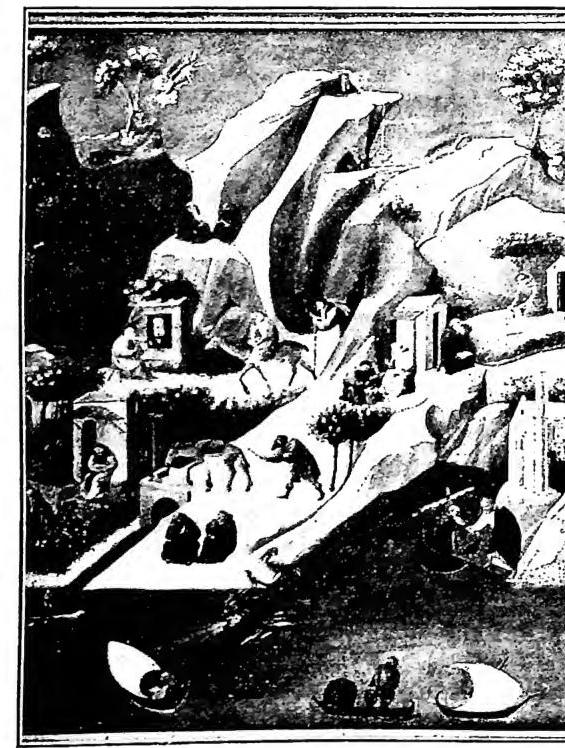
(Alinari photograph)
CONTEMPLATIVA, VITA - Contemplative and active life of the anchorites.
Detail of the panel attributed to Beato Angelico (15th century).
Florence, Uffizi Gallery.
“not so much with regard to the diversity of lives, but rather with regard to the diversity of those living” (In III Sent., dist. 35, q. 1, ad 5); hence, theoretically speaking, “life is sufficiently divided into active and contemplative” (Sum. Theol., 2ᵃ-2ᵃᶜ, q. 179, a. 2).
The doctrine concerning the mixed life, that is, a third kind of life which combines the demands of the active and contemplative life, finds its natural development among later theologians, especially with the spread of the mendicant orders (12th and 14th centuries). According to this teaching, Orders of the mixed life are called those which join the apostolic ministry to contemplation for the spiritual good of souls (“apostolic life”).
Concerning the superiority of the contemplative life over the active, the thought of St. Thomas, universally accepted, is that the active life, if directed toward the spiritual good of one’s neighbor, is more useful than the contemplative life, but the latter is nobler and more worthy in itself. “The contemplative life is simply better than the active, insofar as it more closely resembles that life which one strives to attain through the active and contemplative life.” But “the active life, with regard to that part which is concerned with the salvation of one’s neighbors, is more useful than the contemplative” (Sum. Theol., 3ᵃ, 35, q. 1, a. 4). The superiority of the contemplative life over the active is demonstrated by nine arguments drawn from Aristotle, patristic thought, and Sacred Scripture. The active life, moreover, disposes one toward the contemplative insofar as it orders the various passions of the soul (op. cit., 2ᵃ-2ᵃᶜ, q. 182, a. 3).
Suarez specifies that “contemplatio theologica est finis humanae vitae,” which must be understood of the contemplation enjoyed in the future life (lumen gloriae); in the present life, contemplation, although having the character of a means for increasing charity and grace, is far more perfect than the active life, which has only the value of a means (De Religione, IV, t. 2, cap. 9, n. 6).
Since the wayfarer can never wholly dispense with the active life, because the necessities of life weigh even upon anchorites, nevertheless, the closer the contemplative life approaches perfection, the more faithfully the active life will serve it as a handmaid. The factor capable of maintaining equilibrium amid the various interferences love (v.) or supernatural charity.
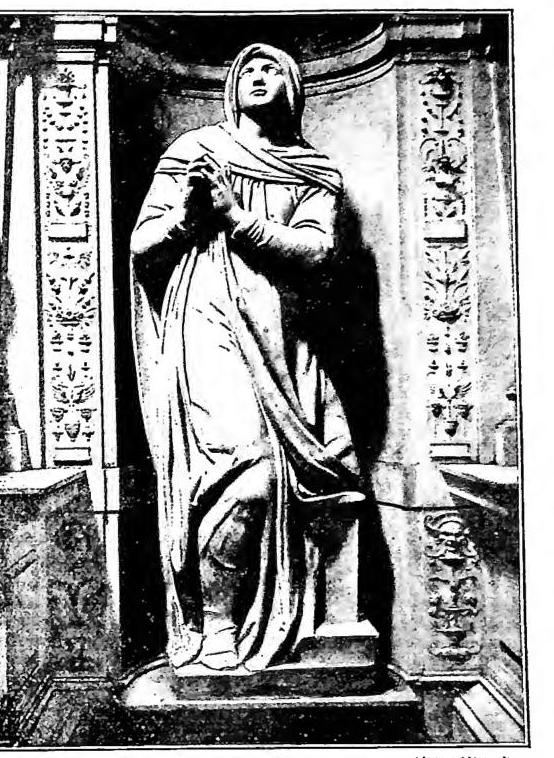
(phot. Alinari)
CONTEMPLATIVA, VITA — Statue of Rachel, symbolizing the Contemplative Life, in the monument to Julius II. Sculpture sketched by Michelangelo and completed by pupils — Rome, basilica of S. Pietro in Vincoli.
Phat-Diem, Phom-Penh, Hué, Saigon, Bangkok. At Vinh there are the Poor Clares. There are also various Dutch Carmels in Indonesia and Borneo, as well as in Papua and Burma. India has the Carmels of Calcutta, Bangalore, Mangalore, and Colombo, all in full development. In Tibet, the mission of the Gran S. Bernardo occupies the posts of Wei-si and Siao, while other posts in India are occupied by the mission of the abbey of St-Maurice. In French Africa, the Poor Clares are found in Algiers, and in the Sahara the Little Brothers of Jesus, recently founded.