
BURMA. –
I. GEOGRAPHY
In English Burma; a region of southern Asia (N.W. Indochina) comprising almost the entire basin of the Irrawaddy and the middle and lower part of that of the Salween, as well as a long strip of territory (Tenasserim) extending as far as the Malay Peninsula (605,000 sq. km.). A predominantly mountainous country, covered with splendid forests rich in valuable timber, especially teak, which then opens southward into broad valleys. Three-quarters of the population consists of Burmese (of Sino-Tibetan stock), chiefly devoted to agriculture; among its products (cotton, millet, sesame, tobacco, tea), rice is pre-eminent, and Burma is one of the world’s largest exporters of II. More important than livestock raising is fishing; among the mineral resources (silver-bearing lead, copper, zinc, tungsten, precious stones), the extraction of petroleum has assumed considerable importance.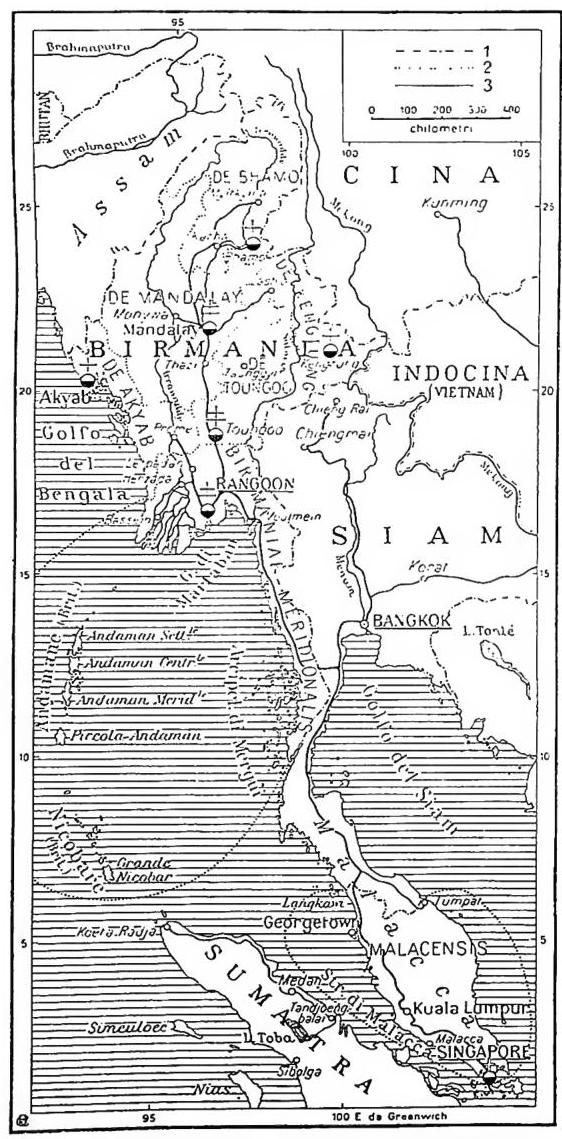

(Fides photograph) BIRMANIA - Giant statue of “Belooma” in local stone, in the jungle near Jaungtha.
divided into Lower and Upper B.; the latter included
some protected small states (Shan and Kerenni).
By the Treaty of London of 17 October 1947, B. was
recognized as having the right to independence. The
capital, Rangoon, on the Irrawadi delta, is a large
center (500,000 inhabitants) and the country’s chief port.
In Upper B. lies Mandalay (150,000 inhabitants).
Of today’s 17 million inhabitants, the overwhelming
majority profess Buddhism; just under one million, in
the interior of the country, practice animistic cults, and
over half a million profess Islam. Catholics are estimated
at approximately 150,000.
BIBLI: L. Fea, Quattro anni fra i Birmani e le tribù limitrofe,
Milan 1896; H. J. Wehrli, Zur Wirtschaftsgegographie von
Ober-Burma und der nördlichen Schan-Staaten, Zurich 1906;
J. Dantremer, La B., Paris 1912; H. T. White, Burma,
Cambridge 1923; L. D. Stamp, The Vegetation of Burma, Lon-
don 1925; R. Grant Brown, Burma as I saw it, there 1926;
H. L. Chibber, The Physiography of Burma, there 1933; id.,
The Geology of Burma, there 1934. Giuseppe Caraci
II. EVANGELIZATION OF B
The evangelization of B. before its division in 1866 into three vicariates may be divided into five periods. The first, extending approximately from 1555 to 1721, was the period of occasional evangelization, limited to the larger centres and directed principally toward European colonists and Portuguese military personnel. Secular and regular priests (Dominicans, Franciscans, Jesuits), for the most part Portuguese, were engaged in II. On various occasions (Capuchins in 1648, missionaries from Paris in 1704), the Sacred Congregation of Propaganda sought to ensure the establishment of a genuine mission. It succeeded only in the second period (1721–1830), with the Barnabites and almost by chance, as an appendage, that is, to the unsuccessful legation of Carlambrogio Mezzabarba in China, who from Canton sent Fr. Sigismondo Calchi, a Barnabite, with powers (though without the title) of apostolic vicar of Ava, Pegu, and Martaban, together with a secular priest, Don Giuseppe Vittoni (1721). Opposed by the padroado missionaries (v. PATRONATO), but well regarded by the people and by the king of Ava, who granted them freedom to preach, the Barnabite mission began under favourable auspices. But, despite its zeal and intelligent labours, the mission suffered, one after another, a whole series of extremely grave misfortunes. In 1741 and 1746, during the internal struggles between the Burmese and the Peguans, the first two apostolic vicars, Msgr. Pio Gallizia and Paolo M. Nerini, were killed. A brief interval of relative calm followed under the apostolic vicar G. M. Percoto (d. 1776), but shortly thereafter revolutions, civil wars, and persecutions resumed, culminating in the Anglo-Burmese War of the first quarter of the nineteenth century. The last apostolic vicar able to work was G. M. Mantegazza (d. 1794). Corbenonis, elected as his successor, died before receiving his appointment, and L. Grondona could not be consecrated bishop. The last Barnabite missionaries were Fr. G. d’Amato and Fr. Vincenzo Sangermano. In 1830, the Barnabite Congregation, finding itself unable to continue maintaining the Burmese mission, was compelled to renounce II. It deserves credit for the first serious and sustained attempt to evangelize the Burmese and the Karen tribes, and for the first indigenous linguistic literature.In the third period (1830–39), the Piarists succeeded them, with the apostolic vicar Federico Cao and a few priests or religious hastily gathered together, among whom Don Tarolli of Trento stood out. Propaganda then entrusted the mission to the Oblates of the Virgin Mary of Turin (fourth period: 1839–1856), who worked zealously under their two apostolic vicars, Cerretti (1842–47) and Balma (1848–56). But their work was soon destroyed and the fathers imprisoned following the second Anglo-Burmese War of 1851–52. Their last missionary was Fr. Abbona. The mission (fifth period: from 1856 onward) then passed to the Society of Paris, with the first apostolic vicar, Bigandeh, who, aided by the regime of freedom established by England and by the peace that followed the occupation, was able, after a study tour through the region, to begin implementing his programme of apostolate (especially in the educational sector) with such success that ten years later he could propose to the Sacred Congregation of Propaganda the division of the entire territory of the single mission into three vicariates (1866). These were precisely those of northern, eastern, central, and south-western B., all entrusted to the same Society of Paris and subsequently definitively reorganized in 1870, when the eastern vicariate was ceded to the seminary of the Foreign Missions of Milan. From then onward, the individual jurisdictions began their separate existence (v. the relevant articles). At present, B. has the following missions: three apostolic prefectures—AKIBA (v.), BAHÁ'ISMO (v.), and Kengtung (v.)—and three apostolic vicariates—southern B. (v.), Mandalay (v.), Toungoo (v.)—with a combined total of nearly 150,000 Catholics. As regards organization, the missions of B. depend upon the Apostolic Internunciature of India, based in New Delhi.
Protestant missions are numerous and active in B. The first to arrive were the English Baptists, who came from Bengal in 1808; they were followed (1815) by the Americans, who began the Rangoon mission and soon gained the upper hand over the English. They first penetrated among the Karen tribes of lower B., then advanced ever farther north. These missions developed greatly after the second Anglo-Burmese War and the annexation of lower B. to the British Empire. In 1859, the S. P. G. (Society for the Propagation of the Gospel in foreign parts), dependent upon the Anglican Church, established itself there; it created a bishopric in Rangoon. The Baptists have slightly fewer than 100,000 Christians, and the S. P. G. slightly more than 10,000. They were followed by the American Episcopal Methodists (1879), the English Wesleyans (1885), the Salvation Army (1915), the Adventists (1919), and the Plymouth Brethren (1920). The total number of Protestant Christians in B. is estimated at 120,000.