
BEATTY, CHESTER, papyri. — A collection of 12 groups of Greek papyri, purchased in 1930 and 1931 in Egypt by A. Chester B., perhaps originating from the ruins of an unidentified local Christian monastery, preserved in B.’s collection in London and published in the years 1933–37 by Frederic George Kenyon of the British Museum. The discovery of these papyri was the most sensational discovery of ancient biblical texts since that of the Codex Sinaiticus.
Their contents are as follows: New Testament. — Pap. I (siglum: P 45): 30 leaves containing portions of the 4 Gospels and Acts, surviving from a codex of 110 leaves, or 220 numbered pages, written perhaps in the first half of the 3rd century and containing the 4 Gospels and Acts. Another leaf of this codex is in Vienna, published in 1933 by H. Gerstinger.
Pap. II (siglum P 46): 86 leaves in excellent condition, containing most of the following epistles of St Paul: Rom., Hebr., I and II Cor., Eph., Gal., Phil., Col., I Thess. Of these 86 leaves, 56 are in London in the collection of Ch. B. and 30 in Ann Arbor at the University of Michigan, published in 1935 by H. A. Sanders. The codex from which these leaves survive, written in the first half of the 3rd century, had 104 leaves and contained all the Pauline letters, except, apparently, the Pastoral Epistles.
Pap. III (siglum: P 47): 10 leaves of a 3rd-century codex containing Apoc.
Old Testament. — Pap. IV (siglum: 961): leaves of a 4th-century codex of 66 leaves, containing Gen.
Pap. V (siglum: 962): 22 leaves of a 3rd-century codex of 84 leaves, also containing Gen. These two manuscripts of Gen. are of special importance, because most of Gen. is missing from the great Vatican (B) and Sinaitic (S) codices.
Pap. VI (siglum: 963): substantial portions of 33 leaves, and identified fragments of another 22 leaves, of a 2nd-century codex of 108 leaves, containing Num. and Deut. This papyrus is the oldest in the entire collection.
Pap. VII (siglum: 965): fragments of 33 leaves of a codex of 104 leaves from the first half of the 3rd century, containing Is.
Pap. VIII (siglum: 966): fragments of 2 leaves of a codex from the end of the 2nd and the beginning of the 3rd century, containing Ier.
Pap. IX and X: Of a codex of perhaps 118 leaves from the first half of the 3rd century, 29 leaves of Ez. and 8 leaves of Eith., as well as 13 mutilated leaves of Dan. (siglum: 968), have survived. Eight of the 29 leaves of Ez. belong to Ch. B. and 21 to J. H. Scheide, being deposited at Princeton University and published in 1938 by Johnson, Gehman, and Kase. The papyrus of Dan. is of very special importance, because it differs from all the other Greek codices and from the Vulgate: it does not give the version made by Theodotion, but the Septuagint version preserved only in a 10th-century Greek codex and in a Syriac version.
Pap. XI (siglum: 964): 1½ leaves from the 4th century, containing Eccl.
Pap. XII: 8 leaves (belonging to Ch. B.) and 6 leaves (belonging to the University of Michigan) are from a 4th- or 5th-century codex containing the apocryphal book of Enoch, which was very popular in antiquity and is cited in the canonical Epistle of Jude, and a homily by Melito of Sardis (2nd century).
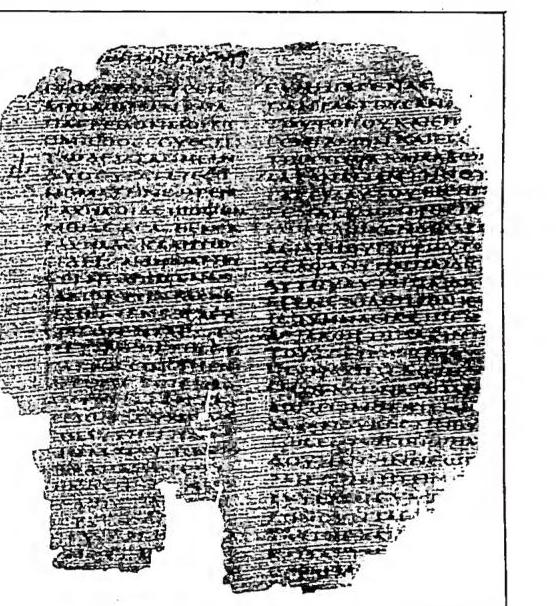
Ida F. G. Kenyon, The Chester Beatty Biblical Papyri, London 1932, fasc. I, rev. IV
BEATTY, CHESTER, papyri — Papyrus IV, Gen. 29:15–27 (4th century), British Museum.
a century before the oldest Vatican (B) and Sinaitic (S) Codices.
Lit., 63 (1944), pp. 379–96; A. Allecier, Die Ch. B.-Papyr zum Pentateuch, Paderborn 1938; H. C. Hoskier, Appendix to an Article on the Ch. B.-Papyrus of the Pauline Epistles, Oxford 1937; id., A Commentary on the Various Readings in the Text of the Epistle to the Hebrews in the Ch. B. Papyrus P. 46 (ca. 200 A. D.), London 1938; C. C. Tarelli, The Ch. B. Papyrus and the Western and Byzantine Texts, in Journ. Theol. Stud., 41 (1940), pp. 253–60; id., Some further linguistic aspects of the Ch. B. Papyrus of the Gospels, ibid., 43 (1942), pp. 19–25; H. F. D. Sparks, The Order of the Epistles in P. 46, ibid., 42 (1941), p. 180; G. D. Kilpatrick, The Ch. B. Papyrus P. 46 and Hebrews 11, ibid., 41 (1940), p. 68; id., Western Text and Original Text in the Gospels and Acts, ibid., 44 (1943), pp. 24–36.
Ernesto Vogt - Aristide Calderini