
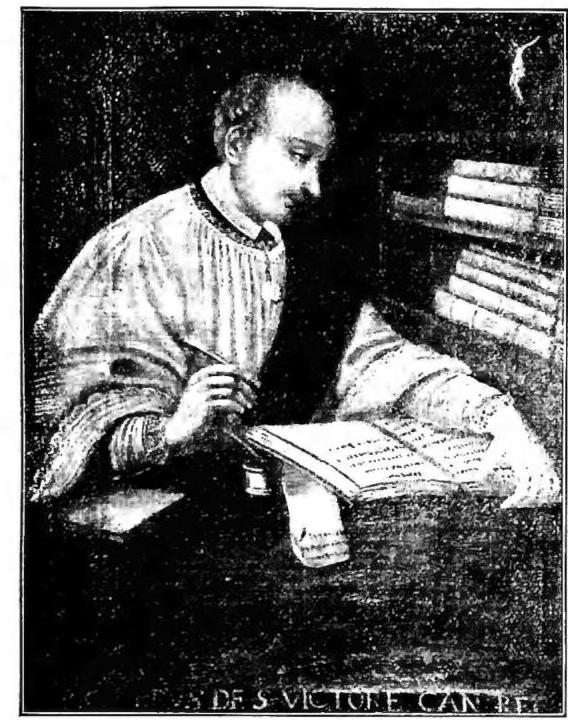
RICCARDO di SAN VITTORE. - Theologian and mystic, born probably in Scotland at the beginning of the 12th century, died in Paris on March 10, 1173. Having entered the Canons Regular of St. Victor (Paris) in the time of Abbot Gilduin, he was a disciple of Hugh of St. Victor (v.) and probably succeeded him in teaching theology at the monastic school.
This treatise is one of the most original and surprising syntheses of the 12th century, which because of its urgent search for « rationes necessariae » to demonstrate the intrinsic non-repugnance of the high mystery, gave rise in more recent times (Pohle, Heitz) to the suspicion of a rationalistic tinge in Richardian theology; today criticism is more favorable to him, but in the golden age of scholasticism his speculation, of a Greek tendency, was more admired than followed (cf. A.-M. Ethier, Le « De Trinitate » de Richard de Saint-Victor, Paris-Ottawa 1939); indeed, while received by Alexander of Hales, it was neglected by St. Bonaventure and St. Thomas.
Inspired by the same method of rationes necessariae, in the manner of St. Anselm and without a rationalistic tinge, are: De tribus appropriatis personis in Trinitate; Liber de Verbo Incarnato; Quomodo Spiritus Sanctus est amor Patris et Filii; De superexcellenti Baptismo Christi; De potestate ligandi atque solvendi; Tractatus de Spiritus blasphemia; De differentia peccati mortalis et venialis. But R. established himself above all in mysticism, in which he shared an undisputed primacy with St. Bernard throughout almost the entire
Middle Ages, through a series of works that constitute a complete theoretical treatment of the subject: De praeparatione animi ad contemplationem, a book called Beniamin minor: it indicates in the mortification of the passions and the exercise of virtues the way to attain contemplation; De gratia contemplationis, seu Beniamin maior: it is R.'s masterpiece, his most famous work and the most utilized by posterity.
He treats of charity in the pamphlets: De gradibus caritatis, De quattuor gradibus violentae caritatis. Important is his broad treatise on the interior life: De conditione interiori hominis. Among the numerous pamphlets of the same nature, Exit edictum or De tribus processionibus is worthy of note (ed. J. Chatillon-W. J. Tulloch, in Richard de St-Victor, Sermons et opuscules spirituels inédits, I, Paris 1951, with complete bibliography on pp. XV-XVII). Although R. indulged, more victorino, in a far-fetched allegorism and his style is at times too burdened with words and images, nevertheless his thought is limpid, sustained by an extraordinary speculative force, which Dante recognized in him in the well-known verse:
« Che a considerar fu più che viro » (Parad., X, 132).