
HANOI, APOSTOLIC VICARIATE of. — It is located in south-western Tonkin (Viet-nam) and has an area of 4,600 sq km. Following the division of the apostolic vicariate of Tonkin in 1678, the two vicariates of Eastern and Western Tonkin were established; from the latter, on 17 March 1846, that of Southern Tonkin was detached. Finally, in 1901, the apostolic vicariate of Maritime Tonkin was carved out of II.
The present designation of H. was given on 3 December 1924. It comprises the provinces of Hadong, Hanan or Phily, and parts of the provinces of Namdinh, Hoabinh, Hungyèn, and Sontay. The inhabitants are all Annamites, except those in the mountainous region, who belong to the « Thai » or « Tho » peoples, with their many idioms, and have nothing in common with the Annamite language. There are three religions: Buddhism, Confucianism, and Taoism; but they have the name of religions only, since they have been reduced to sects whose doctrine is gross atheism and materialism. The cult of the ancestors is especially tenacious. Several Protestant sects have been transplanted from America and France to the city of H., but have made few converts. At the beginning of the 17th century, various missionaries, including the well-known Alessandro de Rhodes, preached the Gospel in Tonkin with considerable success. The first two Tonkinese priests were ordained in its territory in 1668; on 14 February 1670 the Tonkinese Synod was celebrated there. The Christian population
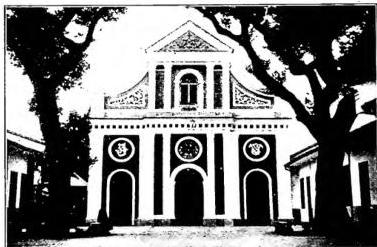
(photo Fides)
Of a population of more than 2,200,000 inhabitants, there are 195,070 Catholics, 6,924 catechumens, and 2,000,000 pagans. There are 165 Annamite priests and 57 foreign priests; 20 Annamite brothers and 13 foreign brothers; 427 Annamite sisters and 44 foreign sisters; 370 catechists; 1 major seminary with 42 students and 1 minor seminary with 110 students; 23 districts; 87 quasi-parishes, 200 churches, and 546 chapels. There are 1,069 teachers; 212 elementary schools, with 7,285 boys and 2,469 girls; 4 middle schools, with 763 boys and 886 girls; 2 secondary schools, with 825 boys and 496 girls; 1 school for catechists, with 43 students; 4 hospitals with 140 beds; 4 orphanages with 140 orphans; 2 homes for the elderly with 1,003 residents; and 1 printing press, from which various periodicals are published. H., the intellectual capital of Viet-nam, is the residence of the Ordinary.