
CONFUCIANISM. — This is the name given to the entire body of religious, ethical, Confucius (v.) gathered from antiquity, inculcated through his life and teaching, and transmitted to posterity—doctrines that Mencius (Meng Tzu, 372?–289? B.C.) consolidated, and to which Ciusci (Chu Hsi, 1130–1200) unfortunately gave that atheistic interpretation and rationalistic form which dominated from the twelfth to the twentieth century. Although it is neither a religion nor, strictly speaking, a philosophical system, for more than two millennia Confucianism occupied the place of both for millions of Chinese and, through the centuries, formed the fabric of China.
This body of doctrine is scattered throughout the Five Classics and the Four Books, to which Confucius, in one way or another, according to ancient tradition—though today that tradition has been strongly shaken by critics—linked his name. Whereas it was formerly commonly accepted that all these books had either been written or at least edited by Confucius, today not a few would maintain that none of them dates back beyond the third century B.C. The list of the Five Classics comprises: 1. The Book of Changes, a sort of extremely abstruse manual of divination, consisting of two parts. The older part is generally attributed to King Uen (Wen) and his son, the duke of Ceu (Chow), and would therefore date back to the eleventh century B.C.; the second, more recent part, must be attributed to the disciples of Confucius and thus date from the fifth–fourth centuries B.C. — 2. The Book of Historical Annals, a collection of prose documents intended to give us the sequence of China’s events from the beginning of its history—or rather prehistory—down to the seventh century B.C. This collection, attributed to Confucius, was destroyed in the fire of 213 B.C., rediscovered in 140 B.C., lost again and rediscovered once more, this time only in part, the other half having been added in the third century A.D. — 3. The Book of Odes, a collection of 300 odes, likewise attributed to Confucius, the oldest of which may date from the thirteenth–twelfth centuries B.C. and the most recent from the beginning of the sixth century B.C. — 4. The Records of Rites, containing texts compiled in their present form between the fourth and first centuries B.C., though some passages may date from a still more remote antiquity. — 5. The Spring and Autumn Annals, a concise chronicle of the State of Lu, Confucius’s homeland, from 722 to 484 B.C., likewise attributed to the great master. The quintessence of Confucianism is then epitomized in the Four Books, in which, from the twelfth century A.D. onward, the following works were collected through the efforts of Ciusci: The Great Learning, extracted from the Records of Rites, of which it forms chapter 39, and now comprising eleven chapters, the first of which is said to be by Confucius and the other ten (one of them was added by Ciusci himself, who believed it to be missing) by someone from his school in approximately the fourth century B.C. The Unchanging Mean, also extracted at a fairly early date from the Records of Rites, of which it forms chapter 28; it is attributed to a great-grandson of Confucius, Ccomchi (K’ung Chi, 483–402 B.C.), who might also be a pseudonym. The Discourses of Confucius are a collection of anecdotes and aphorisms of the great master, initially transmitted probably by word of mouth and then committed to writing by the disciples of his disciples at the beginning of the fourth century B.C.; the present text dates from the second century A.D., but was based on three texts from the second century B.C., now lost. The Discourses of Mencius have transmitted, in beautiful and clear prose, the thought of Mencius, who is regarded as China’s “second saint” after Confucius; known since the third century B.C. and perhaps even earlier, they did not become a subject of study until the second century A.D., when their first commentary appeared, and they were not raised to the rank of a classical book until 1662. Put into writing perhaps by the disciples, they were probably revised and edited by Mencius himself, who supervised their publication.
The content of Confucianism, as found in these sources, is religious and ethical.
From the religious point of view, Confucius never presented himself either as the founder of a religion or, still less, as a god; the Chinese have always regarded him as China’s first “saint,” and as such have honored him for approximately two millennia. His religious thought is therefore that of the ancients, who venerated a Supreme Being, to whom from the beginning, or at least from the thirteenth–twelfth centuries B.C., they gave the name Ti, or Dominator, and more often Scianti, or Supreme Dominator; from the eleventh century B.C. onward they also called him Tien, or Heaven, either alone or accompanied by adjectives such as August, Immense, and so forth. These names, moreover, were perfectly interchangeable, as is shown by this passage from an authentic chapter of the Historical Annals (IV, 94): the fame of King Uen “reached the Supreme Dominator, and the Dominator approved; Heaven then gave a great mandate to King Uen.” The Discourses of Confucius show that for him, as for the ancient Chinese, Heaven is the “Great One alone” (VIII, 19), since everything depends upon him (XIV, 38), including life and death (VI, 8), riches and honors (XII, 5); he is the One from whom the philosopher has received his virtue (VII, 22) and his doctrine (IX, 5), enabling him to trust in God and defy his enemies (IX, 5); the One to whom he often turns in prayer (VII, 34), since he is provident (II, 4) and the only one who knows him fully (XIV, 37); he is an infallible (IX, 11) and unappealable (III, 13) judge; he is therefore worthy of everyone’s respect, including that of the superior man (XVI, 8). It also seems that Confucius intuited the proof of God’s existence through causality and order, since he asserts that there is no need for Heaven to speak, given that the four seasons proceed regularly and beings are produced in the world, as though they themselves were God’s voice (XVII, 18). Regarding this verse from the Book of Odes (I, 17), which proves God’s spirituality and transcendence—“The actions of sublime Heaven have neither sound nor smell”—he, or at least his school, exclaims: “Here is the height of perfection!” (Unchanging Mean, end).
To this Supreme Dominator, or Heaven, from the very beginning of the nation, the sovereign customarily offered a sacrifice in the southern suburb of the capital. Indeed, markets and fairs—that is, commercial exchanges—are still held in China today in the suburbs. And it is also in the suburbs that the ancient Chinese wished to conduct exchanges with
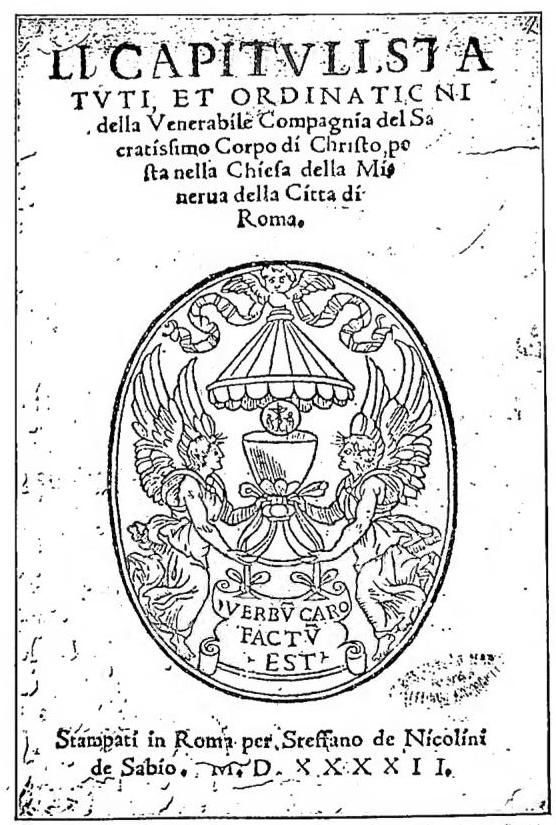
CONFRATERNITIES (COMPANIES) OF THE MOST HOLY SACRAMENT – Frontispiece of Li Capituli, Statuti, et Ordinati of the Venerable Company of the Most Sacred Body of Christ, Rome 1542. Rome, copy in the National Library.
the divinity. Out in the open, beneath the blue vault of the heavens, before dawn, they offered the sacrifice to Heaven upon a small raised mound in the suburb south of the capital. The character indicating both the mound and the sacrifice to Heaven is pronounced chias, and is composed of two elements: the first, placed before it, signifies relations or exchanges, and the second, which follows, signifies city; hence, exchanges before the city, that is, the capital. This sacrifice was reserved exclusively to the sovereign. It was performed as early as the twentieth century B.C. and throughout the second and first millennia B.C., always in honour of the one Heaven, which can only be the true God. Only in 31 B.C. was Earth also associated with Heaven, and from that moment until 1911, with the advent of the Republic, the worship of Heaven and Earth assumed prodigious importance. This dual worship had the unfortunate consequence that the concept of personal Heaven almost imperceptibly gave way to that of the material sky; and, as though this were not enough, over time countless divinities of the second, third, and fourth orders were added. Of these, only about ten were deified historical or legendary figures, while all the others were sidereal, atmospheric, terrestrial, and aquatic divinities. Finally, in the fourteenth century, there was at least a partial return to the primitive simplicity, with the suppression, or at least the considerable reduction, of these secondary divinities. In any case, the latter, who served almost as satellites to Heaven and Earth, were no longer deified human beings, but celestial or terrestrial beings, and therefore were related either to Heaven or to Earth. Even the Heaven–Earth dualism seems, at least for the more learned, to have been merely verbal, conceptual, and apparent, and through heaven and earth they intended, in short, always to honour that personal Heaven, known and worshipped from the earliest centuries under the name of the Supreme Ruler. In fact, speaking of the ancients, Confucius is said to have declared: « By the sacrifice of the suburb to Heaven and by that of the Earth, they served the Supreme Ruler » (Invariable Mean, 10); that is, despite the apparent dualism, indeed through this dualism, they always intended to honour the one Supreme Ruler. It therefore seems that the worship of Heaven, whose most solemn act was the sacrifice offered by the emperor once a year at the winter solstice, recovered during the last five hundred and more years of the Empire almost all the freshness and purity of the earliest centuries. This worship was neither Buddhist nor Taoist, and was conducted within and according to the principles of C.
Confucius, however, like the Chinese generally, was inclined less toward metaphysics and abstract questions than toward ethics and the practice of life. In this he excelled, as can be seen from his Discourses, to which all the following bibliographical references refer when no other indication is given.
As regards individual ethics, Confucius did not yet take a position on the question, later so much debated by Chinese philosophers, whether human nature is in itself good or evil. He maintains that human beings are born equal, but that they subsequently differ according to the habits they acquire (XVII, 2), dividing into four classes. At the top is the « sage », for whom both knowledge and virtue are innate; immediately below comes the « superior man », who acquires both through study and diligence; next comes the fool who, despite his limited ability, makes efforts to attain both; and finally the simpleton who does nothing to rise above his foolishness (XVI, 9). Indeed, few are those who follow virtue (XV, 3), while many allow themselves to be carried away by beauty (IX, 17; XV, 12). Yet the man of character, the man of virtue, does not seek to save his life at the cost of virtue; rather, he is prepared to sacrifice his life in order to remain in virtue (XV, 8). This, in turn, consists in « ne quid nimis » (VI, 27). Among the virtues, Confucius recommends sincerity, justice, courage, wisdom, courtesy, and especially gen, which may signify benevolence, philanthropy, or even humanity. It is noteworthy that he advanced as far as negative charity: to a disciple who asked him for a maxim to serve as an ideal throughout his life, the master replied: [This maxim] « would it not perhaps be charity, namely, what you do not want for yourself, do not do to others? » (XV, 23). For him, study was a joy (I, 1). He could therefore say to his disciple: « Study as though you might never reach the goal, and as though the danger of forgetting what you have learned were ever present » (VIII, 17). In any event, the scholar must not deceive himself: « knowledge consists in knowing that you know what you know and that you do not know what you do not know » (II, 17). The highest ideal of humanity after the « sage » is the « superior man », whose moral portrait follows. He seeks clarity in what he sees and discernment in what he hears; he is affable in manner and modest in conduct; he is sincere in speech and respectful in action; when he doubts, he asks questions, and when he feels the stirrings of anger, he restrains himself by considering the inconveniences that would result; when he conducts good business, he is concerned with justice (XVI, 10).
If one passes from the individual to the family, Confucius inculcates in children above all filial piety toward their parents, which consists « in serving them according to the prescriptions while they are alive, and after death in burying them and making offerings to them always according to the prescriptions » (II, 5). A pious son must care for his parents’ persons, care for what he has received from them, namely his own body, and care to ensure their continuation through the centuries by means of male offspring obtained in marriage, perhaps even through polygamy. He must also conform his will to theirs while they are alive, and after their death he must continually keep their memory alive within himself by frequently making offerings to them. The summit of filial piety consists in imitating the ancient sages, who « served the dead as they had served them in life, and served them when buried as they had served them when present » (Immatable Mean, 19). A son, in the Confucian mentality, always remains a son, just as a creature always remains a creature in relation to God. It follows that acts performed toward the dead are nothing other than the continuation of those performed while they were still alive. The son would kneel before a living father or mother and present them with food; now that they are dead, he wishes to continue doing the same as though they were still alive, as required by filial piety as the Chinese understand II.
From the family one then proceeds to the State. In the Confucian system, he who knows how to govern his own family also knows how to govern the State, which is nothing other than a larger family. The sovereign reigns by virtue of the “heavenly mandate” that he has received, but which is not eternal, because through the vices of the one invested with it, it may be lost or pass into other hands. Probably playing on the word “cem,” which can mean both “to govern” and “to be upright,” Confucius declares: “to govern is to be upright” (XII, 17). He maintains that the sovereign’s influence upon the people, for good or for ill, is enormous. “The superior man resembles the wind and the common man the grass; when the wind blows upon the grass, it necessarily bends” (XII, 18), that is, it undergoes the influence of the stronger. When the prince “is upright, the people do their duty, even without any order being issued; when, on the other hand, he himself is not upright, even if he issues all the orders he wishes, he will never be obeyed” (XIII, 6). Conversely, the prince’s vices are the cause of the people’s vices; to one who had usurped a dignity that did not belong to him and nevertheless complained about the great number of thieves there were, Confucius courageously observed: “If you were not so rapacious, no one would steal, even if you were prepared to give a reward to the thief” (XII, 17). For Confucius, the virtuous sovereign is like the Pole Star, which, while remaining motionless, draws all the other stars toward itself (II, 1).
This body of doctrines, which from the first centuries of the Christian era until the early years of the twentieth century was regarded as China’s sole and true orthodoxy, was always jealously guarded by the Confucian literati. In this immense host, two names stand out: Mencio and Ciusci. The former devoted his entire life to the practice and dissemination of the principles set out above, while the latter imparted a disastrous direction to c., giving the clearest texts of antiquity concerning Heaven and the Supreme Ruler a decidedly materialistic interpretation, which unfortunately lasted at least until 1904.
Thus, when Fr. Matteo Ricci found himself, at the end of the sixteenth century, for the first time confronted with this teaching, undermined by the school of Gusci, he very wisely rejected that school’s arbitrary interpretations and returned to the texts of Chinese antiquity, restoring to them the meaning they had possessed in the past. After this necessary purification, it seemed to him that c. was not properly speaking a religion, but a politico-literary academy, which moreover imposed nothing contrary to the truth of the faith and, in ethics, agreed sufficiently with the teaching of the Church, except, naturally, on polygamy; the cult of ancestors, properly understood, could also be tolerated, at least so long as it remained possible to Christianize it completely. And in general this is what the Jesuit missionaries of the thirteenth century did as well, while other missionaries of other Orders thought differently. Yet even in 1934 the Foreign Minister of the nationalist government of Nanking declared unequivocally to the press that c., devoid of theology and without any claim to doctrinal infallibility, was a philosophical school, not a religion, and that Confucius was a great man to be honored but not worshipped. And in 1948, an old follower of Confucius, formerly Foreign Minister and President of the Council of Ministers, who later became a Catholic, priest, and monk, wrote at the end of his long life: “c., whose norms of moral life are so well founded and beneficial, finds in Revelation and in the existence and life of the Catholic Church the most evident justification of all that it possesses which is human and immortal, and at the same time finds therein the completion of light and moral power that resolves the problems before which our sages had the humility to stop, understanding that it is not for man to pronounce judgment on the mystery of Heaven and that, while venerating the providence of Heaven, one must await the Creator’s own revelation, should He deign to make it” (C. Lou Tseng tsiang, Souvenirs et pensées, 2nd ed., Paris 1948, p. 78).
phie sociale et politique du confucianisme, Paris 1938; S. Lokuang, La sapienza dei Cinesi, Rome 1945. For further bibliographical references, cf. H. Cordier, Bibliotheca Sinica, Paris 1904-14, cols. 700-13, 3112, 3535-36. Pasquale D'Elia