
NANCHINO, ARCIDIOCESI di. – The first ecclesiastical organization of N. (= capital of the south) was established in 1658 with the erection of the apostolic vicariate of the same name, extending over the territory of various civil provinces, which until then had depended on the single diocese of Macao.
On 10 April 1690, at the request of the King of Portugal, the dioceses of Beijing and N. were erected; like Macao, they too were suffragans of Goa. To the diocese of N. were assigned, in addition to the present civil provinces of Kiangsu and Anhwei, those of Chekiang, Fokien, Kwangsi, Hupeh, Hunan, Kweichow, and Yunnan. In 1690 many of these provinces were constituted as independent apostolic vicariates, and Kiangsu, Anhwei, and Hunan remained with the diocese of N. The latter was also detached from N. and erected as an apostolic vicariate on 2 March 1844 (v. NANYANG).
On 21 January 1856 the diocese of N. was suppressed and the apostolic vicariate of the same name reconstituted; on 8 August 1921 it was divided into the vicariate of Anhwei (v. WUHU) and that of Kiangsu. The latter on 1 May 1922 once again came to be called that of N., a designation confirmed on 3 December 1924, and was repeatedly divided in order to give rise to new ecclesiastical circumscriptions, namely: AMIENS (v.) in 1926, Süchow (v.) in 1931, Shanghai (v.) in 1933. With the establishment of the episcopal hierarchy in China in 1946, N. was elevated to a metropolitan archdiocese of the ecclesiastical province of Kiangsu, with the suffragan dioceses of Haimen, Shanghai, and Süchow, to which the new diocese of Soochow was added in 1949.
The Jesuits governed the diocese of N. from 1696 to 1718 and then again from 1752 to 1787, and thereafter from 1856 to 1933, when the Chinese secular clergy assumed the government of the apostolic vicariate of N., a city that had recently become the capital of the Republic.
It has an area of approximately 30,000 sq km. On 30 June 1948 it had approximately 6,000,000 inhabitants, of whom 32,390 were Catholics and 987 catechumens. It was served by 37 Chinese secular priests and 12 foreigners, including some Italian fathers of the Pia Società di S. Paolo di Alba and some Belgian fathers of the Società degli Ausiliari delle Missioni. There were 14 major seminarians; 5 lay brothers, all foreigners; 34 Chinese nuns and 9 foreign ones. The institutions included 1 orphanage, 12 dispensaries for medicines, 5 institutions for the education of youth, and 44 schools of various levels. From earlier statistics it was known that the territory was divided into 2 districts with 18 churches and 87 chapels, 13 primary stations, and 100 secondary ones.
The mission owes its origin to the celebrated Jesuit Fr. Matteo Ricci (v.), who established his residence there in 1599, came into contact with the literati, and baptized a military mandarin together with his entire family.
In 1609 Fr. Vagnoni arrived; after the conversion of a high-ranking mandarin, he obtained permission to build a church, the first in N., dedicated on 3 May 1611 to the “Lord of Heaven.” According to the testimony of Fr. Lombardi, Ricci’s successor as superior of the Jesuit mission, Christianity was flourishing and conversions were numerous, even among the literati. The era of persecutions began in 1626: the missionaries were dragged before the tribunals and subjected to grave insults and violence. After the apostolic vicariate of N. was established in 1658,
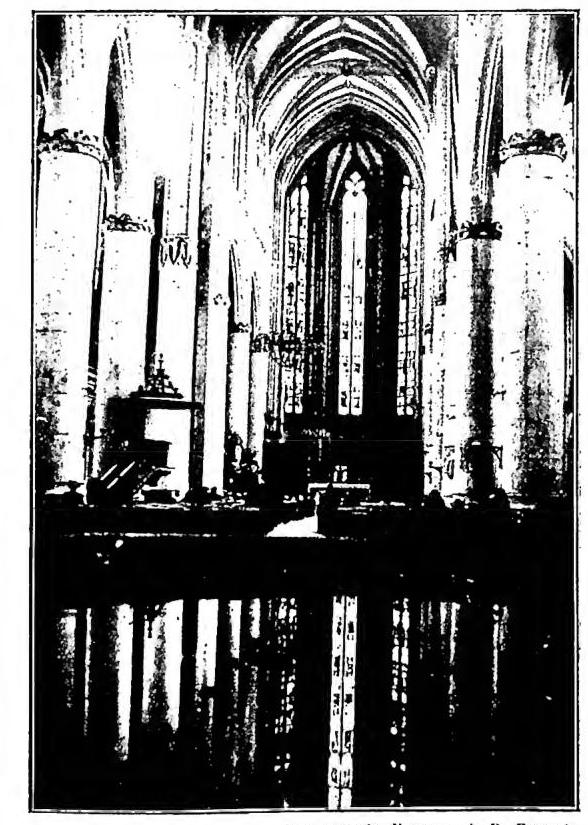
Vanara and Dugout, looted and ravaged the residence, and turned the church into a stable. Some Jesuits from California, who had been sent to open a school in N., were driven out by Chinese students. The Christian community of Wusih, between N. and Shanghai, which dates back to 1701, also had its church burned.