
HONG KONG. – British colony consisting of several islands (the two largest being Hong Kong and Lantau) and a section of the facing Chinese coast of Kwang-tung, opposite Macao: 1,013 sq km, with 1.8 million inhabitants (all Chinese, except for 7,000 British), of whom 450,000 are concentrated in the capital, Victoria (on the first island), a very busy port for trade with southern China.
Giuseppe Caraci
DIOCESE OF H. K. — It comprises the English colony of the same name on the coast of southern China and the three districts of Poon, Waichow, and Hoifung in the civil province of Kwang-tung. Erected as an apostolic prefecture on 22 April 1841, immediately after the foundation of the English colony, it initially comprised only the territory of the latter, which until then had formed part of the diocese of Macao. It was administered by the pro tempore procurators of the S. Congregation of Propaganda Fide, the last of whom, the Veronese Fr. Luigi Ambrosi, in 1858 called upon the priests of the Seminary for Foreign Missions of Milan to assist him. In 1867, upon Ambrosi’s death, they also assumed the direction of the prefecture, which in 1874 was elevated to an apostolic vicariate, with the annexation of the three aforementioned mainland districts, which until then had belonged to the apostolic prefecture of Canton. On 11 April 1946, with the establishment of the episcopal hierarchy in China, H. K. was elevated to a diocese, suffragan to Canton.
It has an area of 16,000 sq km. On 30 June 1949, the total population was approximately 4,000,000.
Of these, 37,146 were Catholics and 1,726 catechumens. In addition to the bishop, there were 36 priests and 2 lay brothers of the Pontifical Institute for Foreign Missions of Milan, as well as 21 Chinese secular priests. The minor seminarians numbered 30, and the major seminarians 3, at the regional seminary for Kwangtung and Kwangsi, located at Aberdeen on the island of H. K. and entrusted to the Irish Jesuits. There were 44 catechists, 506 teachers, 9 physicians, and 45 nurses. The territory was divided into 4 districts with 12 parishes, 17 primary stations and 129 secondary stations, 15 churches, and 180 chapels. Among the institutions were 6 hospitals
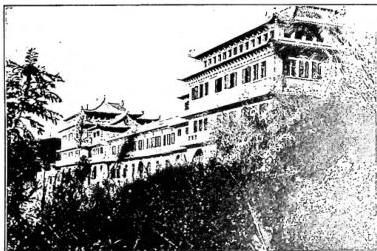
(fot. Fides)
H. K. is also assisted by 20 Salesian priests and 15 lay coadjutors, 16 Brothers of the Christian Schools, and 383 nuns belonging to ten different institutes. Moreover, the Society of Foreign Missions of Paris and that of Maryknoll have a procuration in H. K.; on the date mentioned above, they respectively had 12 and 4 priests there. The Dominicans have a procuration and a house of study with 28 fathers, while the Friars Minor have transferred there the biblical study house they had in Beijing, with 9 fathers. The island of H. K. acquired importance only after the British occupation (1840), and the first priests landed there almost immediately to minister to the many soldiers, most of them Irish Catholics, who, owing to the harshness of the climate, were dying without a priest to administer the Sacraments to them. The missionaries of the Seminary of Milan, assisted by the Sisters of St Paul of Chartres and the Canossians of Verona, opened schools, provided assistance to the soldiers, and went to the bedsides of the sick in the large hospitals scattered throughout the area. In 1859 they extended their work to the Chinese on the mainland, where, along the coast of the present-day Poon district, Frs. Volonteri and Burghignoli established a Christian community of 350 souls, distributed among 12 small centers; later preaching was extended to the other two districts of Waichow and Hoifung. Today the mainland, which as early as the five-year period 1927–33 had suffered, especially in the Hoifung district, the looting of Christian communities, the capture of missionaries and nuns, and the massacre of 200 Christians at the hands of the Bolsheviks, is once again under communist domination. The territory under British rule, meanwhile, is overcrowded because of the large number of refugees and suffered greatly during the Second World War, when it was occupied by the Japanese.