
HONDURAS. -
I. GEOGRAPHY
Region of the Isthmian part of America, between Mexico, Guatemala, Salvador, and Nicaragua, comprising a larger independent State and a small British colony.The territory of the Republic of H. (115,570 sq. km.) consists of a predominantly mountainous region, which has its greater frontage on the Atlantic (640 km.), while on the Pacific the coast is reduced to the inner part of the deep Gulf of Fonseca (96 km.). The climate, typically equatorial along the flat coastal strips, becomes milder with altitude, while remaining consistently very humid and rainy.
The population (1.3 million inhabitants; 11 per sq. km.) consists predominantly of mestizos (69%); next in number are the Amerindians (20%), and the Negroes and Zambos (5%). The whites number little more than 350,000.
The country’s principal resource is agriculture, especially bananas, coconuts, and coffee; maize, potatoes, tobacco, and fruit are also produced. Livestock farming is fairly widespread (especially cattle and sheep); forest resources are substantial and provide valuable timber. Mineral resources are not lacking (iron, copper, lead, zinc, antimony, and tin), but only gold and silver give rise to any significant mining activity. Commerce is in the hands of the U.S.A., which absorb approximately three-quarters of the trade, made difficult by the inadequate communications network.
The capital, Tegucigalpa, in the interior, is the only inhabited center with more than 50,000 inhabitants.
H. is a unitary republic (17 departments and 1 territory), with an elective government and unicameral representation; the president serves for 6 years.
The colonial territory (English since 1638) consists of the coastal strip of south-eastern Yucatán lying between Chetumal Bay and the Gulf of H. (21,268 sq. km.). It is still a little-known region, covered with dense forests, from which valuable woods (mahogany, cedar, pitchpine) are obtained, and cultivated only to a small extent (bananas, coconuts, and chicle).
The population (61,500 inhabitants, barely 3 per sq. km.) consists almost entirely of Amerindians and Negroes; the whites number approximately one thousand. The capital is Belize (18,000 inhabitants), the only noteworthy inhabited center.
II. EVANGELIZATION
In the present-day Republic of H., shortly after the conquest by Cortes in 1526, the Franciscans were the first missionaries. The indigenous Indian tribes were for the most part peacefully subjugated; they still constitute the majority of the population today.In 1531 the diocese of Trujillo de H. was erected; in 1568 it was transferred to Comayagua as a suffragan see of Guatemala. In the impenetrable forests, uncivilized Indian tribes remained, and the Franciscans ministered to them in the seventeenth and eighteenth centuries. To this day, thousands of Indians have not yet been converted. Under the Republic (from 1812),
ecclesiastical property was confiscated and the separation of Church and State was proclaimed. In 1916 the ecclesiastical hierarchy was organized. The diocese of Comayagua was replaced by the archdiocese of Tegucigalpa, with the suffragan sees of S. Rosa de Copán and the apostolic vicariate of S. Pedro Sula. The Lazarists are still working for the conversion of the Indians who remain pagan in the apostolic vicariate of S. Pedro Sula; the Redemptorists are concerned with those in the archdiocese of Tegucigalpa.
In British H. (v. BELGIO), the Jesuits have been working among the blacks, mulattoes, and certain Indian tribes since 1853. In 1888 the apostolic prefecture of H. was erected; it was raised to an apostolic vicariate in 1893 and received its present designation, Belize, in 1925.
Giovanni Rommerskirchen
III. LEGAL STATUS OF THE CHURCH
In the Republic of H., the system of separation of Church and State is in force, as explicitly proclaimed in Art. 57 of the Constitution, and the free exercise of all religions is guaranteed. This regime, in fact, is merely the legal expression of the secular and anticlerical mentality that characterized the revolutionary movements which, in the last century, led the Republics of Central America to independence.As regards marriage, the law of the Republic recognizes only civil marriage; religious marriage may be celebrated only upon presentation of a certificate attesting that the civil ceremony has taken place, under penalty of imprisonment or a fine of up to 250 dollars if the offense is committed by a national priest, and expulsion from the country if the priest is a foreigner. Divorce is legally permitted and practiced for very trivial reasons.
(propr. Enc. Catt.) HONDURAS - 1) State boundaries; 2) Boundaries of ecclesiastical jurisdictions; 3) Railways.
Another provision of the Constitution, which creates no slight difficulties for the Church, is that contained in art. 18, according to which foreigners may not hold public positions or offices, including those of the religions permitted in the country, on pain of expulsion. Given the scarcity of Honduran clergy, this rule makes the appointment of bishops to H. particularly difficult, although the legislation retains no claims of patronage.
The Constitution also prohibits the establishment in the territory of the Republic of associations of any kind of a monastic character; the law regulates the entry into the country of persons belonging to the aforesaid associations (art. 61). These provisions, however, are not applied in all their rigor.
Similarly, responsible members of the government have shown deferential benevolence toward the Church in recent years.
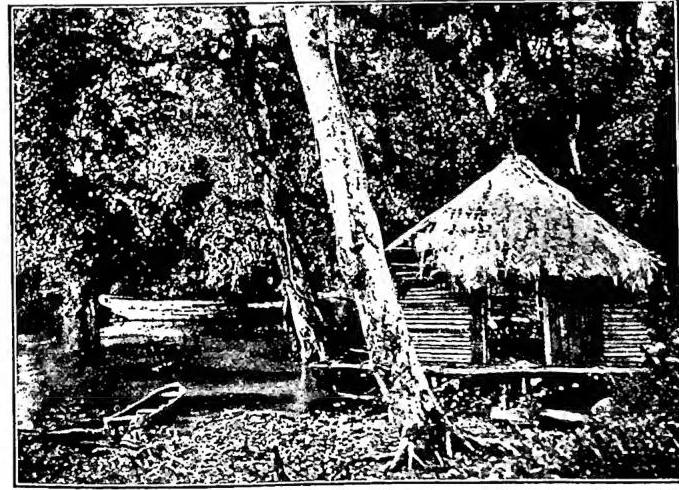
(from R. Hierardi, L'America centrale, in Geografia universale, VI, Turin 1931, p. 575) HONDURAS - Landscape of the Atlantic coastal region of H.
IV. EDUCATIONAL SYSTEM
Art. 24 of the Constitution of the Republic of H. states: “The State has the principal duty of promoting and protecting public education in its various branches. Primary education is compulsory, secular, and free; secondary and higher education are likewise secular. No minister of a religious society may direct schools supported by the State.”Primary education is provided in the 987 primary schools dependent on the municipalities and subsidized by the State. Secondary education is provided in 23 colleges. Teachers are trained in the 4 normal schools, the model normal school of Comayagüela, and the “Central Institute” of Tegucigalpa. Higher education is provided at the “Universidad Nacional” in Tegucigalpa, founded in 1847, and at the “Escuela Nacional de Agricultura,” founded in 1923. Given the high percentage of illiterates, the government has exceptionally authorized the establishment of 5 Catholic missionary elementary schools among the Indians, where the number of illiterates reaches 80%.
The education of the Catholic clergy is provided for at the metropolitan Seminary of S. Vicente in Tegucigalpa.